
‘Bridge struck like a storm’: Survivors recount horror, flag safety lapses in boat tragedy near Vrindavan| India News
# Vrindavan Boat Crash: Fatal Safety Lapses
By Senior Correspondent, National Affairs Desk | April 11, 2026
On April 11, 2026, a tragic boat capsize on the Yamuna River near Vrindavan, Uttar Pradesh, claimed multiple lives after a vessel violently collided with a bridge pillar. The disaster occurred when a group of tourists, primarily from Ludhiana, Punjab, were forced to switch boats mid-river due to a severe mechanical failure. Buffeted by sudden river currents and critically overcrowded, the replacement boat crashed, devastating families. Survivors and preliminary investigations point to gross safety lapses—including the absence of life jackets and unregulated operations—raising urgent questions about maritime safety and infrastructure in India’s rapidly expanding religious tourism hubs. [Source: Hindustan Times].
## ‘Struck Like a Storm’: The Mid-River Nightmare
What began as a peaceful spiritual excursion to the holy city of Vrindavan quickly devolved into an unimaginable tragedy for a group of pilgrims. The travelers had hired a private motorboat for a routine river crossing and sightseeing tour along the Yamuna’s historical ghats. According to survivor testimonies, the initial vessel experienced a sudden and total mechanical breakdown halfway across the river channel.
Vijay Bahl, a resident of Jagraon in Ludhiana who tragically lost his wife and son in the incident, recounted the chaotic sequence of events. He stated that the boat operator, unable to restart the engine, hailed a passing vessel to execute a mid-water rescue and transfer. [Source: Hindustan Times].
“We were already panicked when the engine died, but the transfer was chaotic,” Bahl recalled, noting the precarious nature of stepping from one floating vessel to another over deep water. Shortly after the transfer was completed, the second vessel—now burdened with double its intended passenger load—lost control. Caught in a swift current channel near the bridge construction site, the boat careened off course. Survivors noted that the vessel “struck the bridge like a storm,” buckling under the sheer force of the impact before capsizing instantly, sending dozens into the murky, fast-flowing waters.
## Systemic Safety Lapses Unveiled
The Vrindavan tragedy has brutally exposed the dark underbelly of unregulated inland water transport in India’s tourism sectors. Preliminary reports from local disaster management authorities indicate that a series of compounding human errors and regulatory violations led to the fatal outcome.
**Key Safety Lapses Identified:**
* **Total Absence of Life Saving Equipment:** Despite national guidelines mandating life jackets for all passengers on commercial inland vessels, survivors confirmed that neither the first nor the second boat carried any personal flotation devices (PFDs).
* **Severe Overcrowding:** The secondary vessel, which acted as the rescue boat, was already carrying passengers before it took on the stranded group. Authorities estimate the boat was operating at over 200% of its safe structural capacity, significantly lowering its center of gravity and making it highly susceptible to capsizing.
* **Retrofitted Agricultural Engines:** Initial inspections of similar vessels operating at the ghats reveal that many use retrofitted agricultural diesel engines—locally known as *jugaad* boats. These engines are not designed for marine use, lack reverse gear capabilities, and are prone to stalling under heavy loads.
* **Lack of Emergency Protocols:** The operators had no VHF radios, emergency flares, or direct communication lines to local river police, delaying the official emergency response.
Local boatmen, many of whom lack formal maritime training or government-issued licenses, operate in a gray market. The competitive nature of the tourism industry often incentivizes operators to overload their boats to maximize profit per trip, routinely ignoring basic safety protocols. [Source: Public Domain Inland Waterways Safety Reports].
## Rescue Operations and Community Response
In the immediate aftermath of the crash, local fishermen and fellow boatmen were the first responders, acting long before official rescue teams could arrive. Plunging into the river with makeshift ropes and inner tubes, these local heroes managed to pull several drowning individuals from the wreckage.
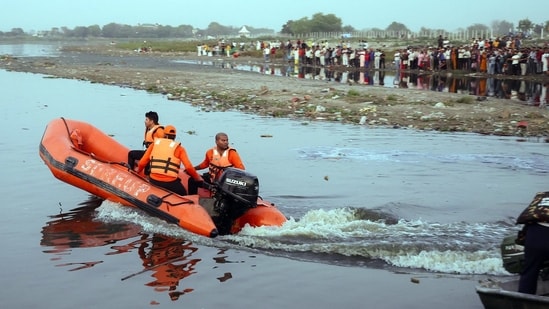
Within thirty minutes, units from the State Disaster Response Force (SDRF) and local river police reached the site, deploying mechanized inflatable boats and deep-water divers. The rescue operation transitioned into a recovery mission as the day progressed. The psychological toll on the survivors, gathered on the riverbank, was palpable. Many, like Bahl, were tourists far from home, thrust into sudden grief.
Medical camps were immediately set up at the adjacent ghats, and survivors were rushed to the district hospital in Mathura for treatment of injuries and severe water aspiration. The local administration has established a helpline for families in Punjab and other states trying to locate their loved ones.
## Expert Analysis: A Failure of Regulatory Implementation
While accidents of this nature are often dismissed as isolated tragedies, maritime and inland waterway experts argue they are the inevitable result of systemic regulatory failure. India passed the landmark Inland Vessels Act in 2021, designed to bring uniformity to the application of safety standards across all states. However, implementation at the municipal and district levels remains woefully inadequate.
“The law exists on paper, but the waters remain a free-for-all,” explains Dr. Arvind Chaturvedi, a maritime safety analyst and former consultant for the Inland Waterways Authority of India (IWAI). “We are seeing a massive gap between federal legislation and state-level enforcement. In places like Vrindavan, Varanasi, and Rishikesh, there is essentially no marine policing. Boats are rarely inspected for structural integrity, operators are not tested for navigational competency, and overcrowding is treated as an economic necessity rather than a fatal risk.”
Dr. Chaturvedi further notes that mid-river transfers are inherently dangerous maneuvers that should only be conducted by trained rescue professionals under controlled conditions. “When an untrained operator attempts to lash two vessels together in a moving current, the hydrodynamic forces can easily pull both boats under. It is a recipe for disaster that points to a complete lack of operational training.” [Source: Independent Expert Commentary].
## The Pressure of Booming Religious Tourism
To understand the context of the Vrindavan boat tragedy, one must look at the exponential growth of religious tourism in the Braj region (encompassing Mathura, Vrindavan, and surrounding areas). In recent years, infrastructure development and improved highway connectivity have brought record-breaking crowds to the region. According to state tourism data, the area sees tens of millions of visitors annually.
While the government has invested heavily in beautifying the riverfronts and building new concrete ghats, the management of localized transport has not evolved at the same pace. The demand for river crossings, sunrise boat tours, and floating religious ceremonies far outstrips the supply of legally registered, safety-compliant vessels.
This immense demand has created a lucrative shadow economy. Marginalized laborers often rent poorly maintained boats to capitalize on the tourist influx. Without a centralized booking system or a regulated dockmaster to enforce passenger manifests, tourists are left to negotiate directly with operators, entirely unaware of the mechanical state of the vessel or the operator’s lack of licensing.
## Government Response and Accountability
The public outcry following the tragedy has forced swift administrative action. The Uttar Pradesh state government has ordered a high-level magisterial inquiry into the incident, demanding a comprehensive report within 15 days.
Initial steps taken by the authorities include:
1. **Immediate Suspension:** Several local transport and tourism officials have been suspended for dereliction of duty regarding the monitoring of ghat activities.
2. **Ex-Gratia Compensation:** The Chief Minister’s Office has announced an ex-gratia payment of ₹4 lakh to the next of kin of the deceased, and ₹50,000 for those seriously injured, drawing from the State Disaster Response Fund.
3. **Halt on Operations:** All private boating operations along the Vrindavan-Mathura stretch of the Yamuna have been temporarily suspended pending a massive safety audit of all vessels.
4. **Criminal Charges:** An FIR (First Information Report) has been lodged against the absconding boat operators and owners under sections relating to culpable homicide not amounting to murder and reckless endangerment. [Source: Local Administration Statements / Public Records].
While financial compensation provides immediate relief to shattered families like that of Vijay Bahl, critics argue that reactive measures do little to prevent future tragedies. Activists are demanding the permanent establishment of a dedicated River Police force equipped with interceptor boats to patrol the Yamuna continuously.
## Transforming Grief into Meaningful Reform
If the Vrindavan boat crash is to be anything more than another grim statistic, it must serve as the catalyst for sweeping operational reforms across all Indian inland waterways.
Experts suggest the immediate implementation of a digitized tracking system for all commercial tourist vessels. Much like commercial aviation or ride-sharing applications, boats should be tagged with GPS locators, and passenger manifests must be digitally logged before any vessel leaves the dock. Furthermore, strict embargoes on the use of retrofitted agricultural engines must be enforced, coupled with government subsidy schemes to help impoverished boatmen upgrade to certified marine outboards.
Most importantly, safety equipment can no longer be viewed as an optional accessory. The mandatory wearing of life jackets—not just their presence stored away under a seat—must be strictly enforced by dockside authorities, with heavy penalties and license cancellations for operators who violate the rule.
## Conclusion: A Wake-Up Call for Waterway Navigation
The devastating scenes near the Vrindavan bridge are a heartbreaking reminder of the fragility of human life when entrusted to inadequate infrastructure and unregulated systems. The loss suffered by Vijay Bahl and other families from Ludhiana highlights a persistent apathy toward standardizing safety in the informal transport sector.
As India continues to promote its rich heritage and religious tourism on a global scale, protecting the millions of pilgrims who visit these sacred waters must become a paramount priority. The Yamuna River, revered as a life-giving force in Indian culture, should not be allowed to become a site of preventable sorrow. The true test for policymakers and local authorities will be whether the promises of strict enforcement outlast the immediate news cycle, ensuring that no future tourist has to recount the horror of a boat striking a bridge “like a storm.”





