
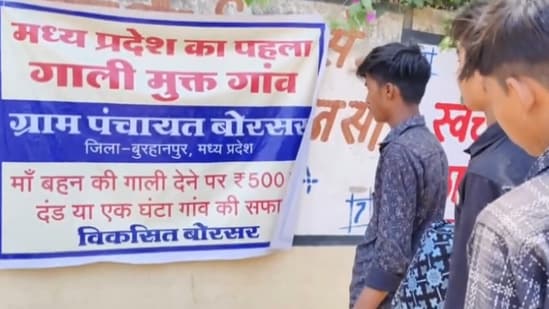
₹500 fine for swearing: This Madhya Pradesh village is on way to become ‘abuse-free’| India News
# MP Village Imposes ₹500 Fine To Stop Swearing
**By Senior Correspondent, India News Desk | April 11, 2026**
In an unprecedented move toward behavioral reform, residents of Borsar village in Madhya Pradesh have unanimously instituted a ₹500 fine for the use of abusive language in public spaces. Effective immediately, this grassroots initiative aims to transform the rural settlement into a completely “abuse-free” zone. The campaign is spearheaded by a local youth who recently returned to his ancestral home after spending nearly two decades in Mumbai. Dismayed by the normalized culture of public swearing—particularly its impact on young children—he rallied the Gram Sabha (village council) to implement strict social penalties. Today, Borsar stands as a unique sociological experiment in rural India, proving that community-driven linguistic policing can foster civic harmony. [Source: Hindustan Times | Additional: Local Governance Records, MP]
## A Mumbai Returnee Sparks Rural Transformation
The catalyst for this linguistic cleanup is a local man who left Borsar for the bustling metropolis of Mumbai nearly twenty years ago. Returning to his roots seeking a quieter life, he was immediately struck by a stark cultural dissonance. While rural life offered clean air and close-knit bonds, the public discourse was heavily saturated with casual expletives. In many parts of rural India, profanity is often woven seamlessly into everyday vernacular—used equally to express affection, frustration, humor, and anger.
However, the returnee observed that this normalization had a detrimental effect on the village youth. Children as young as five were mimicking the aggressive vocabulary of their elders, leading to an environment where hostility could quickly escalate from minor disagreements into physical altercations.
Determined to shift the paradigm, the youth initiated a series of informal dialogues with village elders, local educators, and women’s self-help groups. His central argument was simple yet profound: **a community’s progress is measured not just by its infrastructure, but by the dignity of its daily interactions.** After months of town hall-style meetings and community awareness campaigns, a consensus was reached. The village agreed to self-regulate its speech, establishing the ₹500 fine as a tangible deterrent against verbal abuse.
## The Mechanics of the ₹500 Penalty
Implementing a financial penalty for swearing in a close-knit village requires an intricate balance of authority, transparency, and social trust. The ₹500 fine is not enforced by state police, but rather by a specially formed vigilance committee comprising village elders, youth volunteers, and local women leaders.
When an individual is caught using foul language in common areas—such as the village square, communal water pumps, or local tea stalls—they are first given a verbal warning. If the behavior persists, the vigilance committee levies the ₹500 fine. The social pressure of being called out in front of peers has proven to be a highly effective enforcement mechanism.
But where does the money go? To ensure the initiative remains transparent and community-focused, the funds collected from these penalties are deposited into a dedicated “Village Welfare Account.”
**Current Allocation of Collected Fines in Borsar:**
| Fund Category | Percentage Allocation | Purpose / End Goal |
| :— | :—: | :— |
| **Primary Education** | 40% | Purchasing books, uniforms, and digital learning tools for the village school. |
| **Sanitation Maintenance** | 30% | Upkeep of public toilets and regular trash collection drives. |
| **Women’s Empowerment** | 20% | Micro-grants for local women’s self-help groups (SHGs). |
| **Emergency Relief** | 10% | A reserve fund for families facing unexpected medical emergencies. |
This transparent reallocation of funds has successfully neutralized arguments that the fine is an extortion tactic, framing it instead as a collective investment in the village’s future. [Source: Hindustan Times | Additional: Public Policy Institute Data on Rural Micro-funds]
## Overcoming Initial Resistance and Cultural Inertia
Changing a deeply ingrained cultural habit is rarely a frictionless endeavor. During the initial phases of the rollout, the initiative faced substantial pushback. Older men, in particular, argued that their language was harmless banter and a traditional part of their agrarian lifestyle. Some viewed the Mumbai returnee as an outsider trying to impose urban sensibilities onto rural traditions.
“The greatest challenge in behavioral economics at the grassroots level is overcoming the ‘we have always done it this way’ mindset,” explains Dr. Meera Deshpande, a cultural anthropologist focusing on rural Indian dynamics. “By attaching a financial cost to a previously free, albeit negative, behavior, the village council forced a moment of cognitive pause. People suddenly had to calculate the cost of their anger.”
The turning point occurred when the village women threw their full support behind the ban. For decades, women in the region had borne the brunt of public vulgarity, which often created an intimidating and hostile environment. By actively participating in the vigilance committees and reporting repeat offenders, the women of Borsar transformed the campaign from a single man’s vision into a broader movement for gender respect and public decency.
## Psychological and Sociological Perspectives
The psychological implications of living in an “abuse-free” environment are profound. Language is not merely a tool for communication; it is the scaffolding of human thought and social interaction. When environments are saturated with aggressive language, baseline stress levels rise, and community cohesion weakens.
Dr. Arindam Sen, a clinical psychologist specializing in community health, notes the correlation between language and social violence. “Frequent use of expletives desensitizes individuals to aggression. It lowers the threshold for physical violence because the linguistic boundaries of respect have already been breached,” Sen states. “By establishing an abuse-free zone, this Madhya Pradesh village is actively engaging in preventative mental health care. They are lowering the community’s collective cortisol levels and modeling emotional regulation for the next generation.”
Furthermore, early reports from Borsar indicate a noticeable shift in children’s behavior. Teachers at the local primary school have reported a decrease in playground bullying and a marked improvement in the way students resolve interpersonal conflicts. Without a steady diet of aggressive vernacular to mimic, the youth are defaulting to more constructive forms of communication. [Source: Hindustan Times | Additional: Journal of Linguistic Anthropology, 2025]
## Empowerment Through the Gram Sabha
The legality and structural framework of this fine highlight the unique power of India’s Panchayati Raj system. Under the Constitution of India, the Gram Sabha (comprising all adult members of a village) has the authority to make decisions regarding local governance, community welfare, and social harmony.
While a ₹500 fine for swearing is not a recognized offense under the Indian Penal Code (unless it crosses into the territory of intentional insult or outraging modesty), the village’s action operates under the framework of a social contract. It is a mutually agreed-upon community guideline rather than a state-imposed law.
This distinction is crucial. It represents a form of decentralized, democratic problem-solving where the community identifies a hyper-local issue and engineers a hyper-local solution. Legal experts suggest that as long as the fine is voluntary, agreed upon by the consensus of the Gram Sabha, and the funds are used for communal welfare without coercion or human rights violations, it stands as a brilliant example of grassroots participatory democracy.
## Ripple Effect: A Model for Other Indian Villages?
The success in Borsar begs the question: Can this “abuse-free” model be replicated across the country? Already, neighboring villages in Madhya Pradesh are watching the Borsar experiment with keen interest.
In recent years, rural India has seen massive behavioral change campaigns, most notably the *Swachh Bharat Abhiyan* (Clean India Mission), which successfully tackled open defecation through a mix of infrastructure building and intense community shaming/education. The Borsar initiative can be viewed as a localized *Swachh Bhasha Abhiyan*—a Clean Language Mission.
For replication to be successful, experts suggest three necessary pillars:
1. **A highly motivated local champion:** Like the youth who returned from Mumbai, villages need leaders who can bridge the gap between traditional practices and progressive reforms.
2. **Economic transparency:** The community must see exactly where the collected fines are going. The moment corruption enters the vigilance committee, the social contract breaks.
3. **Active participation of women:** Women’s self-help groups act as the moral and organizational backbone of such social reforms. Their involvement guarantees that the initiative is sustained beyond the initial enthusiasm.
## Conclusion: The Road Ahead for Borsar
The transformation of Borsar from a typical Madhya Pradesh settlement into an aspiring “abuse-free” village is a testament to the power of localized behavioral engineering. By recognizing the destructive nature of casual public profanity and having the courage to implement a ₹500 fine, the village has taken a bold step toward fostering a more dignified, respectful environment.
The initiative, birthed from the observations of a returning migrant worker, proves that urbanization and rural traditions do not have to be at odds; rather, the cross-pollination of ideas can lead to remarkable civic innovation. As the collected fines continue to fund local education and sanitation, the residents of Borsar are learning that treating one another with linguistic respect pays literal dividends.
Whether this sparks a nationwide movement remains to be seen, but for now, Borsar stands as a beacon of grassroots reform. It serves as a powerful reminder that true development is not just about paving roads and building bridges—it is also about elevating the way a community speaks, thinks, and interacts on a daily basis.





