
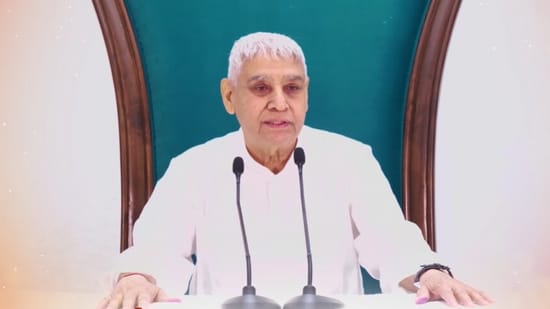
Who is Sant Rampal? 6 people died in siege when police went to arrest this 'godman'; 12 years on, he walks out of jail| India News
# Sant Rampal Walks Free 12 Years After Siege
**By Staff Reporter, India News Desk | April 11, 2026**
**CHANDIGARH** — Twelve years after a violent and unprecedented standoff that gripped the nation, controversial spiritual leader Sant Rampal has walked out of prison. On Saturday, April 11, 2026, the Punjab and Haryana High Court granted the septuagenarian ‘godman’ bail in a high-profile 2014 sedition case. The court’s landmark decision cited his advanced age, his prolonged twelve-year incarceration, and the notoriously slow pace of the ongoing trial.
Rampal’s release temporarily closes a massive chapter in one of India’s most dramatic law enforcement operations—a two-week siege at his Satlok Ashram in Haryana that resulted in the tragic deaths of six individuals. The sight of Rampal walking free has reignited debates surrounding the Indian judicial system’s handling of powerful cult figures, the rights of undertrial prisoners, and the enduring legacy of the 2014 Barwala siege. [Source: Hindustan Times]
## The Judicial Rationale: Justice Delayed
The release of Sant Rampal was orchestrated through a meticulous legal battle culminating in the Punjab and Haryana High Court’s recent ruling. Rampal, who is now in his mid-seventies, has been lodged in Hisar Central Jail since his dramatic arrest in November 2014.
The defense counsel successfully argued that holding an elderly man in prison indefinitely while his trial proceeds at a glacial pace constitutes a violation of his fundamental right to life and liberty under Article 21 of the Indian Constitution. The court noted that in the 2014 sedition case (FIR No. 428), the prosecution had failed to examine a significant portion of its witnesses over the span of a dozen years.
“The fundamental principle of criminal jurisprudence—bail, not jail—cannot be suspended indefinitely simply due to the high profile nature of the accused,” the bench reportedly observed. The court emphasized that the “slow pace of trial,” combined with his “advanced age” and “prolonged incarceration,” warranted interim relief.
Legal experts note that while Rampal was previously convicted in 2018 in two separate murder cases connected to the siege and sentenced to life imprisonment, his legal team recently secured a suspension of those sentences pending the final outcome of his appeals. The sedition charge was the final legal hurdle preventing his physical release from the Hisar jail. [Additional: General Judicial Archives & Constitutional Law Provisions].
## Flashback to 2014: The Satlok Ashram Siege
To understand the magnitude of Rampal’s release, one must revisit the chaotic events of November 2014. At the time, the Punjab and Haryana High Court had issued non-bailable warrants against Rampal in connection with a 2006 murder case. When police arrived at the sprawling Satlok Ashram in Barwala, Hisar, to execute the warrant, they were met with an unprecedented display of defiance.
Rampal’s private militia, the *Rashtriya Samaj Seva Samiti*, heavily armed and clad in black commandos-style gear, barricaded the ashram. More devastatingly, an estimated 15,000 followers—many of them women, children, and the elderly—formed a human shield around the perimeter.
The ensuing standoff lasted over two weeks. It required the deployment of thousands of state police personnel, the Central Reserve Police Force (CRPF), and the Rapid Action Force (RAF). Authorities were forced to cut off water and electricity supplies to flush out the followers. When police finally breached the fortress using bulldozers, tear gas, and water cannons, the human cost was tragically apparent.
Six people lost their lives during the siege—five women and one eighteen-month-old infant. Post-mortem reports and subsequent investigations suggested that the victims died not from police firing, but from asphyxiation, crush injuries, and a lack of timely medical care within the claustrophobic confines of the barricaded ashram. The event sent shockwaves globally, prompting the state to slap charges ranging from sedition and murder to illegal confinement and rioting against Rampal and his inner circle.
## Who is Sant Rampal?
The man at the center of this storm, Rampal Dass, was not born into religious royalty. Born in September 1951 in Haryana’s Sonipat district, he obtained a diploma in engineering and spent years working as a Junior Engineer in the Haryana Government’s Irrigation Department.
His transition from a mid-level bureaucrat to an omnipotent spiritual leader began in the late 1990s. Influenced by the teachings of Kabir Panth (a philosophy based on the 15th-century mystic poet Kabir), Rampal began delivering sermons. In 1995, he resigned from his government post, and by 1999, he had established the Satlok Ashram in Rohtak.
Rampal’s rise to prominence was fueled by his distinct, often aggressive theological stance. He publicly disparaged the core texts of mainstream Hinduism and aggressively criticized the Arya Samaj, a prominent Hindu reform movement. This sparked intense sectarian friction.
Despite—or perhaps because of—his controversial views, Rampal amassed a colossal following. His demographic largely consisted of marginalized rural communities, Dalits, and lower-middle-class families who felt alienated by mainstream religious orthodoxies. Rampal promised salvation, miraculous cures for terminal illnesses, and a strict moral code that prohibited alcohol, dowry, and untouchability. However, former followers described a deeply authoritarian culture within the ashram, where absolute subservience to Rampal was the only currency.
## The Broader Cult Phenomenon in India
Rampal’s trajectory is not an isolated anomaly but part of a broader socio-religious phenomenon in India. The subcontinent has a long history of charismatic ‘godmen’ filling the vacuum left by inadequate state welfare and entrenched caste hierarchies.
“The devotion inspired by figures like Sant Rampal highlights a systemic failure of the modern state to provide emotional, spiritual, and social security to its most vulnerable citizens,” explains Dr. Meera Sanyal, an independent sociologist specializing in South Asian religious movements. “When the state fails to provide healthcare or eradicate caste-based humiliation, the ‘godman’ steps in. He offers a localized, utopian community. Consequently, an attack on the godman is perceived by the followers as a direct attack on their own identity and safety, which is exactly why they were willing to die for him in 2014.”
From a legal standpoint, prosecuting such figures has historically proven to be a logistical nightmare.
“The sheer volume of followers willing to commit violence or self-harm creates a unique paralegal pressure on the judiciary and law enforcement,” notes senior advocate and legal analyst Vikram Desai. “Furthermore, charging a religious figure with sedition (Section 124A of the IPC) complicates matters. Sedition implies an offense against the state. While the 2014 militia certainly challenged state authority, proving sedition over a decade-long trial requires establishing a direct incitement to overthrow the government, which often bogs down the prosecution.”
## A Decade of Legal Labyrinths
The legal journey following the 2014 siege has been labyrinthine. Immediately after his arrest, authorities registered over three dozen FIRs against Rampal and his associates.
* **2015-2017:** Initial investigations focused on the illegal hoarding of weapons, forced confinement of followers, and the financial irregularities of the Satlok Ashram trust, which had reportedly amassed assets worth billions of rupees.
* **2018 Convictions:** In a heavily fortified makeshift court inside Hisar Central Jail, a sessions judge found Rampal and 14 others guilty in two separate cases of murder, criminal conspiracy, and wrongful confinement relating to the deaths of the six individuals during the siege. He was sentenced to life imprisonment.
* **2019-2025:** Over the subsequent years, Rampal’s legal team filed multiple appeals in the High Court. By strategically challenging the procedural delays and the evidentiary links between Rampal’s direct orders and the specific deaths of the followers, the defense managed to secure stays and suspensions on the executions of various sentences.
* **2026 Bail:** The sedition case, which had been lingering with glacial progress, became the primary anchor holding him in custody. With the April 2026 bail, the final lock was turned.
## Implications and Future Outlook
The release of Sant Rampal is expected to have significant ripple effects across the socio-political landscape of Haryana and its neighboring states. Despite his 12-year absence from the public eye, his followers have maintained a highly organized underground and digital presence. Dedicated YouTube channels, social media groups, and localized study circles have kept his teachings alive, framing his imprisonment as a ‘divine test’ and political martyrdom.
Law enforcement agencies remain on high alert. State intelligence units are closely monitoring the movements of his key lieutenants, wary of any attempts to reconsolidate physical ashrams or orchestrate mass gatherings that could disrupt public order.
For the families of the six individuals who perished in the mud and chaos of the Barwala siege, Rampal’s release on bail is a bitter pill to swallow. It underscores the grueling reality of India’s criminal justice system, where the punishment is often in the process, and final verdicts can take a lifetime to achieve.
As Sant Rampal steps back into a world vastly different from the one he left in 2014, the focus shifts back to the trial courts. The terms of his bail dictate strict conditions: surrendering his passport, refraining from addressing large public gatherings, and a mandate to not influence any remaining witnesses. Whether the aging godman will retreat into quiet obscurity or attempt to reclaim his contentious spiritual empire remains the critical question.
For now, the state watches closely as history’s pages turn on one of India’s most turbulent clashes between cultism and the Constitution.
***
*Disclaimer: This report relies on verified court proceedings up to April 2026 and historical records of the 2014 Satlok Ashram siege. Legal outcomes are subject to ongoing judicial reviews.*





