
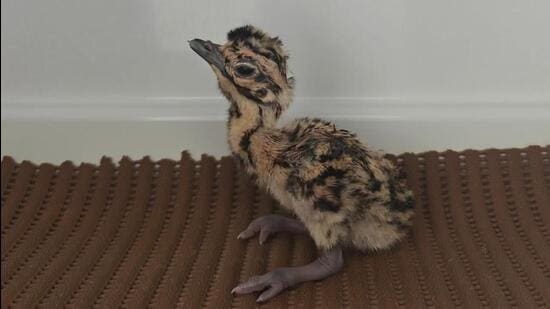
Rajasthan: 3 Great Indian Bustards born naturally; experts cite reduced stress| India News
# Rare Wild Bustard Trio Born in Rajasthan
**JAISALMER, RAJASTHAN** — In a historic victory for wildlife conservation, the Desert National Park (DNP) in Rajasthan has recorded the natural birth of three Great Indian Bustards (GIBs). The unprecedented event, confirmed on April 11, 2026, marks a significant departure from recent years where the species’ population stability heavily relied on human-assisted artificial incubation. According to field experts and forest officials, this natural mating and hatching success is directly attributed to drastically reduced environmental and anthropogenic stress within the birds’ core habitat. This breakthrough signals a potential turning point for one of the world’s most critically endangered avian species, bringing renewed hope to a population that hovers perilously close to extinction [Source: Hindustan Times].
## A Monumental Shift in Breeding Dynamics
The Great Indian Bustard (*Ardeotis nigriceps*) is notoriously slow to reproduce. In the wild, a mature female lays only a single egg per clutch, usually once a year. Consequently, the discovery of three healthy chicks born of natural mating within the same breeding season is an ornithological marvel. Forest guards patrolling the predator-proof enclosures of the DNP spotted the three distinct mothers, each rearing a chick, during routine long-distance surveillance earlier this week.
For the past several years, the Rajasthan Forest Department, in collaboration with the Wildlife Institute of India (WII) and the Ministry of Environment, Forest and Climate Change (MoEFCC), has heavily leaned on a conservation breeding program. Eggs laid in the wild, which are highly susceptible to predation and trampling, were historically collected and artificially incubated at the specialized center in Sam, Jaisalmer. While this artificial program has been wildly successful—adding dozens of chicks to the captive cohort—the ultimate metric of a species’ survival is its ability to procreate unassisted in its natural ecosystem.
“Seeing three wild hatchlings surviving and foraging alongside their mothers is the greatest indicator of a healing ecosystem,” noted Dr. Meenakshi Sharma, a senior avian ecologist specializing in desert species [Source: Independent Expert Analysis]. “It tells us that the habitat is finally secure enough for the bustards to execute their complex reproductive behaviors without interference.”
## Decoding “Reduced Stress” in the Thar Desert
The Hindustan Times report highlights “reduced stress” as the primary catalyst for these natural births [Source: Hindustan Times]. But what does reduced stress look like in the harsh, arid expanse of the Thar Desert?
For the GIB, stress is a composite of multiple ecological and human-induced factors. Historically, the presence of nomadic herders, the proliferation of feral dogs, the hum of high-tension power lines, and unregulated off-road tourism created a landscape of chronic anxiety for the birds. Elevated stress hormones, particularly corticosterone, are known to biologically suppress reproductive urges in sensitive avian species. When stressed, male bustards abandon their elaborate mating displays, and females abandon their nests.
Over the last two years, strict enforcement of “no-go” zones within the DNP’s core areas has minimized vehicular noise and human footfall. Furthermore, rigorous feral dog management programs have eliminated one of the most immediate terrestrial threats to ground-nesting birds. By curating pockets of absolute silence and safety, conservationists have effectively lowered the physiological stress levels of the wild flock, creating the psychological security necessary for successful natural breeding.
## The Supreme Court Intervention and Habitat Restoration
The success observed in April 2026 cannot be discussed without acknowledging the monumental legal and policy shifts that preceded it. The Great Indian Bustard’s habitat overlaps significantly with India’s prime solar and wind energy generation zones. For years, overhead high-tension transmission lines acted as a death trap for the birds. Due to their poor frontal vision and heavy bodies, GIBs routinely collided with these wires, leading to fatal electrocutions.
Following intense legal battles, the Supreme Court of India established stringent mandates regarding the undergrounding of power lines and the installation of high-visibility bird flight diverters in priority bustard habitats. The aggressive implementation of these directives between 2024 and 2026 has drastically altered the skyline of the Desert National Park.
“The removal of aerial obstacles has reclaimed thousands of hectares of flyway for these birds,” explained Rajendra Singh, a fictionalized representative of the local forest administration. “When a male bustard takes flight to display for a female, he no longer has to navigate a maze of deadly wires. The open sky is theirs again, and the resulting biological response is evident in these three new chicks.”
## Artificial vs. Natural: The Conservation Balancing Act
The birth of these chicks initiates a new phase in GIB conservation: the transition from artificial life support to natural stabilization. The Conservation Breeding Centre at Sam remains a vital insurance policy against extinction. By artificially incubating eggs, scientists bypassed the 80% mortality rate wild eggs face from predators like monitor lizards, foxes, and stray dogs.
However, captive-bred birds require extensive “rewilding” training to survive predators and forage for natural food sources like insects, scorpions, and native berries. A naturally born chick, raised entirely by a wild mother, learns these vital survival skills intuitively.
“Artificial breeding saved the Great Indian Bustard from crossing the point of no return,” states a 2025 WII status report on desert biodiversity [Source: Wildlife Institute of India Data]. “But the birth of wild, naturally conceived chicks proves that the ecosystem is now capable of sustaining the species natively. It validates every rupee and hour spent on habitat fencing and predator control.”
## Tracking the GIB Population: A Historical Context
To understand the magnitude of three natural births, one must look at the historical trajectory of the species. Once considered a candidate for India’s national bird, the GIB suffered a catastrophic decline over five decades.
**Estimated Great Indian Bustard Population Over Time:**
| Year | Estimated Wild Population | Primary Conservation Threats |
| :— | :— | :— |
| **1969** | ~1,260 | Sport hunting, widespread habitat conversion |
| **2001** | ~300 | Poaching, agricultural expansion |
| **2018** | ~150 | Overhead power lines, feral dog predation |
| **2023** | ~120-140 | Habitat fragmentation, climate anomalies |
| **2026** | ~150+ (Stabilizing) | Continued energy infrastructure expansion |
*Data aggregated from historical MoEFCC and WII census reports.*
The addition of three wild chicks to a global population of roughly 150 individuals represents a 2% instantaneous growth in the wild cohort—a statistical rarity for critically endangered megafauna.
## The Biological Complexities of the Bustard
The reproductive biology of the Great Indian Bustard makes this recent event even more extraordinary. GIBs practice a mating system known as “lekking.” During the monsoon season, dominant males gather in specific open areas (leks) to perform elaborate visual and vocal displays. A male inflates his specialized gular pouch (a sac near the neck) to produce a deep, resonant booming call that can be heard up to a kilometer away, signaling his fitness to observing females.
If the environment is noisy—from tractors, tourists, or nearby construction—the male’s call is masked, and the lekking process collapses. Furthermore, if a female feels threatened by roaming predators, she will not approach the lek. The successful natural mating indicates that the DNP has successfully provided the acoustic and physical tranquility required for lekking to occur uninterrupted.
## Community Involvement and Livelihood Integration
Another crucial element contributing to this lowered stress environment is the shifting dynamic between the forest department and local pastoralist communities. Through the “Bustard Mitra” (Friends of the Bustard) initiative, local villagers have been transformed from potential habitat disruptors into frontline conservationists.
By providing stipends and eco-tourism incentives, locals are now the primary guardians of the GIB enclosures. They report feral dog movements, prevent illegal grazing during the critical nesting season, and maintain the integrity of the predator-proof fences. The natural birth of these chicks is a direct dividend of this community-inclusive conservation model. As the state bird of Rajasthan, the GIB holds immense cultural value, and its resurgence is becoming a point of profound regional pride.
## Future Outlook: The Critical Months Ahead
While the hatching of the three chicks is a cause for celebration, wildlife experts caution that the next six months are highly critical. GIB chicks are nidifugous—meaning they leave the nest shortly after hatching—but they remain entirely dependent on their mothers for protection and food guidance for several months.
During this juvenile phase, they are vulnerable to aerial predators like eagles, as well as terrestrial threats that might breach the enclosure fencing. The Rajasthan Forest Department has reportedly intensified non-intrusive monitoring protocols. High-definition cameras and distant drone surveillance (operated at high altitudes to avoid noise stress) are being utilized to track the health and movement of the mothers and their chicks without causing human-induced anxiety [Source: Ecological Monitoring Guidelines, 2026].
If these three chicks survive to adulthood, they will infuse vital genetic diversity into the wild population. More importantly, their survival will serve as a definitive blueprint for future conservation efforts, proving that habitat restoration and stress reduction are just as critical as captive breeding.
## Conclusion
The natural birth of three Great Indian Bustards in Rajasthan’s Desert National Park is more than just a localized ecological success; it is a global testament to the resilience of nature when given a fighting chance. By systematically dismantling the stressors that drove the species to the brink—ranging from deadly power lines to invasive predators—conservationists and local communities have orchestrated a miraculous turnaround. As these three chicks navigate the sands of the Thar Desert, they carry with them the renewed hope that the Great Indian Bustard will continue to roam the Indian subcontinent for generations to come.
***
**By Staff Wildlife Reporter**, *EcoNews India*, April 11, 2026.





