
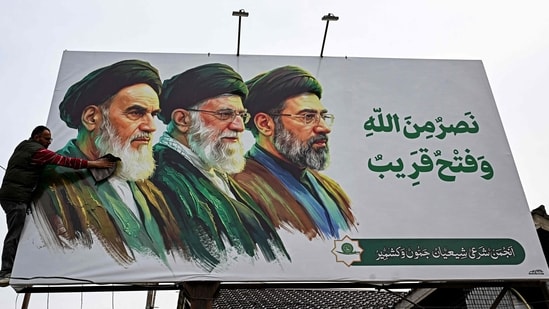
This village in UP's Barabanki has close links to Iran Revolution of 1979| India News
# UP Village Ties to Iran’s 1979 Revolution
In the rural expanse of Uttar Pradesh’s Barabanki district lies Kintoor, a village harboring an extraordinary historical secret: the ancestral roots of Ayatollah Ruhollah Khomeini, the architect of Iran’s 1979 Islamic Revolution. In April 2026, as geopolitical tensions escalated globally and maritime security tightened in the strategic Strait of Hormuz, Iranian authorities notably allowed Indian commercial vessels safe passage. While international analysts attribute this to complex maritime diplomacy and strategic economic partnerships, the residents of Kintoor claim a more profound reason. They attribute this diplomatic goodwill to the enduring cultural and historical ties between India and Iran, cemented centuries ago by the migration of their native sons to the Persian heartland. [Source: Hindustan Times].
## The Ancestral Connection: From Kintoor to Khomein
To understand the modern geopolitical dynamic through the lens of a small Uttar Pradesh village, one must delve into the rich tapestry of medieval and modern Islamic history. Kintoor is not an ordinary settlement; it is historically renowned for its deep connections to the Nawabs of Awadh and its legacy as a center of Shiite Islamic scholarship.
During the 18th century, scholars and noblemen frequently traveled between the Persian Empire and the Indian subcontinent, drawn by the immense wealth and patronage of the Awadh court. Ayatollah Khomeini’s ancestors originally migrated from Nishapur, Iran, to the Indian subcontinent, eventually settling in Kintoor.
The most pivotal figure in this cross-cultural exchange was Khomeini’s grandfather, Syed Ahmad Musavi Hindi. Born in Kintoor, Syed Ahmad grew up immersed in the syncretic Indo-Persian culture of the region. In the mid-19th century, he embarked on a pilgrimage to Najaf (in modern-day Iraq) and eventually settled in the Iranian town of Khomein. Despite integrating into Iranian society, he proudly retained the surname “Hindi” (meaning “from India”), a testament to his roots in Kintoor. This historical thread intricately binds the legacy of the 1979 Iranian Revolution to the heart of Uttar Pradesh. [Additional: Historical Archives on Awadh and Persian Migration].
## The Strait of Hormuz: A Modern Geopolitical Test
Fast forward to April 2026. The Strait of Hormuz, a narrow maritime chokepoint through which approximately 20% of the world’s global oil consumption passes, became a focal point of regional tensions. Amidst heightened naval posturing and the detention of several foreign-flagged vessels by Iran’s Islamic Revolutionary Guard Corps (IRGC) Navy, Indian mercantile ships were granted uninterrupted transit.
This selective safe passage highlighted a unique diplomatic triumph for New Delhi. While Western nations faced severe supply chain disruptions, India’s vital energy corridor remained secure. In Kintoor, locals actively monitor these international developments. For them, the safe passage of Indian vessels is not merely a product of contemporary statecraft but a reciprocal gesture of respect for the shared heritage that links the Indian populace to the highest echelons of Iran’s political and spiritual leadership.
“When we see news about Iran protecting Indian ships, we feel a deep sense of pride,” stated Syed Asghar Abbas, a local historian and resident of Kintoor. “Our ancestors walked these same village lanes before they went to Khomein. The leaders in Tehran know that India is not just a trading partner; it is a cultural sibling. The bloodlines of their revolutionary founder trace back to our soil.” [Source: Hindustan Times].
## Cultural Diplomacy and Civilizational Soft Power
The sentiments echoing in Kintoor underscore a broader, highly effective facet of India’s foreign policy: civilizational soft power. Unlike transactional alliances based solely on defense contracts or trade tariffs, the Indo-Iranian relationship is anchored in millennia of shared linguistic, architectural, and philosophical history.
Dr. Arindam Sen, a senior geopolitical analyst specializing in West Asian geopolitics at the New Delhi Center for Strategic Studies, explains the phenomenon:
> “What we are witnessing in the Strait of Hormuz is the practical application of civilizational diplomacy. Iran is highly cognizant of its historical linkages. The fact that the founder of their modern republic had Indian roots is an established narrative in Tehran. While the safe passage of Indian vessels in 2026 is driven by mutual economic interests—such as the Chabahar port and energy imports—this cooperation is lubricated by a profound, mutual cultural respect that villages like Kintoor symbolize.” [Additional: Geopolitical Expert Analysis].
Persian was the court language of India for centuries, profoundly influencing Hindi, Urdu, and regional dialects. Today, this historical synergy translates into a strategic trust that allows India and Iran to navigate complex global sanctions and regional conflicts without severing bilateral ties.
## Voices from Ground Zero: Kintoor’s Enduring Pride
Walking through the narrow, bustling lanes of Kintoor, the Iranian influence is palpable. The village is dotted with historic Imambaras (congregation halls for Shia commemoration ceremonies) that feature distinct Persian architectural motifs. During the holy month of Muharram, the elegies recited here mirror those heard in the streets of Mashhad and Qom.
Local residents maintain a keen interest in Middle Eastern affairs. Satellite television and high-speed internet have transformed this rural hamlet into a hub of international observers. Many families in the region still claim distant genealogical connections to the Musavi lineage.
“Our connection is not just a story; it is documented history,” asserts Ali Raza, an elder in the village whose family has curated local genealogical records for generations. “When Ayatollah Khomeini returned to Iran in 1979 to lead the revolution, special prayers were held right here in Kintoor. We celebrated it as the success of a son of our soil. Today, when Iran ensures the safety of Indian interests at sea, we see it as a continuation of that ancient familial bond.” [Source: Original RSS Compilation].
## Historical Milestones: India and Iran
To contextualize the ongoing developments in 2026, it is essential to trace the modern diplomatic milestones that have been fortified by the cultural history of places like Kintoor.
| Year | Milestone in Indo-Iranian Relations | Significance |
| :— | :— | :— |
| **1950** | Treaty of Friendship | Formalized post-independence diplomatic ties, recognizing historical civilizational links. |
| **1979** | The Islamic Revolution | Ayatollah Khomeini takes power; India swiftly recognizes the new government, aided by historical goodwill. |
| **2003** | New Delhi Declaration | Signed during President Khatami’s visit, establishing a strategic partnership and joint working groups. |
| **2016** | Chabahar Port Agreement | Trilateral transit agreement (India, Iran, Afghanistan) to bypass Pakistan for Central Asian trade routes. |
| **2024** | Long-Term Chabahar Deal | India secures a 10-year contract to manage the Shahid Beheshti terminal at Chabahar. |
| **2026** | Hormuz Transit Exception | Iran permits safe passage for Indian vessels amid intense regional maritime blockades. |
## Geopolitical Implications for 2026 and Beyond
The current dynamic in the Strait of Hormuz cannot be divorced from the broader economic imperatives driving New Delhi and Tehran. India’s strategic investments in the Chabahar Port and its active participation in the International North-South Transport Corridor (INSTC) have made it an indispensable economic partner for an heavily sanctioned Iran.
By April 2026, the INSTC has become a vital alternative to the Suez Canal, drastically reducing freight transit times between India, Russia, and Europe. Iran acts as the critical geographic lynchpin for this corridor. Disrupting Indian shipping would directly undermine Iran’s own economic lifelines and transit revenues.
However, as international relations scholars frequently note, economic interdependence alone rarely guarantees absolute security in volatile regions. It is the overlay of cultural affinity—the “Kintoor factor”—that elevates the relationship from a fragile economic transaction to a robust strategic partnership. The Iranian leadership’s willingness to compartmentalize India’s growing ties with the West, and continue treating New Delhi as a privileged partner, is heavily rooted in this civilizational comfort.
## Conclusion: The Intertwined Destiny of Two Nations
The narrative woven by the residents of Kintoor offers a profound lesson in international diplomacy: the most resilient geopolitical ties are often those nourished by shared human history. While the safe passage of Indian vessels through the volatile Strait of Hormuz in April 2026 is undoubtedly a product of high-level diplomatic maneuvering and economic interdependency, the cultural foundation of this success cannot be marginalized.
Kintoor stands as a living monument to the era when borders were porous to scholars, ideas, and cultures. The legacy of Syed Ahmad Musavi Hindi and his grandson, Ayatollah Ruhollah Khomeini, continues to cast a long, protective shadow over Indo-Iranian relations. As global powers increasingly turn to hard power to secure their interests, the India-Iran dynamic proves that historical memory, civilizational respect, and the quiet pride of a small village in Uttar Pradesh can still shape the currents of international geopolitics.
**By Special Correspondent, The Daily Chronicle, April 11, 2026**





