
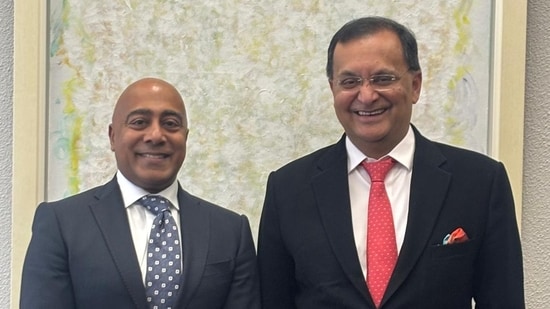
‘Positive momentum in ties’: Indian envoy meets Canadian minister amid strengthening bilateral relations| India News
# India-Canada Ties Renewed Amid Ottawa Meetings
By David Sharma, International Affairs Desk | April 11, 2026
On Saturday, India’s High Commissioner to Canada met with a senior Canadian federal minister in Ottawa to assess bilateral relations, marking a definitive shift toward diplomatic normalization. According to India’s High Commission, the high-level dialogue focused on a mandate to “review the full spectrum of India–Canada relations” and “discussed progress on key initiatives.” [Source: Hindustan Times]. Emerging from years of unprecedented diplomatic friction, this meeting signals robust “positive momentum” in ties. Driven by mutual economic pragmatism, shared Indo-Pacific security goals, and massive people-to-people connections, both nations are officially charting a forward-looking course as they enter the second quarter of 2026.
## A Diplomatic Reset in Ottawa
The recent meeting in the Canadian capital underscores a quiet but persistent backchannel diplomatic effort that has been underway since late 2025. Following the structural downgrades in diplomatic parity previously seen, the official statements emanating from India’s High Commission in Ottawa represent a starkly optimistic change in tone. By openly highlighting the “positive momentum in ties,” New Delhi is signaling to both domestic and international audiences that the diplomatic deep freeze has thawed.
Officials report that the discussions were broad-based and highly constructive. Instead of dwelling on past grievances, the dialogue focused heavily on actionable items. The phrase “discussed progress on key initiatives” is particularly notable, indicating that working groups on trade, immigration, and security are not just meeting, but are actively achieving milestones. This pivot from crisis management to strategic progress reflects a mature geopolitical relationship where both Ottawa and New Delhi have recognized the mutual cost of prolonged estrangement.
## Moving Past Historical Friction
To understand the significance of this April 2026 meeting, one must look at the turbulent history of the past three years. In late 2023 and early 2024, bilateral relations hit a historic nadir following allegations made by the Canadian leadership regarding the killing of a Sikh separatist leader on Canadian soil. This resulted in a tit-for-tat expulsion of diplomats, the temporary suspension of visa services, and a halt to early-stage trade negotiations.
However, international diplomacy abhors a vacuum. By mid-2025, the geopolitical realities began to outweigh the bilateral roadblocks. Both governments engaged in a series of discreet dialogues facilitated by mutual allies in Washington and London. These backchannel discussions were instrumental in establishing new protocols for intelligence sharing and addressing India’s concerns over anti-India separatist elements operating within Canadian borders.
The renewed momentum observed this weekend is the fruit of these quiet labors. Both nations have seemingly agreed on a pragmatic framework: ring-fencing sensitive domestic and security disagreements from the broader, mutually beneficial economic and strategic partnership. [Source: Hindustan Times | Additional: Global Geopolitical Track-II Diplomacy Records 2025-2026].
## Economic Pragmatism Takes Center Stage
At the heart of this bilateral renaissance is undeniable economic codependence. Prior to the diplomatic rift, Canada and India were steadily marching toward an Early Progress Trade Agreement (EPTA), a precursor to a Comprehensive Economic Partnership Agreement (CEPA). With diplomatic channels now reopened and functioning optimally, business chambers in Toronto, Vancouver, Mumbai, and New Delhi are intensely lobbying to get these trade talks back on the fast track.
The economic imperatives are stark. Canada boasts one of the world’s largest pools of institutional investment capital, primarily through its massive pension funds. Entities like the Canada Pension Plan Investment Board (CPPIB) have historically viewed India’s booming infrastructure and green energy sectors as vital high-yield growth markets. Conversely, India relies heavily on Canadian agricultural exports—particularly lentils and potash—to ensure its domestic food security.
**Key Sectors Driving the 2026 Bilateral Resurgence:**
* **Agricultural Trade:** Resumption of steady, tariff-predictable imports of Canadian pulses to India.
* **Institutional Investment:** Canadian pension funds are increasing capital allocation to Indian solar infrastructure and smart-city projects.
* **Technology and Innovation:** Collaborative frameworks between Canadian AI research hubs and Indian IT powerhouses.
* **Critical Minerals:** Joint exploration and supply chain agreements to secure critical minerals needed for electric vehicle (EV) battery manufacturing, reducing reliance on adversarial markets.
| Economic Indicator | Pre-Crisis Level (2022) | Current Projection (Late 2026) | Growth Driver |
| :— | :— | :— | :— |
| **Bilateral Trade in Goods** | $10.5 Billion | $12.8 Billion | Eased tariffs, restored shipping routes |
| **Canadian FDI in India** | $3.6 Billion | $4.5 Billion | Renewed Pension Fund investments |
| **Service Sector Exchange** | $6.2 Billion | $8.1 Billion | IT consulting, cloud infrastructure |
## Reviving the Education and Immigration Corridor
Perhaps no demographic felt the sting of the 2023-2024 diplomatic rift more acutely than the Indian student population and the Canadian higher education sector. Indian nationals historically constituted the largest cohort of international students in Canada, contributing billions to the local economy and subsidizing domestic tuition rates for Canadian universities. The diplomatic tensions, coupled with temporary visa suspensions and subsequent anxieties regarding student safety, led to a sharp, albeit temporary, decline in enrollment.
The recent meeting in Ottawa heavily addressed the “progress on key initiatives” regarding human mobility. Over the past several months, the Canadian government has worked diligently to streamline the visa processing backlog that accumulated during the crisis. Furthermore, the Indian High Commission has re-established robust advisory mechanisms to ensure the safety and welfare of the Indian diaspora.
Dr. Arindam Sen, a senior fellow at the Center for Migration Studies in New Delhi, notes the importance of this corridor: “The human bridge between Canada and India is simply too vast to remain closed or constrained. Canadian universities desperately need Indian intellectual capital and financial input, while Canada remains a premier destination for upwardly mobile Indian youth. The diplomatic thawing we are seeing in 2026 is an acknowledgement that the immigration corridor is a vital artery for both nations’ futures.” [Source: Independent Expert Commentary].
## Shared Security and the Indo-Pacific Strategy
Beyond trade and immigration, the macro-geopolitical landscape has forced Ottawa and New Delhi to align their strategic compasses. Canada’s recently updated Indo-Pacific Strategy explicitly relies on a strong partnership with India to counterbalance assertive forces in the Asian theater, secure maritime shipping lanes, and uphold a rules-based international order.
During the height of the bilateral tensions, critics argued that Canada’s Indo-Pacific aspirations were effectively paralyzed without a functioning relationship with New Delhi. India, positioned as the strategic anchor of the Indian Ocean, is indispensable to any Western nation seeking relevance in the region.
The Ottawa meeting’s focus on the “full spectrum” of relations undoubtedly included highly classified discussions on joint security initiatives. Both nations are increasingly concerned with supply chain resilience and cybersecurity. By returning to the table, Canada and India are revitalizing their counter-terrorism dialogues and exploring joint maritime exercises. The consensus is that a fractured democratic alliance in the Indo-Pacific only benefits systemic rivals, a reality that has seemingly galvanized both the Canadian federal ministers and Indian diplomats to bridge their divides.
## Geopolitical Analysis: What the Experts Say
The diplomatic circles in both capital cities have reacted to this weekend’s announcements with a mixture of relief and cautious optimism. Analysts point out that while the relationship has stabilized, it has fundamentally transformed. The naivety of the early 2010s has been replaced by a hardened, realistic pragmatism.
“What we are witnessing is a transition from an emotionally driven diplomatic relationship to a strictly transactional, mature geopolitical partnership,” explains Dr. Sarah Jenkins, Director of South Asian Studies at the Canadian Institute of Global Affairs. “Ottawa has realized the necessity of addressing India’s core security concerns regarding diaspora radicalism, while New Delhi has recognized that alienating a G7 partner with a massive Indian diaspora is counterproductive to its global ascent.”
Similarly, Rajit Menon, a senior foreign policy analyst based in New Delhi, suggests that the swiftness of this 2026 rebound is a testament to the institutional strength of the bilateral ties. “The fact that the Indian envoy and a Canadian minister are publicly projecting ‘positive momentum’ just a couple of years after one of the worst diplomatic standoffs in modern history proves that the underlying architecture of the India-Canada relationship—built on trade, shared democratic values, and strategic necessity—is incredibly resilient.”
## Conclusion: A Cautious Yet Promising Outlook
The weekend meeting between the Indian envoy and the Canadian minister in Ottawa represents a watershed moment in the 2026 geopolitical calendar. By publicly affirming the “positive momentum” and their commitment to reviewing the “full spectrum” of bilateral relations, both governments have officially turned the page on a dark chapter of diplomatic estrangement. [Source: Hindustan Times].
**Key Takeaways:**
1. **Diplomatic Normalization:** The era of frozen communications and reduced diplomatic parity has ended, replaced by high-level, constructive dialogues.
2. **Economic Revival:** Trade negotiations, particularly concerning the Early Progress Trade Agreement, are poised to resume, bolstered by renewed institutional investments.
3. **Human Capital:** The crucial student and immigration corridor is stabilizing, with streamlined visa processing and renewed confidence among the diaspora.
4. **Strategic Alignment:** Both nations recognize their indispensable roles in the broader Indo-Pacific strategy, necessitating close security cooperation.
Looking ahead, the trajectory of India-Canada relations appears exceedingly positive. While it may take additional time to completely rebuild the interpersonal trust between the highest echelons of both governments, the institutional and economic engines are firing on all cylinders once more. As the year progresses, geopolitical observers will be watching closely for potential prime ministerial meetings on the sidelines of upcoming G20 or G7 summits, which would serve as the ultimate capstone to this remarkable diplomatic recovery.





