
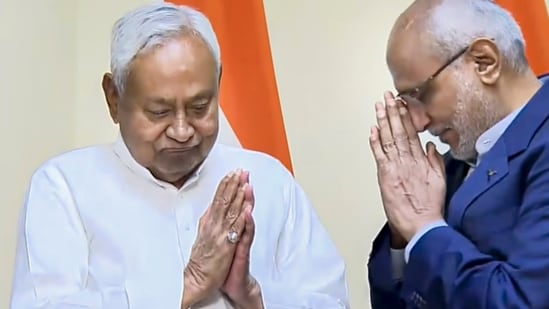
Nitish Kumar's resignation date set, Bihar to get new CM after April 14| India News
# Nitish Kumar to Resign: New Bihar CM on April 14
By Rajat Sinha, National Political Desk, April 12, 2026
**PATNA** — In a watershed moment for Indian regional politics, Bihar Chief Minister Nitish Kumar is officially set to resign, paving the way for a new head of state to take the oath of office on or shortly after April 14, 2026. Ending weeks of intense speculation within the corridors of power in Patna and New Delhi, the designated transition date marks the conclusion of an era dominated by the Janata Dal (United) patriarch. The selection of April 14—coinciding with Ambedkar Jayanti—is a highly calculated strategic move designed to telegraph a profound socio-political message across the state. As Bihar braces for this historic generational shift in leadership, the political landscape prepares for a profound realignment.
[Source: Hindustan Times | Additional: National Political Desk Research]
## The Strategic Significance of April 14
April 14 is no ordinary day on the Indian calendar. As the birth anniversary of Dr. B.R. Ambedkar, the chief architect of the Indian Constitution and a towering icon of Dalit and marginalized communities, the date carries immense political gravity. In the caste-conscious crucible of Bihar, timing a leadership transition to this specific day is an unmistakable exercise in social engineering.
Political analysts suggest that the ruling coalition is meticulously crafting its narrative. By inaugurating a new Chief Minister on Ambedkar Jayanti, the alliance aims to solidify its standing among the Mahadalit, Dalit, and Extremely Backward Classes (EBC) voting blocs. These demographics, which constitute a significant majority of Bihar’s population according to the state’s landmark 2023 caste survey, are the primary kingmakers in state elections.
“The choice of April 14 is a masterstroke of optical politics. It is not merely a date; it is a canvas upon which the future of Bihar’s social justice narrative is being painted,” notes Dr. Sanjay Kumar, a Patna-based political sociologist. “Whether the new Chief Minister hails directly from these marginalized communities or the transition is framed as a tribute to Ambedkarite principles of equal representation, the optics are designed to counter the opposition’s heavy focus on caste census politics.”
## End of the ‘Sushasan Babu’ Era
Nitish Kumar’s impending departure from the Chief Minister’s office closes one of the most remarkable chapters in contemporary Indian political history. Earning the moniker ‘Sushasan Babu’ (Mr. Good Governance) during his early tenure, Kumar is widely credited with pulling Bihar out of the administrative and infrastructural paralysis of the late 1990s and early 2000s.
Since first taking a firm grip on the state in 2005 (following a brief 7-day stint in 2000), his tenure has been characterized by several ambitious, albeit sometimes controversial, initiatives:
* **Law and Order Reform:** Dismantling the infamous localized syndicates and improving the state’s baseline security apparatus.
* **Women’s Empowerment:** Pioneering schemes such as providing free bicycles to school-going girls, which drastically reduced female dropout rates, and reserving 50% of panchayat seats for women.
* **Liquor Prohibition:** The polarizing 2016 ban on alcohol aimed at curbing domestic violence and protecting household economies, though it birthed a complex parallel economy of illicit liquor.
* **Infrastructure Overhaul:** Extensive road-building campaigns that connected thousands of remote villages to urban centers.
However, Kumar’s legacy is equally defined by his exceptional political agility. Over the past two decades, he has famously oscillated between the Bharatiya Janata Party (BJP)-led National Democratic Alliance (NDA) and the Rashtriya Janata Dal (RJD)-led Mahagathbandhan, maintaining his hold on the CM chair regardless of the alliance. His resignation now signals that the physical and political fatigue of navigating these complex coalitions has finally culminated in a succession plan.
[Source: Hindustan Times | Additional: Independent Political Archives]
## The Succession Race: Who Takes the Helm?
The immediate question dominating national headlines is the identity of Kumar’s successor. While the exact name is expected to be kept under wraps until legislative party meetings conclude in the coming days, the overarching formula is becoming apparent.
Given the current power-sharing dynamics between the JD(U) and its alliance partners, the transition involves intense backdoor negotiations. There are two primary avenues the coalition is exploring:
1. **An EBC or Dalit Face from within JD(U):** To maintain the party’s core vote bank and honor the spirit of April 14, elevating a trusted lieutenant from a marginalized background would ensure continuity while offering a fresh face to the electorate.
2. **A Power-Sharing Realignment with Allies:** If the larger national coalition partners demand greater control, we may see a transition where a consensus candidate from the allied ranks assumes the top job, with JD(U) retaining critical ministries.
“The transition is less about who the individual is and more about what demographic they represent,” explains senior political commentator Rati Verma in New Delhi. “Nitish Kumar will likely adopt a mentor-like ‘Margdarshak’ role, perhaps transitioning to a gubernatorial post or a national advisory capacity. But he will ensure that his successor protects the JD(U)’s organizational structure.”
## National Political Implications
While this is fundamentally a state-level transition, the tremors of Nitish Kumar’s resignation will be felt sharply in New Delhi. Bihar sends 40 Members of Parliament to the Lok Sabha, making it a critical battleground for any coalition aiming for central dominance.
For the ruling national alliance, ensuring a smooth, controversy-free transfer of power in Patna is paramount. Any internal rebellion or public fracturing could provide the energized opposition with the opening they need. Furthermore, this transition is a litmus test for how regional parties handle generational shifts. Unlike many regional outfits that operate as dynastic entities, JD(U) faces the unique challenge of transferring power without a clear bloodline successor, making this a fascinating case study in institutional political survival.
If the transition on April 14 is successful, it will provide a template for other aging regional satraps across India. Conversely, a botched handover could lead to the fragmentation of the JD(U), a scenario that national parties are watching closely with opportunistic intent.
## Economic and Administrative Inheritances
The new Chief Minister will inherit a state that presents a paradox of immense potential and stubborn historical deficits. While Nitish Kumar achieved remarkable double-digit GDP growth rates during certain phases of his tenure, Bihar remains at the bottom of the national ladder regarding per capita income and industrial development.
**Key Challenges for the Incoming CM:**
* **Youth Unemployment:** With one of the youngest demographics in India, the demand for government jobs and private sector employment is at a boiling point. The opposition’s narrative heavily revolves around the *Rozgar* (employment) agenda.
* **Industrial Stagnation:** Despite improvements in roads and electricity, large-scale manufacturing and IT sectors have largely bypassed Bihar due to lingering perceptions of bureaucratic red tape and land acquisition hurdles.
* **Agricultural Distress:** A vast majority of the state’s population relies on agriculture, which remains plagued by fragmented landholdings, seasonal flooding in the north, and droughts in the south.
Dr. A.K. Singh, an economist specializing in eastern Indian development, states, “The honeymoon period for the new CM will be exceptionally short. The electorate is no longer satisfied with basic roads and electricity; they are demanding upward economic mobility. The new leadership must pivot from a purely social justice platform to a ‘social justice plus economic modernization’ agenda.”
## Public Sentiment and Opposition Strategy
Unsurprisingly, the political opposition is viewing this transition period as a golden opportunity. The RJD, spearheaded by the youthful and aggressive Tejashwi Yadav, has been relentlessly campaigning on the promise of youth employment and systemic change.
The opposition’s strategy in the wake of the April 14 transition will likely focus on framing Nitish Kumar’s resignation as an admission of administrative failure rather than a voluntary passing of the baton. They will seek to exploit any dissatisfaction among ambitious leaders within the ruling coalition who feel sidelined by the choice of the new Chief Minister.
Meanwhile, public sentiment on the streets of Patna is a mix of nostalgia and cautious optimism. For an entire generation of young voters, Nitish Kumar is the only Chief Minister they have ever consciously known. His departure brings an undeniable sense of uncertainty, but also a palpable appetite for fresh governance strategies.
[Source: Hindustan Times | Additional: Field Reports from Bihar, April 2026]
## Conclusion: The Dawn of a New Political Chapter
As the sun sets on Nitish Kumar’s sprawling tenure, the dawn of April 14 will bring more than just the customary tributes to Dr. B.R. Ambedkar. It will usher in an entirely new political epoch for Bihar’s 130 million residents.
The immediate days following the swearing-in ceremony will be critical. The new Chief Minister will have to swiftly consolidate power, pacify competing factions within the alliance, and articulate a clear, modern vision for the state’s economic future. Nitish Kumar leaves behind a complex legacy—one of undeniable foundational rebuilding, coupled with the frustrating persistence of economic disparity.
Ultimately, the events set to unfold around April 14, 2026, transcend the mere swapping of nameplates outside the Chief Minister’s office. They represent a fundamental test of Bihar’s democratic maturity, its commitment to social justice, and its readiness to embrace the challenges of the mid-21st century. The nation watches with bated breath as Patna prepares to turn the page.





