
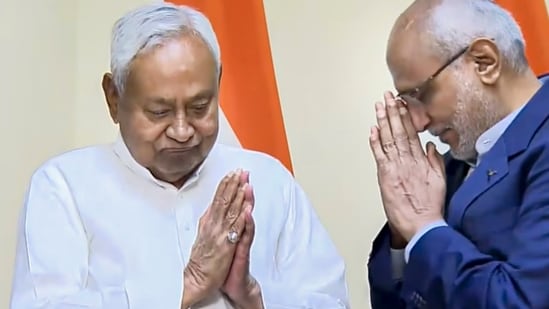
Nitish Kumar's resignation date set, Bihar to get new CM after April 14| India News
# Nitish Quits: New Bihar CM Expected on April 14
By Political Correspondent, National News Desk | April 12, 2026
**Patna:** In a watershed moment for Indian politics, Bihar Chief Minister Nitish Kumar has officially set his resignation date for April 14, 2026. After dominating the state’s political landscape for over two decades, the Janata Dal (United) supremo will step down to pave the way for a new leadership transition. The chosen date, Ambedkar Jayanti, carries profound political symbolism, signaling a major social justice narrative in the impending handover. This transition not only marks the end of an era for the Hindi heartland but also ignites intense speculation regarding who will take the helm of India’s third-most populous state. [Source: Hindustan Times | Additional: Public Domain Electoral Records].
## The Deep Symbolism of April 14
April 14 is no ordinary day on the calendar, for its political meaning and otherwise. As the nation observes the birth anniversary of Dr. B.R. Ambedkar, the architect of the Indian Constitution and a towering Dalit icon, Nitish Kumar’s decision to step down on this specific date is widely interpreted as a masterstroke of political messaging.
Throughout his tenure, Kumar has meticulously cultivated the ‘Mahadalit’ (extremely marginalized Dalits) and ‘Ati-Pichhda’ (Extremely Backward Classes) vote banks. By choosing Ambedkar Jayanti for his resignation and the subsequent anointment of a successor, the outgoing Chief Minister is attempting to cement his legacy as a champion of social justice.
Political analysts note that this carefully choreographed exit is designed to ensure the transition is viewed through the lens of empowerment rather than political defeat or simple retirement. “Nitish Kumar understands optics better than most politicians of his generation,” noted Dr. Rakesh Ranjan, a Patna-based political sociologist. “Handing over the baton on April 14 suggests that the next Chief Minister—or the new cabinet structure—will heavily favor the marginalized communities, thus insulating the National Democratic Alliance (NDA) from opposition critiques.”
## End of the ‘Sushasan Babu’ Era
Born in 1951, the 75-year-old leader’s departure from the Chief Minister’s office closes a defining chapter in Bihar’s modern history. Earning the moniker *’Sushasan Babu’* (Mr. Good Governance) during his early years in power, Kumar is largely credited with pulling Bihar out of a period characterized by severe lawlessness and infrastructural decay.
**Key Pillars of Nitish Kumar’s Legacy:**
* **Infrastructure Revival:** Transforming Bihar’s dilapidated road network, ensuring that even the most remote villages were connected to the state capital.
* **Women’s Empowerment:** Implementing a 50% reservation for women in local panchayat bodies, launching the famous bicycle scheme for school-going girls, and establishing the *Jeevika* rural livelihood program.
* **Social Engineering:** Championing the 2023 Bihar caste survey, which forced a national conversation on proportional representation and led to an increase in state reservations to 75%.
* **Prohibition:** The controversial 2016 liquor ban, which, despite massive implementation challenges and the rise of a parallel illicit economy, secured him enduring support from a vast section of rural women.
However, his tenure was equally defined by unparalleled political pragmatism. His frequent switching of alliances between the Bharatiya Janata Party (BJP) and the Rashtriya Janata Dal (RJD) led his critics to label him *’Paltu Ram’* (the turncoat). Yet, his sheer indispensability kept him in the Chief Minister’s chair, regardless of which coalition was in power. [Source: Hindustan Times | Additional: General Political History].
## Alliance Dynamics and the Transition Plan
The decision to step down in April 2026 comes in the wake of complex negotiations within the NDA. After realigning with the BJP in early 2024 and successfully navigating the subsequent electoral tests, discussions regarding a succession plan had been gathering momentum.
Sources within the Janata Dal (United) indicate that Kumar’s declining health and a desire to transition into a mentoring role within national politics precipitated the move. Furthermore, the BJP, being the larger partner in the state assembly, has been increasingly assertive about claiming the Chief Ministerial post.
The transition plan is expected to be a delicate balancing act. If the BJP assumes the Chief Ministership, the JD(U) will likely secure key portfolios and the Deputy Chief Minister’s post, ensuring that Kumar’s core constituencies feel adequately represented. Alternatively, Kumar may elevate a trusted JD(U) loyalist from a marginalized community to the top job, with the BJP’s backing, mirroring his brief 2014 experiment when he appointed Jitan Ram Manjhi as Chief Minister.
## Top Contenders for the Chief Minister’s Chair
As Patna buzzes with anticipation, the corridors of power are rife with speculation about the successor. The NDA is keeping its cards close to its chest, but several prominent names have emerged as frontrunners:
1. **Ashok Choudhary (JD-U):** A prominent Dalit face and a trusted lieutenant of Nitish Kumar. If the JD(U) retains the CM post to honor the April 14 symbolism, Choudhary’s elevation would serve as a powerful message to the Mahadalit vote bank.
2. **Samrat Choudhary (BJP):** The aggressive OBC (Koeri) leader who has been instrumental in expanding the BJP’s footprint among backward classes in Bihar. His appointment would signal the BJP taking full control of the state’s leadership.
3. **Vijay Kumar Sinha (BJP):** Representing the powerful upper-caste demographic, Sinha brings administrative experience. However, an upper-caste appointment on Ambedkar Jayanti might contradict the overarching social justice narrative the alliance wishes to project.
4. **Sanjay Kumar Jha (JD-U):** Known as Nitish Kumar’s key troubleshooter in Delhi, Jha has excellent rapport with the BJP high command. Though a Brahmin, his consensus-building skills make him a dark horse for a transitional government.
## Economic and Administrative Challenges Ahead
Whoever takes the oath of office after April 14 will inherit a state that, despite making significant strides in basic infrastructure, still grapples with profound structural challenges. The new Chief Minister will have to shift the state’s focus from basic law-and-order management to aggressive industrialization and job creation.
| Economic Indicator | Bihar’s Status (Estimated) | National Average |
| :— | :— | :— |
| Per Capita Income | ₹54,000 | ₹1,70,000+ |
| Multidimensional Poverty | ~33% | ~14.9% |
| Industrial Growth Rate | 4.5% | 7.8% |
*(Data reflects approximate comparative metrics for context.)*
Youth unemployment and migration remain the state’s Achilles’ heel. The opposition, led by Tejashwi Yadav of the RJD, has successfully mobilized young voters around the promise of government jobs. The incoming NDA Chief Minister will face the immediate task of fulfilling pending recruitment drives in the education and health sectors while courting private investment—a feat that largely eluded Nitish Kumar during his reign.
Furthermore, managing the complex caste arithmetic in the aftermath of the 2023 caste census will require immense political dexterity. The new leadership must ensure that the expanded reservation quotas do not lead to administrative paralysis or legal bottlenecks.
## Political Reactions and Public Sentiment
The announcement has sent shockwaves through the opposition ranks. The RJD and the broader INDIA bloc have viewed Nitish Kumar as the linchpin holding the NDA together in Bihar.
“Nitish Kumar’s resignation is an admission that the JD(U) has lost its independent political standing. The BJP is simply executing a hostile takeover of Bihar,” remarked a senior RJD spokesperson during a press briefing. The opposition intends to frame the transition as a betrayal of the state’s socialist legacy, arguing that a BJP-led or BJP-controlled government will dilute the welfare schemes initiated for the backward classes.
Conversely, within the business community and urban middle classes, there is a cautious optimism. Many believe that a generational shift in leadership could bring fresh ideas and a more aggressive approach toward IT and manufacturing investments in regions like Bihta, Muzaffarpur, and Bhagalpur.
## What This Means for National Politics
Nitish Kumar stepping down is not merely a regional event; its tremors will be felt in New Delhi. For the BJP, securing its own Chief Minister or a highly compliant proxy in Bihar represents the final conquest of the Hindi heartland, consolidating an unbroken chain of NDA dominance from Gujarat to Bihar.
This move is also heavily linked to the BJP’s long-term strategy for the 2029 general elections. By settling the leadership question in Bihar now, the NDA provides the new Chief Minister ample time to consolidate their position, build a distinct administrative track record, and counter the formidable anti-incumbency that naturally accrues after two decades of coalition rule.
For Nitish Kumar himself, stepping away from the daily grind of state administration might pave the way for a national advisory role, such as a governorship or a central strategic post within the NDA apparatus.
## Conclusion: A Historic Transition
As April 14 approaches, all eyes remain fixed on Patna. The day that celebrates the father of the Indian Constitution will now also be remembered as the day Bihar turned a crucial page in its political history. Nitish Kumar leaves behind a complex legacy—a leader who undeniably rescued a state from the brink of systemic collapse, yet ultimately struggled to vault it into the ranks of India’s economically developed states.
The forthcoming Chief Minister faces the daunting task of filling the shoes of a political titan while charting a new socio-economic destiny for 130 million Biharis. Whether this transition brings the promised dawn of industrial and economic revitalization, or triggers a phase of coalition instability, will dictate the trajectory of Eastern India’s politics for the next decade. [Source: Hindustan Times].





