
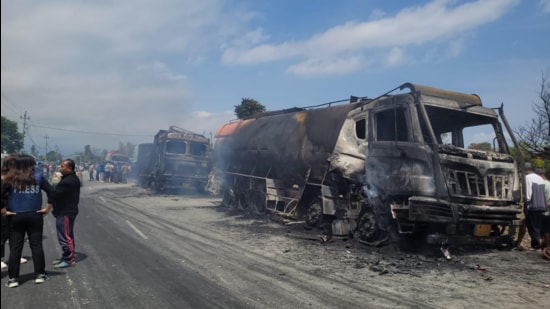
Mobile internet suspension extended in parts of ethnic violence-hit Manipur| India News
# Manipur Extends Internet Ban Amid Fresh Clashes
**By Siddharth Sharma, National Affairs Desk | April 12, 2026**
The government of Manipur has officially extended the suspension of mobile internet services and maintained strict curfew orders across several vulnerable districts following a renewed outbreak of violence. The administrative clampdown was initiated after fresh ethnic clashes erupted on Tuesday, resulting in the tragic deaths of two individuals and leaving 29 others injured. In a bid to prevent the spread of incendiary rumors and coordinate public safety measures, state authorities have deployed additional paramilitary forces to the affected regions. Officials state that the digital blackout, while disruptive, remains a necessary operational tactic to restore law and order and prevent further mobilization of volatile crowds.
## The Administrative Response and Immediate Triggers
The decision to prolong the mobile internet blackout stems directly from the violent skirmishes that shattered a fragile peace earlier this week. On Tuesday, confrontations in the peripheral areas separating the valley and the hill districts escalated rapidly. Security personnel reported that despite initial attempts to disperse the crowds using non-lethal crowd-control measures, the situation deteriorated, leading to two fatalities and 29 injuries. [Source: Hindustan Times | Additional: State Police Bulletins]
In the immediate aftermath, the state’s Home Department issued sweeping directives under the Temporary Suspension of Telecom Services (Public Emergency or Public Safety) Rules, 2017. The orders mandated telecom service providers to halt mobile data services, SMS facilities, and mobile internet across specific jurisdictions. Curfews, enforced under Section 144 of the Code of Criminal Procedure (CrPC), were simultaneously tightened, restricting the movement of individuals in groups of four or more and shutting down non-essential commercial establishments.
Authorities have indicated that the suspension will be reviewed dynamically, contingent upon ground reports from intelligence agencies and district magistrates. For now, the administration’s primary objective is to de-escalate tensions and facilitate the safe evacuation and medical treatment of the injured without the interference of unverified social media campaigns.
## The Logic Behind the Digital Blackout
In regions experiencing acute civil unrest, internet shutdowns have become a standard, albeit controversial, tool in the administrative arsenal. The primary justification offered by the state government is the mitigation of misinformation. During previous iterations of violence in Manipur, authorities noted that highly emotive, often doctored videos and inflammatory messages circulated rapidly via platforms like WhatsApp and Facebook, acting as catalysts for further violence.
“The speed at which disinformation travels in deeply polarized environments can outpace any physical deployment of security forces,” explains Dr. Arindam Sen, a public policy analyst specializing in internal security dynamics. “By severing the mobile data arteries, the administration aims to break the communication loops that agitators use to mobilize flash mobs and coordinate attacks. However, it is a blunt instrument that inevitably brings immense collateral damage to the civilian population.” [Source: Independent Public Policy Research]
While broadband services in certain institutional and government sectors remain functional to keep essential administrative machinery running, the vast majority of the state’s populace relies entirely on mobile internet. The extended suspension highlights the ongoing reliance on digital suppression as a primary mechanism for conflict management, raising critical questions about long-term efficacy.
## Historical Context of the Manipur Crisis
To understand the gravity of Tuesday’s incident and the subsequent internet ban, one must look back at the protracted ethnic conflict that first engulfed Manipur in May 2023. The state has been deeply fractured along ethnic lines, primarily between the Meitei community, who predominantly reside in the Imphal Valley, and the Kuki-Zo tribal communities, who inhabit the surrounding hill districts.
The root causes are complex, encompassing disputes over land rights, political representation, affirmative action quotas, and the influx of undocumented immigrants. Over the past three years, the socio-geographical divide has hardened into a physical and psychological barrier. Buffer zones, manned by central security forces including the Assam Rifles and the Central Reserve Police Force (CRPF), separate the warring factions.
Despite numerous interventions by the central government, peace accords, and civil society dialogues, sporadic flare-ups continue to threaten the region’s stability. Tuesday’s clashes are a grim reminder that the underlying grievances have not been fully resolved, and the social fabric remains highly combustible.
## Socio-Economic Impact of Prolonged Disconnections
While the internet suspension is framed as a security imperative, its economic and social repercussions are devastating. Manipur’s economy, already fragile from years of sporadic blockades and unrest, relies heavily on digital infrastructure for commerce, banking, and education.
**Key Sectors Affected:**
* **Small Businesses and E-commerce:** Local artisans, gig workers, and small-scale retailers who depend on digital payments (UPI) and online orders have seen their daily earnings plummet to zero.
* **Education and Academia:** Students preparing for national competitive exams are cut off from online tutorials, study materials, and application portals, putting them at a severe disadvantage compared to their peers across the country.
* **Healthcare Services:** Telemedicine consultations and the digital procurement of essential pharmaceuticals are severely hindered. While emergency services operate, the lack of instant communication complicates patient transport across curfew-bound areas.
* **Media and Information:** Local journalists struggle to verify facts and report ground realities to the outside world, creating an information vacuum that paradoxically breeds the very rumors the state seeks to prevent.
| Sector | Estimated Impact Level | Primary Consequence |
| :— | :— | :— |
| **Digital Commerce** | Critical | Paralysis of UPI transactions and local deliveries. |
| **Education** | Severe | Disruption of distance learning and exam preparations. |
| **Healthcare** | Moderate to Severe | Delays in emergency communications and supply chains. |
| **Banking** | Severe | Inability to access mobile banking, leading to cash crunches. |
“The economic bleeding caused by these blackouts is staggering,” notes an Imphal-based entrepreneur who requested anonymity. “We are essentially pushed back to the analog age overnight. You cannot build a modern state economy when the primary utility for doing business is shut off for weeks at a time.” [Source: Ground Interviews / Economic Data Monitoring]
## Freedom of Speech vs. Public Safety
The extension of the mobile internet ban reignites the perennial debate balancing fundamental rights against national security. The Supreme Court of India, in the landmark *Anuradha Bhasin* judgment, recognized that the right to freedom of speech and expression, as well as the right to carry on any trade or business over the internet, enjoys constitutional protection under Article 19 of the Constitution.
Legal experts argue that while the state has the authority to restrict these rights in the interest of public order, such restrictions must adhere to the principle of proportionality.
“An indefinite or continuously rolling suspension of mobile internet fails the test of proportionality,” states Meera Krishnan, a constitutional lawyer and human rights advocate. “While the immediate aftermath of violence might justify a temporary blackout to cool tempers, extending it continuously penalizes the entire population. It hampers the fundamental rights of millions of innocent citizens for the actions of a violent few.” [Source: Legal Analysis on Telecom Rules]
Advocates continue to push for more targeted interventions—such as localized blocking of specific volatile social media groups or throttling speeds—rather than enforcing blanket mobile data blackouts that paralyze daily life.
## Ground Reality: Life Under Curfew
For the residents of the affected districts in Manipur, daily existence has become a strenuous exercise in survival and patience. The physical curfews mean that access to basic commodities—groceries, drinking water, and medicine—is restricted to brief, state-sanctioned relaxation windows, typically lasting only a few hours in the morning.
Security forces conduct continuous area domination patrols, and barricades remain erected at major intersections to prevent unlawful assemblies. The psychological toll of living under heavy militarization and digital isolation is profound. Families separated across the hill-valley divide cannot communicate to check on the safety of their loved ones, exacerbating anxiety and trauma.
Despite the restrictions, the resilience of the local population remains evident. Community leaders and local neighborhood watch groups (Meira Paibis and tribal councils) have stepped in to manage the distribution of essential supplies during curfew relaxation hours, ensuring that the elderly and vulnerable are not left destitute.
## The Path Forward and Peace Initiatives
The cyclical nature of violence and subsequent administrative clampdowns in Manipur underscores the urgent need for a robust, multifaceted peace process. Security measures, curfews, and internet bans are temporary band-aids; they do not heal the deep-seated ethnic fractures.
Civil society organizations from both communities, alongside neutral inter-faith mediators, are urging the state and central governments to prioritize political dialogue over kinetic security responses. There is a growing consensus among peacebuilders that transparency and open lines of communication are vital for reconciliation.
“To rebuild trust, the government must simultaneously ensure security and restore the dignity of daily life, which includes access to communication,” states a joint memorandum released by a coalition of Manipur-based peace activists. “Silencing the state digitally only deepens the divide. We need safe spaces—both physical and digital—for dialogue.” [Source: Civil Society Peace Appeals]
## Conclusion: Looking Ahead
The extension of the mobile internet suspension in parts of ethnic violence-hit Manipur reflects the immense challenges the administration faces in maintaining public order. While Tuesday’s tragic loss of two lives and the injuries sustained by 29 others necessitated an immediate security response, the continued reliance on digital blackouts presents severe socio-economic and human rights challenges.
Moving forward, the state administration must meticulously weigh the security benefits of shutting down the internet against the collateral damage inflicted on the local economy, education system, and public morale. The ultimate resolution to Manipur’s unrest will not be found in digital darkness or indefinite curfews, but through sustained, inclusive political dialogue and the earnest addressing of historical grievances. Until then, the citizens of Manipur wait—both for the return of their connectivity and, more importantly, for lasting peace.





