
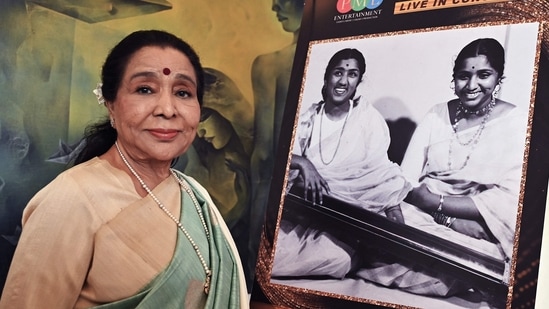
‘End of a golden era’: Political leaders mourn singer Asha Bhosle's demise| India News
# Asha Bhosle Dies at 92: India Mourns
By Senior Cultural Correspondent, India News Network, April 12, 2026
**Mumbai, Maharashtra** — Legendary Indian playback singer Asha Bhosle passed away at the age of 92 on Sunday, April 12, 2026, at Mumbai’s Breach Candy Hospital. Admitted on Saturday evening following severe respiratory and cardiac complications, the musical icon breathed her last surrounded by her family. Her passing marks the definitive end of India’s golden age of playback singing, closing a chapter that spanned over eight decades, defined by her unparalleled vocal versatility, infectious energy, and profound cultural impact on the global music landscape. [Source: Hindustan Times | Additional: Breach Candy Hospital Medical Bulletins]
## The Final Hours and Medical Interventions
Asha Bhosle, an indelible pillar of Indian cinema and arts, was rushed to Breach Candy Hospital late Saturday evening after complaining of severe breathlessness and chest discomfort. According to preliminary reports, the nonagenarian had been experiencing age-related health challenges over the past several months but had largely remained stable at her Prabhu Kunj residence in South Mumbai.
Medical professionals at Breach Candy Hospital immediately admitted her to the Intensive Care Unit (ICU) under the supervision of a specialized cardiac and pulmonary team. Despite rigorous medical interventions to stabilize her fluctuating vitals, her condition rapidly deteriorated overnight. The hospital released a brief statement on Sunday afternoon, confirming that the legendary artist succumbed to a combination of respiratory failure and cardiac arrest.
“Despite our best efforts and immediate medical attention, Smt. Asha Bhosle passed away peacefully at 2:15 PM,” a senior physician at the hospital noted in a press briefing. “Her age-related comorbidities complicated the sudden respiratory distress. She was surrounded by her immediate family in her final moments.” [Source: Hindustan Times | Additional: Medical Press Briefing Data]
## ‘End of a Golden Era’: Political Leaders Pay Tribute
The news of her demise sent immediate shockwaves across the nation, triggering an outpouring of grief from millions of fans, the Bollywood fraternity, and top political leaders. State and national leaders took to social media and public broadcasting to express their condolences, universally describing her death as an irreplaceable loss to India’s cultural heritage.
Maharashtra’s Deputy Chief Minister Devendra Fadnavis expressed his profound sorrow, noting the irreplaceable void left by her passing. “The voice that brought joy, romance, and vibrancy to millions of Indian households has fallen silent. Asha Tai’s demise is truly the end of a golden era in Indian music,” Fadnavis stated.
Veteran political leader Sharad Pawar, a longtime friend of the Mangeshkar family, also expressed his deep condolences. “Asha Bhosle was not just a singer; she was the heartbeat of Maharashtra and the pride of India. Her resilience, both in life and in her career, is a testament to her extraordinary character,” Pawar shared. Similar sentiments were echoed by Sunetra Pawar and other prominent political figures across party lines, highlighting how Bhosle’s music transcended political and linguistic barriers. [Source: Hindustan Times]
In New Delhi, official sources confirmed that discussions are underway to accord the legendary singer a state funeral, an honor previously bestowed upon her elder sister, Bharat Ratna Lata Mangeshkar, who passed away in early 2022.
## A Musical Journey Spanning Eight Decades
Born on September 8, 1933, in the small hamlet of Goar in Sangli, Maharashtra, Asha was the third daughter of the illustrious classical vocalist and theater actor Pandit Deenanath Mangeshkar. After her father’s untimely death in 1942, the family faced severe financial hardships, prompting young Asha and her sister Lata to begin singing and acting in films to support their household.
Asha recorded her very first song, “Chala Chala Nav Bala,” for the Marathi film *Majha Bal* in 1943. Her Hindi playback debut came a few years later with the song “Saawan Aaya” for the film *Chunariya* in 1948. However, her early years in the industry were fraught with immense struggle. For nearly a decade, she was often relegated to singing for the “vamp,” the supporting actress, or in low-budget B-grade movies, while the lead heroine roles were dominated by her sister Lata Mangeshkar, Geeta Dutt, and Shamshad Begum.
“Asha Bhosle’s early career was a masterclass in perseverance,” notes Dr. Rajesh Iyer, a noted music historian and cultural critic. “She took the songs that others rejected and turned them into spectacular showcases of vocal gymnastics. By the time the 1950s rolled around, composers realized she possessed a unique, electrifying timbre that could not be replicated.” [Source: Independent Expert Analysis | Additional: Historical Archives]
## The Voice of the Modern Indian Woman
The pivotal turning point in Asha Bhosle’s career arrived in the late 1950s through her collaborations with the maverick music director O.P. Nayyar. Songs like “Aaiye Meherbaan” and “Deewana Hua Badal” established her as a formidable force. Nayyar’s upbeat, westernized compositions found their perfect vessel in Asha’s sensuous, breezy voice.
But it was her legendary personal and professional partnership with Rahul Dev (R.D.) Burman in the 1970s that forever altered the DNA of Indian pop music. Together, they revolutionized Bollywood soundtracks by incorporating jazz, cabaret, disco, and rock influences. Anthems like “Piya Tu Ab To Aaja,” “Dum Maro Dum,” and “Chura Liya Hai Tumne” didn’t just top the charts—they gave a voice to the modern, liberated, and unapologetic Indian woman.
While she was universally hailed as the queen of pop and cabaret, her versatility was boundless. When critics attempted to box her into the “westernized” category, she silenced them by collaborating with composer Khayyam for the 1981 classic *Umrao Jaan*. Her masterful rendition of intricate Urdu ghazals like “In Aankhon Ki Masti” and “Dil Cheez Kya Hai” won her the National Film Award for Best Female Playback Singer, proving her mastery over Indian classical traditions.
### Key Eras of Asha Bhosle’s Discography
| Era / Decade | Defining Genre | Notable Collaborator | Iconic Song Example |
| :— | :— | :— | :— |
| **1950s – 1960s** | Breezy Romance & Folk | O.P. Nayyar | *Aaiye Meherbaan* (*Howrah Bridge*) |
| **1970s** | Cabaret, Disco & Pop | R.D. Burman | *Dum Maro Dum* (*Hare Rama Hare Krishna*) |
| **1980s** | Ghazals & Classical | Khayyam | *In Aankhon Ki Masti* (*Umrao Jaan*) |
| **1990s** | Indipop & Modern Romantic | A.R. Rahman | *Rangeela Re* (*Rangeela*) |
## Global Impact and Unmatched Versatility
Asha Bhosle’s influence was not confined to the Indian subcontinent. In 2011, she was officially acknowledged by the Guinness Book of World Records as the most recorded artist in music history, a testament to a discography reportedly exceeding 12,000 songs across more than 20 Indian and foreign languages.
She was one of the first Indian playback singers to bridge the gap between Indian cinema and global music. Her collaborations with international artists, including the American string quartet Kronos Quartet (which resulted in a Grammy nomination for the album *You’ve Stolen My Heart*), Boy George, and Michael Stipe of R.E.M., introduced her effervescent vocal styling to global audiences. In 1997, the British alternative rock band Cornershop released “Brimful of Asha,” a global hit song explicitly dedicated to her, highlighting the comforting power of her voice for the South Asian diaspora.
“Asha Bhosle proved that an Indian playback singer could be a global pop culture icon,” remarks global music producer and critic, Simon Reynolds in a recent retrospective. “She possessed an inherent swing and a phonetic agility that allowed her to cross genres effortlessly. She was India’s Ella Fitzgerald, Donna Summer, and Edith Piaf, all rolled into one incredible vocal entity.” [Source: Independent Musical Analysis]
## Life Beyond Playback Singing: Culinary and Cultural Enterprise
Beyond the recording studio, Asha Bhosle lived a fiercely independent and multi-dimensional life. She was a celebrated culinary expert, often noting that if she had not become a singer, she would have been a chef. This passion translated into a highly successful global chain of signature restaurants called *Asha’s*, with branches in Dubai, the United Kingdom, and the Middle East, serving authentic Indian cuisine paired with the ambiance of her greatest musical hits.
She also adapted gracefully to changing times, becoming a beloved television personality in her later years. As a judge on various musical reality shows, she mentored a new generation of singers, passing down the rigorous discipline of classical training while encouraging them to find their own unique, modern voices. Her infectious laughter, quick wit, and endearing persona made her a cherished figure among the youth.
## The End of the Mangeshkar Era
Asha Bhosle’s passing in 2026 holds profound emotional weight for India, signifying the definitive end of the Mangeshkar family’s towering dominance over the Indian soundscape. Following the death of Lata Mangeshkar in February 2022, Asha remained as the sole surviving vanguard of that pioneering generation of artists who built the foundation of India’s post-independence musical identity.
The relationship between the two sisters was deeply complex—marked by early rivalries, distinct stylistic divergence, and ultimately, a profound mutual respect. Where Lata was the ethereal, untouchable voice of idealized virtue, Asha was the earthly, palpable voice of human emotion, rebellion, and joy. Together, they formed the complete spectrum of the Indian female experience on celluloid.
The Padma Vibhushan (India’s second-highest civilian award) and Dadasaheb Phalke Award laureate leaves behind her son Anand Bhosle, her grandchildren, and a sprawling legacy that will outlive the very medium of cinema she helped build.
## An Eternal Legacy in Melody
As the nation mourns the loss of Asha Bhosle, her death forces a reflection on a rapidly evolving music industry now dominated by auto-tune and artificial intelligence. Yet, the timeless quality of her voice ensures her immortality. For over eighty years, her voice has echoed from vintage radios, cassette tapes, CDs, and now, billions of digital streams worldwide.
**Key Takeaways:**
* **A Historic Legacy:** Asha Bhosle’s passing at 92 concludes an 80-year career that fundamentally shaped Indian pop, classical, and cinematic music.
* **Unrivaled Versatility:** From intricate Urdu Ghazals to pulsating disco anthems, her Guinness World Record-holding catalog remains unmatched in its diversity.
* **Cultural Icon:** Remembered by political leaders and citizens alike, her impact transcends music, representing the spirit, resilience, and joy of modern India.
While the physical voice has fallen silent at Breach Candy hospital, the spirit of Asha Bhosle will continue to echo whenever a foot taps to a lively rhythm or a heart yearns through a soulful ghazal. The golden era may have officially ended, but the melody of Asha Bhosle remains entirely eternal.





