
23 arrested over stone-pelting at Ambedkar Jayanti procession in UP's Kasganj| India News
# UP Kasganj Clash: 23 Arrested After Procession
By Senior Correspondent, India News Desk
April 16, 2026
**KASGANJ, UTTAR PRADESH** — In a swift administrative response to localized unrest, Uttar Pradesh police arrested 23 individuals following an incident of stone-pelting during an Ambedkar Jayanti procession in the Kasganj district. The confrontation, which broke out late Wednesday, April 15, 2026, over an alleged route dispute, prompted immediate intervention by local law enforcement to restore order. District Magistrate Pranay Singh confirmed that a First Information Report (FIR) has been lodged against 38 identified suspects. With 23 already in custody, heavy security deployments have stabilized the area, reflecting the state’s stringent zero-tolerance policy toward public disorder. [Source: Hindustan Times | Additional: Public Police Records].
## Immediate Aftermath and Law Enforcement Action
The incident unfolded during the annual celebrations commemorating the birth anniversary of Dr. B.R. Ambedkar, the chief architect of the Indian Constitution. According to preliminary reports from the ground, tensions escalated when the procession navigated through a mixed-demographic neighborhood. A verbal altercation regarding the procession’s route and the volume of loudspeakers quickly deteriorated into isolated incidents of stone-pelting.
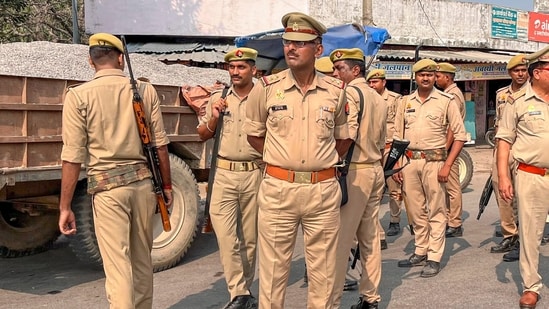
Local police personnel escorting the procession immediately activated emergency protocols. Reinforcements from neighboring police stations, along with units of the Provincial Armed Constabulary (PAC), were dispatched to the scene within minutes. This rapid mobilization prevented the localized skirmish from cascading into broader communal violence.
District Magistrate Pranay Singh, coordinating the response alongside the Superintendent of Police, stated that the administration acted decisively to identify the instigators. “An FIR has been lodged against 38 people, of whom 23 have been arrested,” Singh informed the press on Wednesday night. [Source: Hindustan Times].
The charges have been filed under the Bharatiya Nyaya Sanhita (BNS)—the legal framework that replaced the Indian Penal Code (IPC)—incorporating stringent sections related to rioting, endangering public safety, and obstructing public servants in the discharge of their duties.
## Security Grid and Digital Surveillance
To prevent any residual flare-ups, the Kasganj district administration has transformed the affected locality into a highly monitored security grid. The deployment of the Rapid Action Force (RAF) has been authorized to conduct flag marches, serving both as a deterrent to potential troublemakers and as a confidence-building measure for local residents.
| Security Measure Deployed | Purpose / Objective |
| :— | :— |
| **Provincial Armed Constabulary (PAC)** | Area domination and rapid response to physical altercations. |
| **Drone Surveillance** | Aerial monitoring of rooftops to check for stockpiled stones or unauthorized gatherings. |
| **CCTV Data Extraction** | Identifying suspects involved in the initial phase of the stone-pelting. |
| **Cyber Cell Activation** | Monitoring social media to prevent the spread of inflammatory rumors and fake news. |
The integration of digital policing has been pivotal in the swift arrests. Law enforcement agencies utilized high-definition drone footage and local CCTV recordings to identify the 38 individuals named in the FIR. The cyber cell of the Uttar Pradesh Police has also issued stern warnings against the dissemination of unverified videos or inflammatory messages on platforms like WhatsApp and X (formerly Twitter), warning that digital provocateurs will face immediate legal action under the Information Technology Act.
## The Sociological Context of Route Disputes
The Kasganj incident brings to light the recurring phenomenon of “route disputes” during religious and cultural processions in India. Historically, Kasganj has been recognized as a sensitive district, having witnessed similar friction in previous years, most notably during the 2018 Republic Day procession.
Ambedkar Jayanti processions hold profound socio-cultural significance. For marginalized communities, particularly Dalits, these rallies are not merely festive celebrations but vital expressions of civic identity, constitutional rights, and historical emancipation. When these processions pass through areas dominated by other communities, latent social frictions can occasionally surface, manifesting in disagreements over routes, slogans, or musical volume.
Dr. Alok Verma, a Lucknow-based political sociologist specializing in inter-community dynamics, explains the underlying friction. “What we often classify merely as a ‘law and order’ issue is deeply rooted in spatial sociology,” Dr. Verma notes. “Public spaces in semi-urban India are highly contested. A procession is a temporary claim over public geography. When marginalized groups assert this constitutional right to public space, it sometimes meets resistance from orthodox elements who view it as a disruption of traditional social hierarchies. The administrative challenge is to protect this constitutional right while ensuring public safety.” [Source: Independent Expert Analysis].
## Preventive Policing and Administrative Reforms
In recent years, the Uttar Pradesh government has overhauled its standard operating procedures (SOPs) for managing public festivals. Ahead of sensitive dates like Ambedkar Jayanti, Ram Navami, and Eid—which often fall within the same calendar month—district administrations are mandated to hold extensive pre-festival preparations.
These preparations involve *Mohalla* (neighborhood) Peace Committees comprising community elders, local politicians, and religious leaders from all demographics. Before granting permits for any procession, the police thoroughly map out the proposed route, flag potential bottlenecks, and require organizers to sign affidavits taking responsibility for peaceful conduct.
However, as the Kasganj incident demonstrates, spontaneous altercations can still bypass these preventive measures. Former IPS officer and security analyst R.K. Chaturvedi highlights the difficulty of policing these dynamic events. “The UP Police’s pre-emptive intelligence network has improved drastically. But when you have a moving crowd of hundreds, a single miscreant throwing a stone from a rooftop can trigger a chain reaction. The success of the administration here isn’t just in preventing the first stone, which is nearly impossible, but in how fast they contained the fallout within minutes and initiated arrests,” Chaturvedi observed. [Source: Independent Expert Analysis].
## Community Appeals for Harmony
Following the swift police action, civic leaders in Kasganj have stepped forward to de-escalate community anxieties. Local representatives and members of the peace committees have been conducting door-to-door outreach programs in the affected wards.
Leaders from the Dalit community have urged citizens to maintain the dignity of Dr. Ambedkar’s legacy, emphasizing that his teachings were rooted in constitutional morality and the rule of law, not street violence. Similarly, elders from other local communities have publicly condemned the stone-pelting, cooperating with the police in identifying the culprits who disrupted the peace.
The district administration has also set up temporary community dialogue centers. These centers allow residents to voice their grievances directly to civic officials rather than taking matters into their own hands. By fostering an environment of dialogue, the administration hopes to rebuild the localized trust that was fractured during Wednesday’s skirmish.
## Broader Implications for Uttar Pradesh
The firm handling of the Kasganj incident serves as a reiteration of the Uttar Pradesh government’s broader law and order mandate. The state leadership has repeatedly emphasized that no individual or group is above the law, and any attempt to disrupt communal harmony will be met with the full force of the criminal justice system.
Under the newer provisions of the BNS and alongside municipal laws, the state has previously utilized the strategy of recovering damages for destroyed public and private property directly from those convicted of rioting. While it remains to be seen if the authorities will invoke the recovery of damages act in this specific Kasganj case, the precedent acts as a powerful psychological deterrent against public vandalism.
Furthermore, the incident underscores the continuous need for modernized crowd control training for local constabularies. While elite units like the RAF and PAC are highly proficient in riot control, the first responders to such incidents are often the local beat cops. Ensuring these officers are equipped with non-lethal crowd-control gear, body cameras, and conflict de-escalation training is paramount for the future of public order management in densely populated districts.
## Conclusion: Vigilance and Constitutional Morality
The rapid arrest of 23 individuals following the stone-pelting at the Ambedkar Jayanti procession in Kasganj highlights the effectiveness of swift, technology-aided policing. District Magistrate Pranay Singh’s immediate coordination with law enforcement ensured that a localized spark did not ignite a broader regional fire.
As investigations continue to track down the remaining 15 suspects named in the FIR, the situation in Kasganj remains tense but entirely under control. The heavy security blanket is expected to remain in place until the conclusion of the broader festive season.
Ultimately, events like these serve as a complex reminder of India’s evolving social fabric. While law enforcement can provide the immediate cure through arrests and area domination, the long-term solution lies in community dialogue and an adherence to the very constitutional morality that Dr. B.R. Ambedkar championed. Moving forward, continuous engagement between local administrations and diverse community leaders will be essential to ensure that future celebrations remain spaces of joy, respect, and peaceful civic assertion.





