
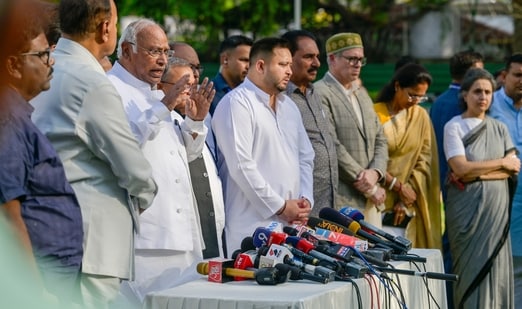
‘Anti-national’: Opposition vows unity to defeat govt's proposal for Lok Sabha expansion| India News
# Lok Sabha Expansion Proposal Sparks Oppn Pushback
By Political Desk, Independent News Wire, April 16, 2026
In a dramatic escalation of India’s political fault lines, a unified opposition has branded the Union government’s impending Lok Sabha expansion as “anti-national,” setting the stage for a historic parliamentary showdown. On Thursday, April 16, 2026, the government confirmed plans to introduce three pivotal legislations: The Delimitation Bill, 2026, The Constitution Bill, 2026, and the Union Territories Laws (Amendment) Bill 2026. This legislative triad aims to redraw electoral boundaries and increase parliamentary seats based on current population metrics. However, opposition leaders, spearheaded by Rahul Gandhi, argue the move will systematically disenfranchise southern states that successfully controlled their populations, vowing a united front to defeat the controversial proposal. [Source: Hindustan Times | Additional: Public Parliamentary Records].
## The Legislative Trio: Decoding the Government’s Strategy
The heart of the current political firestorm lies in three interconnected bills that the Union government has slated for the upcoming parliamentary session. Together, these documents represent the most significant structural overhaul of India’s democratic representation in half a century.
**The Delimitation Bill, 2026** sets the statutory framework for the creation of a new Delimitation Commission. This independent body will be tasked with redrawing the boundaries of assembly and parliamentary constituencies across the country based on the latest available demographic data.
**The Constitution Bill, 2026** is the required constitutional amendment to lift the freeze on the total number of Lok Sabha seats. Under Article 81 of the Indian Constitution, the number of seats has been capped at 543 since the 1970s. This bill seeks to expand the lower house’s capacity, potentially pushing the total number of seats to well over 800 to reflect the massive population growth over the last five decades. The newly constructed Parliament building, notably, was designed with a seating capacity of 888 in the Lok Sabha chamber, foreshadowing this exact legislative maneuver.
Finally, the **Union Territories Laws (Amendment) Bill 2026** addresses the proportional representation and administrative realignment of India’s union territories, ensuring their governance structures align with the newly proposed demographic representation.
“The introduction of these three bills simultaneously signals the government’s intent to push through delimitation before the end of the decade,” notes Dr. Rajesh Venkat, a constitutional law expert at the National Institute of Public Policy. “However, touching the fundamental ratio of representation requires immense political consensus, which currently does not exist.” [Source: Independent Analysis / Public Policy Records].
## Demographics vs. Democracy: The Core Conflict
To understand the opposition’s fierce resistance, one must look back to 1976. During the Emergency, the 42nd Amendment froze the number of Lok Sabha seats based on the 1971 census. The primary motivation was to incentivize states to aggressively implement family planning and population control measures. If seats were reapportioned every ten years, states that failed to control their populations would be politically rewarded with more Members of Parliament (MPs), while states that successfully curbed population growth would be penalized with fewer seats.
In 2001, the 84th Amendment extended this freeze until the first census published after the year 2026. Now that the deadline has arrived, the demographic reality of India presents a stark North-South divide.
Northern states like Uttar Pradesh, Bihar, and Rajasthan have experienced explosive population growth over the last 50 years. In contrast, southern states like Tamil Nadu, Kerala, Andhra Pradesh, and Karnataka have achieved replacement-level fertility rates, stabilizing their populations.
If the Lok Sabha expands strictly according to current population data without safeguards, the political center of gravity will shift drastically northward.
### Projected Shift in Lok Sabha Power (Estimates based on Census Trends)
| State | Current Lok Sabha Seats | Projected Seats (Uncapped Expansion) | Percentage Change in Political Clout |
| :— | :— | :— | :— |
| **Uttar Pradesh** | 80 | ~143 | **Massive Increase** |
| **Bihar** | 40 | ~79 | **Massive Increase** |
| **Tamil Nadu** | 39 | ~41 | *Relative Decline* |
| **Kerala** | 20 | ~20 | *Relative Decline* |
*Note: Projections are estimates based on demographic analysts’ models of a hypothetical 848-seat parliament.* [Source: General Demographic Projections].
## Opposition Forms a United Front: The ‘Anti-National’ Charge
The proposed expansion has galvanized a highly fragmented opposition into a cohesive bloc. The term “anti-national” has been sharply repurposed by opposition figures, most notably Congress leader Rahul Gandhi, to describe the government’s strategy.
During a unified press briefing earlier this week, opposition leaders articulated their stance: punishing states for adhering to national family planning policies is fundamentally detrimental to the nation’s federal structure.
“The government is weaponizing demographics,” declared a spokesperson for the unified opposition bloc. “States in the south and west of India followed the nation’s call for population control, invested heavily in education, and drive the national economy. To reduce their proportional voice in Parliament is the true anti-national act, as it betrays the federal contract of this country.” [Source: Hindustan Times].
Regional powerhouses, including the Dravida Munnetra Kazhagam (DMK) in Tamil Nadu, the Trinamool Congress (TMC) in West Bengal, and the Left Democratic Front (LDF) in Kerala, have aligned closely with the Congress party on this issue. They are demanding a constitutional mechanism that caps the proportional representation of states to their 1971 ratios, even if the absolute number of seats increases, to preserve federal equity.
## The Women’s Reservation Connection
Adding another layer of intense complexity to the 2026 Delimitation Bills is their intrinsic link to the **Nari Shakti Vandan Adhiniyam** (Women’s Reservation Act). Passed with overwhelming bipartisan support in late 2023, the Act mandates a 33% reservation for women in the Lok Sabha and state assemblies.
However, a highly debated caveat was written into the 2023 legislation: the reservation would only come into effect *after* the next delimitation exercise is concluded.
By introducing the Delimitation Bill in 2026, the government claims it is paving the way for women’s reservation to become a reality before the end of the decade. The opposition, conversely, views this as a tactical entrapment.
“The opposition is being placed in a manufactured catch-22,” explains political commentator Meera Singh. “If they block the delimitation bills over federal concerns regarding the North-South divide, the ruling party can accuse them of obstructing the implementation of women’s reservations. It is high-stakes legislative chess.” [Source: Independent Policy Analysis].
## Economic Contributions vs. Political Power
Beyond demographics, the debate has reignited long-standing grievances regarding the distribution of national wealth. Southern states frequently point out that they contribute a disproportionately high percentage to the national exchequer through direct and indirect taxes, yet receive a fraction of that back in central allocations.
For every 100 rupees contributed in taxes, states like Karnataka and Tamil Nadu historically receive less than 40 rupees back, whereas states like Uttar Pradesh and Bihar receive substantially more to aid in their developmental catch-up.
The opposition argues that compounding this economic disparity with a drastic reduction in political representation will alienate southern and industrialized states. “You cannot have a system where the states driving India’s GDP growth and human development indices are relegated to permanent political minorities in the Lok Sabha,” an opposition economic advisor recently published in a policy brief.
## The Government’s Defense and Constitutional Mandate
Despite the intense backlash, the Union government maintains that the legislative steps are constitutionally necessary and fundamentally democratic. The foundational principle of any parliamentary democracy is “one person, one vote, one value.”
Currently, an MP from a state like Uttar Pradesh represents over 2.5 to 3 million citizens, whereas an MP from a smaller or southern state might represent significantly fewer. The government argues that this disparity dilutes the democratic rights of citizens residing in highly populated regions.
Ruling party strategists emphasize that freezing electoral boundaries indefinitely creates severe democratic deficits. They argue that the 2026 bills are merely adherence to the timeline set by previous governments in 2001. Furthermore, government sources indicate a willingness to discuss “safeguards” to protect the federal interests of southern states, potentially through strengthening the role of the Rajya Sabha (Upper House) or restructuring financial devolution formulas, though concrete proposals have yet to be tabled.
## Conclusion: A High-Stakes Constitutional Crossroads
The introduction of the Delimitation Bill, 2026, the Constitution Bill, 2026, and the Union Territories Laws (Amendment) Bill 2026 represents a watershed moment in Indian democracy. The outcome of this legislative battle will define the political architecture of the nation for the 21st century.
**Key Takeaways:**
* **The Freeze is Ending:** The 50-year freeze on the number of Lok Sabha seats is constitutionally set to expire, triggering a massive reapportionment process.
* **A Unified Opposition:** The potential disenfranchisement of southern states has united disparate opposition parties, turning the technical process of delimitation into a fierce ideological battle over federalism.
* **Interlocked Policies:** The fate of the 33% Women’s Reservation mandate is directly tied to the passage and execution of these controversial delimitation bills.
* **Democratic Dilemma:** India faces a profound constitutional challenge: balancing the democratic principle of “one person, one value” against the federal necessity of ensuring regional parity for states that successfully developed their human capital.
As the bills move toward introduction, the parliamentary floor will likely witness some of the most consequential debates in modern Indian history. Whether the government can engineer a consensus or push the legislation through amidst a fractured polity remains to be seen. What is certain, however, is that the political map of India is on the verge of a seismic shift.





