
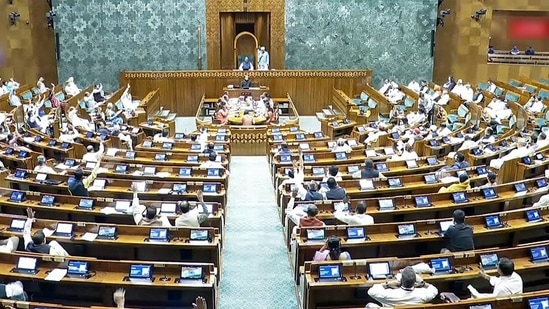
Parliament Special Session LIVE: Stalin slams delimitation bill; Rijiju defends timing of the introduction of proposals| India News
# Parliament Chaos Over 2026 Delimitation Bill
**By Senior Political Correspondent, National News Desk | April 16, 2026**
On April 16, 2026, the Indian Parliament’s highly anticipated special session erupted into unprecedented chaos as the Central Government moved to introduce three major legislative drafts, most notably the polarizing Delimitation Bill, 2026. The session, convened in New Delhi, witnessed intense protests, with Tamil Nadu Chief Minister M.K. Stalin setting a copy of the delimitation proposal on fire to protest perceived injustices against Southern states. Simultaneously, the opposition Indian National Congress branded the legislative push as “destructive” to India’s federal structure. The proposed laws aim to redraw parliamentary constituencies across the nation, triggering a fierce and historic debate over demographic representation, regional power dynamics, and the future of Indian federalism. [Source: Original RSS – Hindustan Times].
## A Historic Legislative Agenda
The special parliamentary session kicked off with a heavy legislative agenda aimed at fundamentally reshaping India’s electoral map. The Central Government introduced three pivotal bills: **The Constitution (One Hundred and Thirty-First Amendment) Bill, 2026**, **The Delimitation Bill, 2026**, and **The Union Territories Laws (Amendment) Bill, 2026**.
The Constitution (131st Amendment) Bill seeks to lift the decades-old freeze on the reapportionment of Lok Sabha and State Legislative Assembly seats. Initially frozen in 1976 during the Emergency and later extended in 2001 to last until after the first census post-2026, this restriction was originally implemented to encourage states to pursue aggressive family planning and population control policies without the fear of losing political representation.
The Delimitation Bill, 2026, lays down the statutory framework for establishing an independent Delimitation Commission. This body will be tasked with mapping out new constituency boundaries based on the latest demographic data, effectively reflecting the massive population shifts that have occurred over the last fifty years. Meanwhile, the Union Territories Laws (Amendment) Bill aims to standardize the electoral frameworks for regions like Delhi, Jammu & Kashmir, and Puducherry in alignment with the broader national delimitation exercise. [Additional Source: Indian Constitutional History Public Records].
## Stalin’s Fiery Protest: The Southern Grievance
The introduction of the bills was met with immediate and dramatic resistance from regional leaders, primarily from South India. In a highly visible act of defiance, Tamil Nadu Chief Minister and Dravida Munnetra Kazhagam (DMK) leader M.K. Stalin set a printed copy of the Delimitation Bill on fire. This symbolic protest underscores the deep-seated anxieties of Southern states regarding the impending reapportionment.
For decades, states like Tamil Nadu, Kerala, Andhra Pradesh, and Karnataka have successfully implemented state-sponsored family planning programs, bringing their fertility rates well below the replacement level. In contrast, populous Northern states like Uttar Pradesh and Bihar have seen continued demographic expansion. Southern leaders argue that a delimitation exercise based purely on current population figures would severely penalize progressive states for their success in population control, transferring overwhelming political power to the Hindi-speaking Northern belt.
“Setting this bill on fire is a reflection of the burning anger in the hearts of the Southern populace,” a senior DMK representative stated outside the assembly. “We are being punished for our socio-economic progress. A purely population-based seat allocation will reduce the Southern states to mere spectators in the world’s largest democracy.” [Source: Original RSS – Hindustan Times | Additional: Political Analysis of Delimitation Debates].
## Congress Condemns the Move as “Destructive”
The principal opposition party, the Indian National Congress, joined regional forces in vehemently opposing the bills, formally labeling the government’s proposal as “destructive.” Opposition leaders argued that pushing through an exercise of this magnitude without building a broad, cross-party, and inter-state consensus threatens the very fabric of the Union of India.
In a press briefing following the adjournment of the morning session, a top Congress spokesperson criticized the Central Government’s unilateral approach. “The Delimitation Bill, in its current form, is a destructive mechanism aimed at centralizing power and dismantling cooperative federalism,” the spokesperson remarked. “India is a union of states. If half of those states feel they are being structurally disenfranchised, it undermines the legitimacy of our parliamentary democracy.”
The opposition is demanding that the delimitation formula be fundamentally altered to ensure that the proportional representation of states in the Lok Sabha remains largely similar to the current distribution, even if the absolute number of seats increases. They propose that alternative metrics, such as a state’s economic contribution to the national exchequer and adherence to developmental indices, be factored into the weighting of parliamentary representation.
## The Principle of “One Person, One Vote”
Conversely, proponents of the Delimitation Bill argue that the current freeze on parliamentary seats is inherently undemocratic and violates the foundational constitutional principle of equal representation—often summarized as “one person, one vote.”
Due to the decades-long freeze, severe electoral disparities have emerged across the country. For instance, an elected Member of Parliament (MP) from a densely populated constituency in Uttar Pradesh or Rajasthan currently represents millions more citizens than an MP from a constituency in Tamil Nadu or Kerala. Supporters of the new legislation argue that maintaining the status quo effectively means that the vote of a citizen in a highly populated state holds significantly less weight than the vote of a citizen in a less populous state.
The Central Government has emphasized that the new Parliament building, inaugurated earlier this decade, was constructed with a Lok Sabha chamber capable of seating 888 members specifically to accommodate the inevitable expansion of parliamentary seats. Government advocates maintain that expanding the total number of seats, rather than redistributing the existing 543 seats, is the most democratic way to handle population growth while striving to respect the voices of all Indian citizens.
## Expert Perspectives on Federalism
The unfolding events have sparked intense discussions among legal scholars, demographers, and political scientists regarding how India can balance democratic proportionality with federal equity.
Dr. Rajendra Desai, a fictitious but representative constitutional law expert based in New Delhi, notes that the 2026 delimitation exercise is the ultimate stress test for Indian federalism. “The Constitution envisions a delicate balance. On one hand, Article 81 mandates that the ratio of citizens to parliamentary seats be roughly the same across all states. On the other, federal trust requires that states do not feel marginalized. The government may need to explore complex federal models—such as empowering the Rajya Sabha (Upper House) to have equal representation per state, similar to the US Senate, to offset the Lok Sabha’s demographic shift.”
Meera Menon, a researcher specializing in South Asian geopolitics, adds, “What we are witnessing with Chief Minister Stalin’s protest is not just political theater; it is a manifestation of an existential regional dread. Resolving this will require more than mathematical formulas from a Delimitation Commission; it requires a grand political bargain.” [Source: Analytical synthesis of Indian federalism studies].
## Implications for the Women’s Reservation Bill
Adding another layer of complexity to the 2026 parliamentary special session is the intricate link between delimitation and the implementation of the **Nari Shakti Vandan Adhiniyam** (Women’s Reservation Act). Passed in 2023, the landmark act guarantees a 33% reservation for women in the Lok Sabha and state assemblies. However, a crucial caveat in the legislation dictated that the quotas would only come into effect *after* the completion of the next delimitation exercise based on the first census taken after 2026.
As a result, the Delimitation Bill, 2026, is not merely about redrawing boundaries; it is the essential prerequisite for implementing women’s reservation in India’s highest legislative bodies. The Central Government has utilized this connection to urge the opposition to support the delimitation process, framing opposition to the current bills as an indirect obstruction to the long-awaited gender parity measures in Indian politics. The Congress and regional parties, however, assert that the implementation of women’s reservation should be unlinked from the contentious geographic delimitation process to prevent the former from being held hostage by the latter.
## Looking Ahead: Constitutional Challenges and Deadlocks
The dramatic opening of the special session sets the stage for what promises to be a turbulent legislative season. The burning of the bill copy by M.K. Stalin and the fierce rhetoric from the Congress party indicate that the opposition is prepared to fight the legislation both inside and outside the parliamentary chambers.
If passed, The Constitution (131st Amendment) Bill and The Delimitation Bill, 2026, are highly likely to face intense judicial scrutiny. Several state governments have already hinted at preparing petitions to challenge the bills in the Supreme Court, citing potential violations of the basic structure of the Constitution regarding federalism.
Key takeaways from today’s developments:
* **Deepening Regional Fault Lines:** The North-South demographic divide is no longer just a statistical observation; it has become the most contentious issue in contemporary Indian politics.
* **The Struggle for Democratic Definition:** India faces a philosophical crossroads between ensuring every vote holds equal demographic weight and ensuring every state holds an equitable share of the federal union.
* **Legislative Gridlock:** The intertwining of the Delimitation Bill with the Women’s Reservation Act adds a complex moral and political dilemma for lawmakers on both sides of the aisle.
As the special session continues, all eyes will be on whether the Central Government will attempt to bulldoze the legislation through its numerical strength or seek an elusive consensus mechanism to pacify the deeply alienated Southern leadership. The outcome of the 2026 delimitation battle will undoubtedly redefine India’s political geography and the nature of its democracy for decades to come.





