
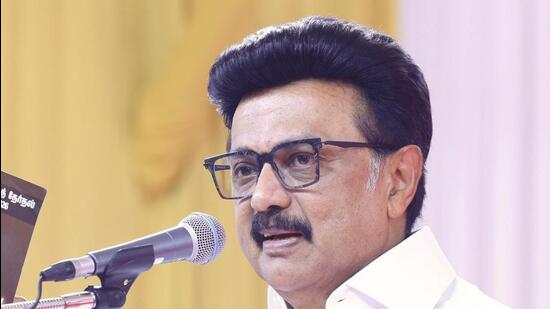
Delimitation Bill they have tabled is nothing short of complete deception: MK Stalin| India News
# Stalin Calls Delimitation Bill ‘Deception’
**By Special Political Correspondent | National Desk**
**Published: April 17, 2026**
Tamil Nadu Chief Minister MK Stalin launched a scathing attack on the Union government this Friday, demanding the immediate and total withdrawal of the newly tabled Delimitation Bill. Calling the proposed legislation “nothing short of complete deception,” Stalin warned the Centre against rushing the sensitive bill through Parliament in undue “haste.” At the heart of this escalating political confrontation is a deep-seated apprehension among southern Indian states that the impending redrawing of electoral boundaries will severely penalize them for successfully implementing national family planning policies, effectively diminishing their political voice and representation in the Lok Sabha [Source: Hindustan Times].
## The Core of the Regional Conflict
The introduction of the Delimitation Bill marks a watershed moment in India’s constitutional history, triggering what could become the most significant federal crisis in decades. For months, political leaders from Tamil Nadu, Kerala, Karnataka, and Andhra Pradesh have expressed profound anxiety over the lifting of the freeze on Lok Sabha seat allocation, which was constitutionally paused until after the first census following the year 2026.
Chief Minister Stalin’s fierce reaction underscores the growing mistrust between the southern states and the Union government. According to his official statement, the tabled bill is deceptive because it ostensibly promises a fair redrawing of boundaries while fundamentally relying on recent population metrics that inherently favor the densely populated, slower-developing northern states.
“The Delimitation Bill they have tabled is nothing short of complete deception,” Stalin stated vehemently. “It is an orchestrated attempt to silence the progressive states of India. We urge that the bill must not be rushed through in haste and the Union government must withdraw it in full.” [Source: Original RSS | Hindustan Times].
## The “Population Penalty” and Constitutional History
To understand the gravity of Stalin’s opposition, one must look at the constitutional mechanics of India’s electoral representation. Article 81 of the Indian Constitution mandates that the allocation of Lok Sabha seats among states should be proportionate to their respective populations. However, during the Emergency in 1976, the 42nd Amendment froze this allocation based on the 1971 Census. This freeze was extended for another 25 years in 2001 via the 84th Amendment, explicitly to ensure that states actively pursuing population control measures were not politically disadvantaged.
With the freeze officially expiring after 2026, the Union government is constitutionally obligated to conduct a delimitation exercise based on the latest census data. However, the demographic landscape of India has drastically bifurcated over the last fifty years. States like Tamil Nadu and Kerala achieved replacement-level fertility rates decades ago, while states like Uttar Pradesh and Bihar continued to see massive population expansions.
If seats are reallocated purely on current population metrics, the southern states face a severe reduction in their percentage share of Parliament, a phenomenon critics have dubbed the “population penalty.”
## Demographic Divergence: The Data
The crux of the southern political anxiety is rooted in hard mathematical realities. If the total number of Lok Sabha seats is expanded and reapportioned according to projected post-2026 population data, the balance of power shifts overwhelmingly to the Hindi heartland.
**Projected Impact of Population-Based Delimitation (Estimates based on demographic models):**
| State | Current Lok Sabha Seats | Projected Seats (Unadjusted) | Net Impact on Influence |
| :— | :— | :— | :— |
| **Uttar Pradesh** | 80 | ~105 – 110 | Massive Increase |
| **Bihar** | 40 | ~55 – 60 | Significant Increase |
| **Tamil Nadu** | 39 | ~39 – 40 | Relative Stagnation/Loss of Share |
| **Kerala** | 20 | ~18 – 20 | Marginal Loss/Loss of Share |
| **Andhra Pradesh** | 25 | ~25 – 26 | Relative Stagnation |
*Note: Data reflects independent demographic projections based on census growth rates [Additional Source: Demographic and Political Research Data up to 2026].*
As the table illustrates, while Tamil Nadu might not lose absolute numbers if the overall size of the Parliament is increased, its *proportional influence* in passing laws, forming governments, and directing national policy will be drastically reduced.
## The Union Government’s Defense
Supporters of the newly tabled Delimitation Bill argue that the legislation is a necessary step to restore the core democratic principle of “One Citizen, One Vote.” Currently, an elected Member of Parliament (MP) in Tamil Nadu represents significantly fewer voters than an MP in Rajasthan or Uttar Pradesh.
“You cannot have a democratic republic where the vote of a citizen in the north is worth statistically less than the vote of a citizen in the south,” notes Dr. Raghavendra Singh, an independent constitutional expert based in New Delhi. “The Union government is fulfilling a constitutional mandate. Freezing political representation in perpetuity creates a severe democratic deficit. The bill attempts to rationalize constituency sizes so that representation is truly equal.”
However, critics like Stalin argue that this purely numerical approach ignores the federal nature of India. By enforcing this bill, the Centre is effectively signaling that states that adhered to national policies for socio-economic development are now being punished for their efficiency.
## The Economic Asymmetry: Taxes vs. Representation
The delimitation debate cannot be divorced from the ongoing friction over fiscal federalism. The southern states have consistently pointed out the growing disparity between their economic contributions to the Union exchequer and the financial returns they receive.
Tamil Nadu, Karnataka, and Maharashtra are massive net contributors to India’s Gross Domestic Product (GDP) and direct tax collections. Conversely, states with booming populations in the north are net recipients of central tax devolution.
Dr. Meenakshi Sundaram, a political economist at the Center for Regional Studies, explains the volatile nature of this intersection: “When you combine the Finance Commission’s tax devolution formulas, which reward population, with a Delimitation Bill that rewards population with political power, you are pushing the southern states into a corner. They are effectively being told: ‘You will fund the nation’s growth, but you will have a shrinking say in how the nation is governed.’ This is precisely why MK Stalin is using the term ‘deception’.”
By calling the bill a deception, Stalin is likely pointing to back-channel assurances previously given by Union ministers that southern representation would be protected—assurances that regional leaders feel are absent or diluted in the actual text of the tabled legislation.
## Forging a Southern Block and Future Legal Battles
Stalin’s demand for a complete withdrawal of the bill is not isolated. In recent weeks, leaders from across the political spectrum in the south have echoed similar sentiments, hinting at the formation of a unified political bloc to resist the legislation.
If the Union government decides to push the bill through both houses of Parliament, relying on its numerical strength, the battlefield will inevitably shift from the legislature to the judiciary. Legal experts predict that the passage of this bill will result in an immediate barrage of Article 32 petitions in the Supreme Court of India.
The legal arguments will likely center around the “Basic Structure Doctrine” of the Indian Constitution, specifically questioning whether drastically altering the federal balance of power violates the foundational principles of Indian federalism.
“The Supreme Court will have to navigate a complex tightrope,” asserts legal analyst Promila Krishnan. “It must balance Article 81, which demands population-based representation, against the broader federal structure that prevents the political obliteration of highly developed states. Stalin’s aggressive posturing today is the first salvo in what will be a defining constitutional war.”
## Conclusion: A Test of India’s Federal Unity
Tamil Nadu Chief Minister MK Stalin’s forceful denunciation of the Delimitation Bill sets the stage for a turbulent parliamentary session. His use of words like “deception” and “haste” highlights the profound existential threat perceived by the southern states.
**Key Takeaways:**
1. **Fierce Regional Pushback:** Tamil Nadu is leading the charge against the Delimitation Bill, demanding full withdrawal due to fears of losing political agency.
2. **The Federal Dilemma:** The crisis pits the democratic ideal of “One Citizen, One Vote” against the federal ideal of equitable regional representation.
3. **Economic Overtones:** The political dispute is deeply intertwined with economic grievances, as higher-contributing states face diminishing parliamentary influence.
4. **Impending Legal Scrutiny:** If passed, the legislation will face severe constitutional challenges at the Supreme Court level regarding the sanctity of federalism.
As the Union government attempts to navigate the post-2026 constitutional requirements, the manner in which it handles the legitimate grievances of states like Tamil Nadu will determine the future stability of India’s federal structure. Rushing a bill of such monumental consequence without consensus, as Stalin warns, risks fracturing the very political unity that binds the diverse linguistic and cultural geographies of the nation.





