
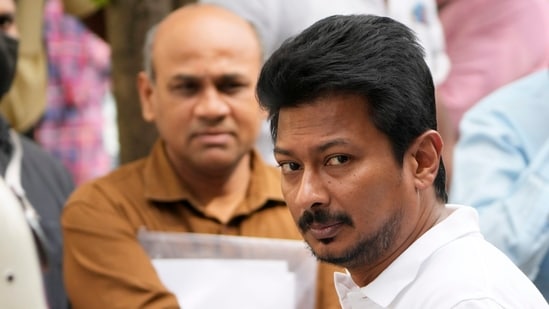
From actor to TN DCM: the rise of Udhayanidhi Stalin as a third-generation political leader in the DMK
# Rise of Udhayanidhi Stalin: 5 Key Facts
By Political Correspondent, National News Desk | April 17, 2026
Udhayanidhi Stalin stands at the forefront of Tamil Nadu politics as the Deputy Chief Minister, marking a meteoric shift from cinema to statecraft. Representing the third generation of the Dravida Munnetra Kazhagam (DMK) dynasty, the 48-year-old leader has transformed from a prominent film producer and actor to the political heir apparent of Chief Minister M.K. Stalin. Elevated to the role of Deputy Chief Minister, his rapid evolution underscores a strategic generational shift within the ruling party. As Tamil Nadu navigates an increasingly competitive political landscape ahead of the highly anticipated 2026 state assembly elections, understanding Udhayanidhi’s journey is crucial to decoding the future of Dravidian politics.
[Source: Hindustan Times | Additional: Public Electoral Records]
## Fact 1: A Calculated Transition from Cinema to Politics
Tamil Nadu possesses a long, storied history of the silver screen acting as a springboard for political power, from C.N. Annadurai and M. Karunanidhi to M.G. Ramachandran and J. Jayalalithaa. Udhayanidhi Stalin’s trajectory honors this regional tradition, albeit with a modern corporate approach.
Before donning the traditional white shirt and dhoti of a politician, Udhayanidhi was a powerhouse in the Kollywood film industry. In 2008, he founded **Red Giant Movies**, a production and distribution company that quickly became one of the most influential banners in the South Indian film industry. He made his acting debut in the 2012 hit romantic comedy *Oru Kal Oru Kannadi*, establishing a strong connection with the younger demographic.
Unlike the larger-than-life action heroes of Tamil cinema, Udhayanidhi carefully curated a relatable, “boy-next-door” on-screen persona. This approachability seamlessly translated into his early political campaigns. While critics often dismissed him merely as a celebrity riding his family’s coattails, his background in mass media provided him with an intuitive understanding of public relations, optics, and grassroots messaging—skills that have heavily influenced the DMK’s recent election strategies.
## Fact 2: Inheriting the Youth Wing Legacy
The structural turning point in Udhayanidhi’s political career occurred in July 2019, when he was appointed the **Secretary of the DMK Youth Wing**. This was no ordinary party post. It was the exact position his father, M.K. Stalin, held for roughly 35 years—a role Stalin used to meticulously build a loyal cadre base that eventually propelled him to the Chief Minister’s office.
By taking over the Youth Wing, Udhayanidhi was formally anointed as the political successor within the party ranks. He immediately initiated a massive membership drive aimed at revitalizing the party’s grassroots appeal among millennials and Gen Z voters. His tenure as Youth Wing Secretary focused on modernizing the party’s digital footprint and establishing a robust social media presence to counter opposition narratives.
“The appointment to the Youth Wing was the DMK’s formal declaration of succession,” notes Dr. V. Suryanarayan, a Chennai-based political analyst. “However, Udhayanidhi recognized that relying on lineage was not enough in the age of digital scrutiny. He had to demonstrate organizational capability, which he did by restructuring the youth cadres across all districts.”
[Source: Hindustan Times | Additional: Regional Political Analysis]
## Fact 3: The AIIMS Brick Campaign and Electoral Debut
Udhayanidhi’s true political baptism came during the 2019 Lok Sabha elections and the subsequent 2021 Tamil Nadu Legislative Assembly elections. It was during the 2021 campaign that he introduced one of the most memorable political props in recent Indian electoral history: **a single brick bearing the acronym ‘AIIMS’.**
During his rallies, he would hold up the brick to highlight the prolonged delay by the central government in constructing the All India Institute of Medical Sciences (AIIMS) in Madurai, a project announced years earlier but left unbuilt. The visual resonated powerfully with the electorate, symbolizing the DMK’s broader narrative of regional neglect by the national ruling party.
In May 2021, Udhayanidhi made his electoral debut, winning the **Chepauk-Thiruvallikeni assembly constituency** by a massive margin of over 69,000 votes. This constituency holds profound symbolic value, as it was previously represented by his grandfather, the late DMK patriarch M. Karunanidhi. Winning this seat effectively cemented his legitimacy among the party’s old guard while establishing his own electoral mandate.
### Timeline of Political Ascension
To understand the rapid speed of his rise compared to his father’s decades-long wait, consider the following milestones:
| Year | Milestone Reached | Significance |
| :— | :— | :— |
| **2019** | Appointed DMK Youth Wing Secretary | Formal entry into party leadership structure. |
| **2021** | Elected MLA from Chepauk-Thiruvallikeni | First direct electoral victory. |
| **2022** | Inducted as State Cabinet Minister | Handed the crucial Sports & Youth Welfare portfolios. |
| **2024** | Elevated to Deputy Chief Minister | Solidified as the administrative and political second-in-command. |
| **2026** | DMK’s Lead Campaigner | Leading the charge for the upcoming State Assembly elections. |
## Fact 4: An Ideological Lightning Rod
While M.K. Stalin has largely maintained a balanced, centrist approach to governance—focusing on industrial investment and welfare—Udhayanidhi has positioned himself as an uncompromising ideological warrior for the Dravidian movement. This has made him a lightning rod for both fierce loyalty and intense national controversy.
The most defining moment of his ideological assertiveness occurred in September 2023, when he made remarks equating “Sanatana Dharma” (orthodox Hindu traditions) to diseases like dengue and malaria, arguing it was fundamentally rooted in the caste system and social inequality.
The comments sparked a massive national firestorm. The Bharatiya Janata Party (BJP) and various right-wing organizations accused him of anti-Hindu bigotry, filing multiple legal cases across different states. Nationally, the controversy created friction within the opposition INDIA bloc, forcing several allied parties to distance themselves.
However, within the geopolitical borders of Tamil Nadu, the stance was a calculated success. It deeply energized the core Dravidian voter base, reaffirming the DMK’s historical commitment to rationalism, anti-caste ideology, and social justice. “Udhayanidhi’s rhetoric is deliberately designed to draw ideological lines,” explains sociologist Dr. K. R. Meenakshi. “He absorbs the national backlash to consolidate regional dominance, proving to his base that he is unafraid to champion the foundational principles of Periyar.”
[Source: Hindustan Times | Additional: Historical Dravidian Context]
## Fact 5: Administrative Acumen and the 2026 Challenge
Critics of dynastic politics often point to a lack of administrative experience among inheritors. To counter this, Udhayanidhi has utilized his tenure as the Minister for Youth Welfare and Sports Development to build an administrative track record.
Under his leadership, Tamil Nadu successfully hosted several high-profile sporting events, including the Khelo India Youth Games and the Asian Champions Trophy for hockey. He has spearheaded initiatives to build mini-stadiums in every assembly constituency, blending youth outreach with infrastructure development. Furthermore, his active, on-ground involvement during crisis management—such as the Chennai floods caused by Cyclone Michaung in late 2023—earned him grudging respect from bureaucratic circles.
As the state moves toward the 2026 Assembly elections, Udhayanidhi’s role as Deputy Chief Minister places him at the very helm of the DMK’s electoral machinery. The political battlefield of 2026 presents unique challenges. He must navigate a multifaceted opposition: a revitalized AIADMK seeking a comeback, an aggressive BJP attempting to breach the Dravidian fortress, and the entry of popular actor Vijay’s newly formed political party, Tamilaga Vettri Kazhagam (TVK), which actively targets the same youth demographic Udhayanidhi commands.
## Conclusion: The Burden of Legacy
Udhayanidhi Stalin’s journey from a film producer to the Deputy Chief Minister of Tamil Nadu is a testament to the evolving nature of dynastic politics in India—where lineage provides the platform, but survival requires continuous political adaptation.
The five facts of his rise highlight a leader who has learned to leverage his cinematic background, embrace his grandfather’s ideological legacy, and accelerate through the ranks much faster than his father did. However, the ultimate test of his leadership lies ahead. While his rapid ascent has been heavily supported by the party infrastructure built by his predecessors, the 2026 elections will require him to prove that he can secure a mandate on his own merit.
Whether he can successfully balance the administrative demands of a heavily industrialized state with the ideological expectations of the Dravidian movement will determine not just his political future, but the future of Tamil Nadu politics for the next decade.
***
*Disclaimer: This article provides a journalistic analysis of political events and figures based on public records, historical context, and reported facts up to April 2026. The perspectives shared by analysts are representative of the broader political discourse.*





