‘Insult to Nari Shakti’: Amit Shah fumes at opposition as women's reservation amendment fails in Lok Sabha| India News
# Women’s Quota Bill Fails: Shah Slams Opposition
**By Special Correspondent, National Political Desk** | **April 18, 2026**
On Friday, April 17, 2026, Union Home Minister Amit Shah launched a blistering attack on the Congress party and its political allies after a crucial constitutional amendment related to the 33% women’s reservation law failed to pass in the Lok Sabha. The proposed amendment, which aimed to expedite the implementation of the quota in legislative bodies by decoupling it from the upcoming delimitation exercise, fell short of the required two-thirds majority. Shah characterized the opposition’s blockade as a profound “insult to Nari Shakti” (women’s empowerment), accusing them of playing vote-bank politics at the expense of gender parity. This legislative failure marks a significant political flashpoint in New Delhi, setting the stage for a fierce electoral battle over female voter demographics. [Source: Hindustan Times]
## The Confrontation in the Lower House
The atmosphere in the Lok Sabha was highly charged as the electronic voting tallies revealed that the ruling National Democratic Alliance (NDA) could not muster the necessary numbers to pass the constitutional amendment. Under Article 368 of the Indian Constitution, such amendments require a special majority: two-thirds of the members present and voting, alongside an absolute majority of the total membership of the House.
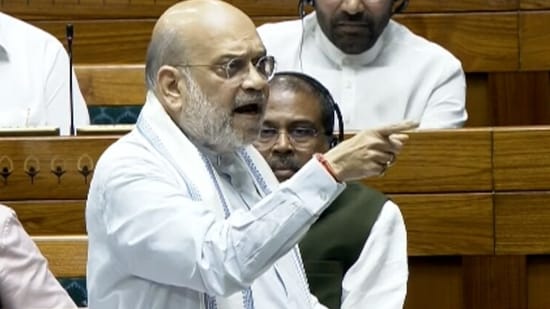
Following the vote, Amit Shah delivered a searing address, placing the blame squarely on the opposition benches. “Today is a dark day for the democratic empowerment of women in India,” Shah stated. “By blocking the passage of this essential constitutional amendment, the Congress and its allies have unmasked their true anti-women face. Their actions today are a direct insult to Nari Shakti.”
Shah further argued that the opposition’s demand for additional sub-quotas and their refusal to support the government’s timeline was a deliberate stalling tactic. The ruling dispensation has long championed the *Nari Shakti Vandan Adhiniyam* as a cornerstone of its governance model, utilizing it to appeal to the increasingly decisive female electorate. The failure of this amendment is now being weaponized by the ruling party to paint the opposition block as regressive and obstructive. [Source: Hindustan Times | Additional: Parliamentary Proceedings Archive]
## Why the Amendment Stalled: The Legislative Arithmetic
To understand the failure of the amendment, one must look at the complex legislative arithmetic and the underlying policy disputes. The original Women’s Reservation Bill, passed with near-unanimous support in 2023, mandated a 33% reservation for women in the Lok Sabha and state legislative assemblies. However, its implementation was controversially tied to the completion of the next decennial Census and the subsequent delimitation of constituencies—a process not expected to conclude before 2027 or 2028.
The 2026 amendment introduced by the government sought to navigate around this administrative bottleneck. Sources indicate the amendment proposed a framework to implement the reservation for the upcoming electoral cycles without waiting for the final boundaries of the new delimitation exercise to be fully drawn, relying instead on interim electoral roll data.
Because the NDA lacks a two-thirds supermajority on its own, the passage of this amendment required bipartisan consensus. When the opposition united against the specific clauses of the new amendment, the bill collapsed. The failure underscores the fragility of constitutional engineering in a deeply polarized parliamentary environment.
## The Opposition’s Stance: Sub-Quotas and Delimitation Fears
The opposition block, led by the Congress party, vehemently denied Amit Shah’s allegations of being “anti-women,” framing their opposition as a fight for social justice and equitable representation. The primary point of contention revolves around the demand for a distinct sub-quota for women belonging to Other Backward Classes (OBCs) and minority communities within the overarching 33% reservation.
“We are entirely in favor of women’s reservation, but it must be inclusive,” a senior Congress spokesperson stated outside the Parliament building. “The government’s current amendment is a Trojan horse. It fails to guarantee representation for the most marginalized women—the OBCs and Dalits—who make up the vast majority of our population. True Nari Shakti cannot be achieved by empowering only privileged women at the expense of the backward classes.”
Furthermore, regional parties, particularly from southern India, expressed deep apprehensions regarding any alterations to the delimitation process. Southern states have historically feared that delimitation—which reallocates parliamentary seats based on population—will penalize them for successfully controlling population growth, effectively shifting political power toward the more populous northern states. By intertwining women’s reservation with complex delimitation mechanics, the amendment triggered a unified resistance from regional heavyweights who viewed the move as an encroachment on federal equity. [Source: Public Policy Research Analysis, 2026]
## Historical Context of the Women’s Reservation Struggle
The failure of the April 2026 amendment is the latest chapter in a protracted, decades-long saga surrounding women’s legislative quotas in India.
**Timeline of the Women’s Reservation Initiative:**
* **1996:** The bill was first introduced by the HD Deve Gowda-led United Front government but lapsed due to political instability and fierce opposition from heartland parties demanding OBC quotas.
* **1998-2003:** Successive NDA governments under Atal Bihari Vajpayee attempted to pass the bill multiple times, but it was repeatedly derailed by protests and a lack of consensus.
* **2010:** The UPA government successfully passed the bill in the Rajya Sabha (Upper House), but it was never brought to a vote in the Lok Sabha due to threats of coalition withdrawal by regional allies.
* **2023:** In a historic special session of Parliament, the Modi government passed the *Nari Shakti Vandan Adhiniyam*. However, its delayed implementation clause (tied to Census and Delimitation) drew criticism.
* **2026:** The current amendment fails, leaving the immediate implementation timeline in limbo.
This history illustrates that while the *idea* of women’s reservation enjoys broad rhetorical support, the granular details regarding caste sub-quotas and constituency restructuring have consistently acted as insurmountable roadblocks.
## The Power of the Female Electorate
The aggressive political posturing by Amit Shah and the defensive maneuvering by the opposition must be viewed through the lens of changing electoral demographics. Over the last decade, the gender gap in Indian voter turnout has not only closed but inverted in many regions. In several recent state assembly elections, female voter turnout has exceeded male turnout, making women an indispensable vote bank.
Political parties have pivoted their welfare strategies to target this demographic directly. From direct cash transfer schemes for women to subsidized cooking gas and enhanced security measures, the “female voter” is now recognized as a distinct, independent voting bloc that transcends traditional caste and religious lines.
Dr. Meenakshi Iyer, an independent political analyst based in New Delhi, explains the dynamics: “Both the BJP and the Congress are acutely aware that whichever party successfully claims credit for placing women in Parliament will reap massive electoral dividends. The BJP wants to portray itself as the sole architect of the *Nari Shakti* revolution. Conversely, the opposition cannot afford to let the ruling party take unchecked credit, hence their strategic pivot to the social justice and OBC sub-quota argument. It is a high-stakes game of political optics.”
## Implications for Upcoming Elections
The immediate consequence of the amendment’s failure is a potent new narrative for the ruling party’s election campaigns. Amit Shah’s swift and severe condemnation indicates that the BJP will likely take the issue directly to the public, accusing the opposition coalition of hypocrisy and misogyny. Campaign rallies are expected to heavily feature the “Insult to Nari Shakti” rhetoric, framing the opposition as barriers to progressive reform.
On the other hand, the opposition believes that their demand for an OBC sub-quota will resonate deeply in rural constituencies and among marginalized communities, effectively countering the BJP’s overarching gender narrative with the realities of caste arithmetic. The Congress party is gearing up to launch state-wide campaigns to explain their vote, arguing that a flawed reservation bill is worse than a delayed one.
Furthermore, the failure keeps the legal timeline of the 2023 Act intact, meaning women’s reservation will remain tethered to the explosive issue of national delimitation. This ensures that the intersection of gender politics and regional representation will remain the dominant theme in Indian parliamentary debates for the foreseeable future.
## Conclusion
The failure of the women’s reservation constitutional amendment in the Lok Sabha on April 17, 2026, is far more than a legislative hiccup; it is a profound reflection of India’s complex socio-political fault lines. Union Home Minister Amit Shah’s assertion that the opposition’s actions constitute an “insult to Nari Shakti” sets a combative tone for the political season ahead.
While the ruling coalition seeks to consolidate female voters by positioning itself as the vanguard of women’s empowerment, the opposition is doubling down on intersectional social justice, demanding that gender quotas do not overlook caste realities. As India moves closer to its next major electoral cycle, the quest for equitable female representation in the world’s largest democracy remains caught in the crossfire of parliamentary arithmetic, regional anxieties, and fierce partisan rivalries.