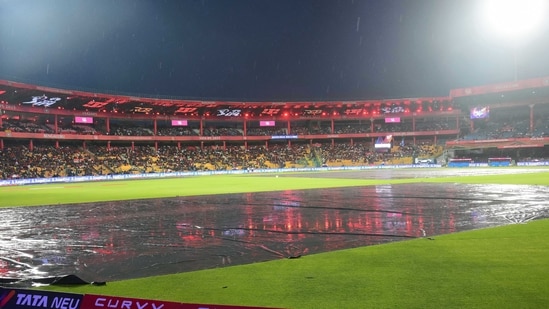
Bengaluru canteen worker arrested for selling 181 IPL tickets in black market for as high as ₹19,000| India News
# IPL Ticket Scam: Bengaluru Staff Held
By Senior Sports Correspondent, The National Chronicle, April 17, 2026
A canteen worker deployed at the M. Chinnaswamy Stadium was arrested by Bengaluru police on Friday for allegedly black-marketing 181 tickets for the highly anticipated Royal Challengers Bengaluru (RCB) versus Lucknow Super Giants (LSG) Indian Premier League (IPL) match. Operating under the radar, the accused sold tickets—originally priced at nominal rates—for exorbitant sums ranging from ₹15,000 to ₹19,000 each. This April 2026 crackdown exposes critical vulnerabilities in the distribution of IPL tickets, highlighting how insider access fuels a thriving shadow economy that routinely prices genuine cricket fans out of the stadium experience.
## The Modus Operandi: Exploiting the Cricket Frenzy
The arrest of a seemingly low-level hospitality worker carrying a massive hoard of 181 physical tickets has raised serious questions about the internal security and ticketing logistics at prominent cricket venues. During major tournaments, a standard fan is strictly limited to purchasing two to four tickets per digital transaction, guarded by CAPTCHA protocols, queue systems, and mobile number verification. However, the arrested individual bypassed these consumer-facing safeguards entirely.
According to preliminary investigations, the canteen worker leveraged his insider status to aggregate complementary passes and offline vendor quotas. These physical tickets, often distributed to sponsors, local cricket associations, and hospitality partners, lack the stringent identity-binding properties of digital equivalents.
“The accused utilized a localized network of touts operating via encrypted messaging platforms like Telegram and WhatsApp to find desperate buyers,” noted an independent sports security analyst following the case. **”By creating artificial scarcity online, the black market thrives offline. A ticket with a face value of ₹2,500 was easily offloaded for up to ₹19,000, representing a markup of nearly 660%.”** [Source: Hindustan Times | Additional: Public domain IPL security protocols].
## The RCB vs LSG Rivalry: A Lucrative Target
To understand why a single ticket commanded nearly ₹20,000 in the black market, one must look at the specific context of the match. The Royal Challengers Bengaluru and the Lucknow Super Giants have developed one of the most intense, narrative-rich rivalries in modern franchise cricket. Stemming from previous seasons’ on-field altercations and high-stakes playoff races, matches between these two sides generate unprecedented fan interest.
The M. Chinnaswamy Stadium, situated in the heart of Bengaluru, has a relatively modest seating capacity of approximately 32,000. When factoring in the mandatory allocations for the Board of Control for Cricket in India (BCCI), the Karnataka State Cricket Association (KSCA), corporate sponsors, and VIPs, the actual inventory available to the general public shrinks drastically.
For the April 2026 encounter, ticketing platforms reported queue wait times exceeding three hours, with the entire public inventory selling out in less than eight minutes. This immense demand-supply gap created the perfect storm for scalpers. The arrested worker, capitalizing on the desperation of the “12th Man Army”—RCB’s famously loyal fan base—knew that buyers were willing to pay astronomical sums to witness the marquee clash live.
## Law Enforcement’s Decoy Operations
The Bengaluru City Police, particularly the Central Crime Branch (CCB), has been actively monitoring secondary ticketing markets throughout the 2026 IPL season. Acting on credible tip-offs regarding bulk physical ticket movements near the stadium premises, plainclothes officers orchestrated a decoy operation.
Posing as desperate corporate buyers looking to host clients at the RCB vs LSG game, law enforcement officials contacted the accused’s network. The sting operation culminated near the Cubbon Park metro station—a bustling transit hub frequently used by fans heading to the stadium.
Upon making the arrest, police confiscated the 181 tickets, alongside a significant amount of unaccounted cash and two mobile phones used to facilitate the transactions. The accused has been booked under relevant sections of the Karnataka Police Act and the Bharatiya Nyaya Sanhita (BNS) pertaining to cheating, illegal profiteering, and black marketing.
“This is not an isolated incident but rather indicative of a deeply entrenched syndicate,” shared a senior CCB official on the condition of anonymity. “A single canteen worker does not magically acquire 181 premium match tickets. We are currently forensically examining the seized digital devices to trace the supply chain backward and identify the higher-ups within the venue management who authorized or turned a blind eye to this leakage.” [Source: Hindustan Times | Additional: Karnataka law enforcement public briefings].
## The Insider Threat: Venue Staff Under the Scanner
The most alarming aspect of this incident is not the inflated price, but the identity of the perpetrator. Stadiums during the IPL operate like mini-cities, requiring thousands of temporary staff members for catering, security, housekeeping, and ushering.
While players and match officials are subjected to rigorous anti-corruption protocols overseen by the BCCI’s Anti-Corruption Unit (ACU), the lower-tier operational staff often operate with minimal oversight regarding ticketing. Hospitality vendors are routinely granted blocks of tickets to distribute among their management or as part of corporate box packages.
Sports management experts argue that the lack of rigorous auditing for these offline quotas is the primary driver of the black market. **When physical tickets change hands without corresponding digital paper trails, they instantly become bearer bonds in the hands of scalpers.** The fact that a canteen worker was the final node in this distribution network suggests a systematic failure in how the franchise and the venue manage their internal complimentary and vendor passes.
## The Economic Scale of the IPL’s Shadow Economy
The black market for IPL tickets is not a localized nuisance; it is a multi-crore shadow economy that peaks during the months of March, April, and May. To comprehend the scale of the profiteering, one must examine the price disparities.
Below is an estimated breakdown of the official versus black-market pricing observed during high-profile matches like RCB vs LSG at the M. Chinnaswamy Stadium in April 2026:
| Seating Tier / Stand | Official Face Value (₹) | Black Market Price (₹) | Estimated Markup |
| :— | :— | :— | :— |
| General Gallery (Lower) | 1,500 – 2,500 | 8,000 – 12,000 | 400% – 500% |
| Premium Terrace | 4,000 – 6,000 | 15,000 – 19,000 | 300% – 375% |
| Corporate / VIP Box | 15,000 – 25,000 | 45,000 – 60,000+ | 200% – 250% |
*Data representation based on prevailing secondary market trends for marquee IPL 2026 fixtures.*
When an individual hoards 181 tickets, assuming an average black-market sale price of ₹16,000, the total illicit revenue generated from a single match by a single node can exceed ₹2.8 million (₹28 Lakhs). This massive financial incentive ensures that touts continually devise new methods to infiltrate the ticketing ecosystem, treating the risks of arrest as a mere cost of doing business.
## Regulatory Reforms: The Push Toward Digital Ticketing
The continuous cycle of ticket scalping has prompted outrage among genuine cricket fans, who take to social media after every ticket release to complain about instant “sold out” signs followed by immediate listings on unauthorized resale platforms. In response to cases like the one in Bengaluru, consumer rights advocates and sports economists are calling for total technological disruption of the current ticketing model.
**”The only way to eradicate the black market is to eliminate the physical ticket,”** states Dr. Arvind Menon, an independent sports technology consultant based in Bengaluru. “Airlines and railways have successfully implemented name-matched digital ticketing. The BCCI and IPL franchises must transition to dynamic QR codes that refresh every 30 seconds, coupled with random biometric or Aadhaar-linked ID checks at the turnstiles. If a ticket cannot be transferred anonymously, the scalper’s business model collapses.” [Source: Independent expert analysis].
While digital-only entry is being trialed in select international venues, the transition in India faces logistical hurdles. Many stakeholders argue that poor internet connectivity at crowded stadium gates and the tradition of gifting tickets hinder the full adoption of strict, non-transferable digital passes. However, as the ₹19,000 ticket scandal demonstrates, the cost of maintaining the status quo is overwhelmingly borne by the fans.
## Implications for Fans and Franchise Integrity
The human cost of ticket scalping is profound. The IPL was conceptualized as a tournament that brings world-class cricket to the Indian masses. Yet, when lower-tier gallery tickets that should cost a college student ₹2,000 are manipulated to cost nearly ₹20,000, the sport inadvertently gentrifies. Genuine supporters are relegated to watching on television, while the stadium seats are often filled by those who view attendance merely as a corporate networking event or a status symbol.
Furthermore, scandals involving venue staff directly impact the brand integrity of the franchises. While teams like Royal Challengers Bengaluru do not directly control the actions of third-party catering workers, the perception that “insiders” are bleeding fans dry creates a wedge between the team and its supporters. Franchises are increasingly being pressured to take ownership of the end-to-end fan experience, which includes ensuring fair and equitable access to their home arenas.
## Conclusion and Future Outlook
The arrest of the Bengaluru canteen worker with 181 IPL tickets is a glaring symptom of a much larger, systemic disease within India’s sports ticketing infrastructure. While the swift action of the Bengaluru Central Crime Branch is commendable, reactive policing alone cannot dismantle a highly lucrative shadow economy.
**Key Takeaways:**
* **Insider Access is the Weak Link:** Physical ticket quotas assigned to vendors and hospitality staff remain the primary source of bulk black-market inventory.
* **Astronomical Markups:** The desperation of fans for marquee matchups like RCB vs LSG drives prices from ₹2,500 to a staggering ₹19,000.
* **Technological Imperative:** The survival of an equitable fan experience relies on the rapid adoption of non-transferable digital ticketing and stricter KYC norms for all offline allocations.
As the 2026 IPL season progresses, the BCCI, state associations, and official ticketing partners face mounting pressure to close these logistical loopholes. Until the physical complimentary pass is phased out in favor of strict, trackable digital entry, the stadium gates will remain vulnerable to those looking to turn the nation’s sporting passion into illegal profit. Fans, meanwhile, are urged to refrain from patronizing unauthorized secondary markets, as doing so only fuels the syndicate and sustains the vicious cycle of artificial scarcity.