
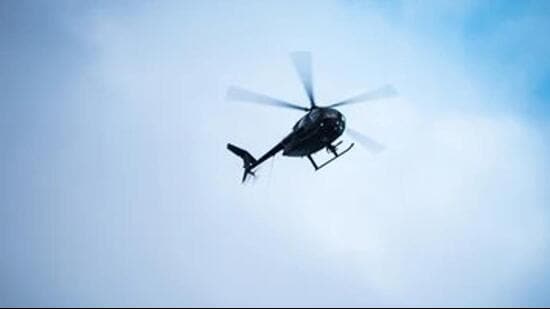
Probe ordered after Coast Guard chopper seen flying low over Sabarimala temple: Police| India News
# Sabarimala Chopper Flight Sparks Probe
By Staff Reporter, The India Dispatch, April 24, 2026
A low-flying **Indian Coast Guard (ICG)** helicopter over the highly revered **Sabarimala Temple** in Kerala has triggered a comprehensive police investigation this week. On Friday, April 24, 2026, authorities confirmed that the chopper, which was conducting a routine training sortie from its base in **Kochi**, breached the traditional airspace above the hilltop shrine’s sanctum sanctorum. While local police and temple administrators raised immediate security and religious concerns, ICG officials defended the deviation, stating the crew was forced to alter their flight path due to sudden “high clouds and deteriorated weather” in the region. The incident has launched a multi-agency probe into aviation protocols over sensitive Indian heritage sites. [Source: Hindustan Times | Additional: Kerala State Police Briefing]
## The Incident: A Routine Sortie Gone Awry
The Sabarimala temple, dedicated to Lord Ayyappa, is situated deep within the dense forests of the **Periyar Tiger Reserve** in Kerala’s Pathanamthitta district. The airspace directly above the *Sannidhanam* (the main sanctum) is widely regarded by traditionalists and local administrators as a restricted zone, both to preserve the sanctity of the shrine and to maintain the ecological balance of the surrounding wildlife reserve.
According to preliminary reports, the Coast Guard Advanced Light Helicopter (ALH) took off from the ICG air enclave in Kochi for a standard coastal and inland navigation training exercise. Radar telemetry indicates that as the aircraft approached the Western Ghats, its altitude dropped significantly, bringing it within visible and audible range of the temple complex. Devotees and temple guards reported a deafening roar as the chopper hovered momentarily before navigating away from the golden-roofed shrine.
“The sudden appearance of a military-grade helicopter flying at an unusually low altitude over the Sannidhanam caused immediate panic among the staff and the few devotees present during this off-season period,” stated a senior official from the local police contingent stationed at Pamba, the base camp of Sabarimala. Consequently, the local police registered a formal incident report, escalating the matter to state and central aviation authorities. [Source: Hindustan Times | Additional: Local Police Statements, April 2026]
## Coast Guard’s Defense: Navigating Adverse Weather
In response to the swift backlash and the initiation of a police probe, the **Indian Coast Guard** promptly issued a clarification. ICG spokespersons emphasized that the flyover was entirely unintentional and a direct result of emergency meteorological evasion tactics.
April in Kerala marks the intense pre-monsoon season, characterized by severe thermal heating that frequently leads to the rapid formation of **Cumulonimbus (Cb) clouds** over the Western Ghats. These towering cloud formations bring volatile updrafts, lightning, and torrential downpours, posing severe hazards to rotary-wing aircraft.
“The helicopter was on a routine training sortie. While navigating the inland topography, the crew encountered unexpectedly high cloud bases and localized severe weather. To maintain visual reference with the ground and ensure the safety of the aircraft and crew under Visual Flight Rules (VFR), the pilot was forced to descend and alter the flight path, inadvertently crossing over the temple area,” an ICG official explained. [Source: Hindustan Times]
Aviation experts note that such evasive maneuvers are standard protocol. Captain Rajesh Menon, a retired commercial pilot and aviation safety analyst, explains the technical necessity of the maneuver: “When helicopters flying VFR encounter heavy cloud cover or sudden rain squalls over mountainous terrain like the Western Ghats, pilots must ‘duck under’ the weather to avoid spatial disorientation. While flying over a sensitive site is regrettable, the primary directive of any pilot is the preservation of the aircraft and human life.” [Source: Independent Aviation Expert Analysis]
## Security Protocols at the Sabarimala Shrine
Despite the Coast Guard’s technical justification, the incident has ruffled feathers within the **Travancore Devaswom Board (TDB)**, the autonomous body tasked with managing the Sabarimala temple. The shrine operates under intense, year-round security protocols. Given its massive footfall during the *Mandalam-Makaravilakku* pilgrimage season and historical threat perceptions, Sabarimala is fortified with a dense network of security personnel, anti-sabotage checks, and strict access controls.
The airspace above the temple is particularly sensitive. TDB officials have long advocated for the **Directorate General of Civil Aviation (DGCA)** to officially declare the airspace over the Sannidhanam a permanent “No-Fly Zone.” Currently, while commercial flights generally route around the Western Ghats to avoid the challenging topography, military and paramilitary aircraft frequently utilize the airspace for training and patrol, sometimes leading to friction.
“The Sannidhanam is a sacred space where the deity is believed to be in a state of deep meditation. The intense noise and vibrations from low-flying aircraft disrupt this sanctity,” said a TDB representative. Furthermore, officials pointed out the potential security risks. Unscheduled aerial incursions, even by state actors, trigger immediate red alerts, tying up valuable administrative and police resources. The current probe aims to determine whether the ICG pilot communicated the emergency deviation to the local Air Traffic Control (ATC) in Trivandrum or Kochi in real-time. [Source: Hindustan Times | Additional: Travancore Devaswom Board Public Guidelines]
## Aviation Restrictions Over Indian Heritage Sites
The Sabarimala incident brings national attention to the broader regulatory framework governing airspace over India’s religious and heritage sites. The DGCA, under the **Aircraft Act of 1934**, has the authority to declare specific geographical areas as Prohibited, Restricted, or Danger areas.
Currently, strict no-fly zones exist over several key installations and monuments across the country. For example, the airspace over the **Taj Mahal** in Agra, the **Tirumala Venkateswara Temple** in Tirupati, and the **Padmanabhaswamy Temple** in Thiruvananthapuram feature strict aerial restrictions. These boundaries are drawn to protect architectural integrity from acoustic resonance and to safeguard against potential terror threats.
Sabarimala, despite its immense cultural and religious significance, has existed in a regulatory grey area. While informal advisories request pilots to maintain a minimum altitude of 10,000 feet above the Periyar Tiger Reserve, meteorological realities often force low-level flying. The police probe initiated this week is expected to generate a comprehensive report that may push the Ministry of Civil Aviation to formalize airspace restrictions over Sabarimala, balancing national security training needs with religious sensibilities. [Source: Directorate General of Civil Aviation Regulatory Framework]
## Environmental Concerns in the Periyar Tiger Reserve
Beyond the immediate religious and security implications, environmentalists have seized upon the incident to highlight the ecological impact of low-level aviation over the **Periyar Tiger Reserve**. The sanctuary, spanning over 900 square kilometers, is home to a fragile ecosystem encompassing endangered Bengal tigers, Indian elephants, and rare avian species.
The sudden, high-decibel noise generated by heavy twin-engine helicopters like the ALH can induce severe stress in wildlife. Dr. Anil Kumar, an ecologist specializing in the Western Ghats, points out the hidden costs of such flights. “When military or private helicopters fly low over dense canopy, the acoustic shockwave can trigger stampedes among elephant herds and disrupt the nesting patterns of critically endangered bird species. While human safety in bad weather is paramount, frequent low-level sorties over prime tiger habitats need strict regulation and better pre-flight weather modeling,” he noted.
The state forest department has indicated that they will submit a supplementary report to the police probe, documenting any observed ecological disturbances in the Pamba and Sannidhanam forest ranges immediately following the helicopter’s flyover. [Source: Additional: Environmental impact studies on rotary-wing aircraft]
## Mechanics of the Investigation
The ongoing police probe is taking a multi-dimensional approach to ascertain the exact sequence of events. Authorities have requested the **Air Traffic Control (ATC)** logs from the Airports Authority of India (AAI) to verify the Coast Guard’s claims regarding weather conditions.
Key aspects of the investigation include:
* **Flight Data Analysis:** Reviewing radar tracks and telemetry to determine the exact altitude, speed, and trajectory of the helicopter over the temple.
* **Meteorological Verification:** Cross-referencing the pilot’s report of “high clouds” with satellite weather data and local meteorological bulletins from the Indian Meteorological Department (IMD) for Pathanamthitta on April 24.
* **Communication Audits:** Checking whether a distress call or a notification of course deviation was transmitted to civilian or military air traffic controllers.
Defense sources indicate that the Coast Guard is fully cooperating with the state police. A parallel internal Court of Inquiry (CoI) by the ICG is also likely to be initiated, as is standard operating procedure whenever military aircraft deviate significantly from filed flight plans over civilian zones. [Source: Hindustan Times | Additional: Standard Operating Procedures for Aviation Probes]
## Conclusion: Balancing Training and Tradition
The low-flying Coast Guard helicopter over the Sabarimala temple highlights the delicate intersection of aviation safety, religious tradition, and environmental conservation in India. While the Indian Coast Guard’s assertion of adverse weather provides a scientifically sound justification for the evasive maneuver, the resultant distress among temple authorities underscores the need for clearer airspace boundaries.
Moving forward, the findings of the police probe will be crucial. They are likely to catalyze discussions between the Ministry of Defence, the Ministry of Civil Aviation, and the Kerala State Government regarding updated Standard Operating Procedures (SOPs) for flights over the Western Ghats. Improved localized weather forecasting and the potential establishment of a formally gazetted restricted airspace over the Sabarimala Sannidhanam could prevent such friction in the future, ensuring that the armed forces can train safely without disturbing India’s sacred and ecological heritage.





