
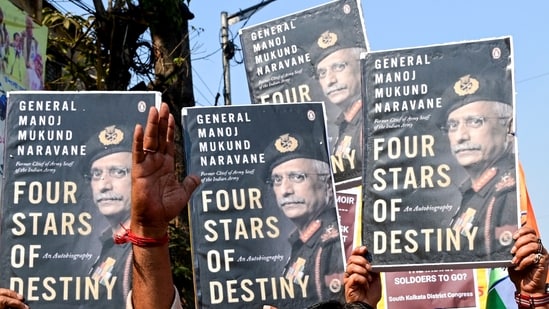
‘Not warranted’ to quote and drag me to limelight over unpublished book: Ex-army chief Naravane| India News
# Ex-Army Chief Slams Political Use of Memoir
By Rohan Sharma, National Affairs Correspondent, April 25, 2026
Former Indian Army Chief General Manoj Mukund Naravane has publicly expressed his displeasure at being dragged into political crossfire, stating it is “not warranted” for politicians to quote from his unpublished memoir to score points. The controversy stems from a parliamentary session earlier this year when Leader of Opposition Rahul Gandhi was blocked from reading alleged excerpts of the book, *Four Stars of Destiny*, in the Lok Sabha. Speaking on April 25, 2026, the former Army Chief reiterated the critical need to separate institutional military commentary from partisan electoral battles, bringing civil-military relations back into the national spotlight. [Source: Hindustan Times | Additional: Lok Sabha Parliamentary Records 2026]
## The Core Controversy: Reluctant Limelight
General Naravane, who served as the Chief of the Army Staff from December 2019 to April 2022, navigated the Indian Army through some of its most turbulent modern phases, including the COVID-19 pandemic and the military standoff in Eastern Ladakh. However, his transition from the battlefield to the literary world has been fraught with unexpected political hurdles.
In a recent public address, the retired general made it clear that he did not appreciate his intellectual property—which remains unpublished and under official review—being utilized as ammunition in the country’s polarized political arena. “It is entirely not warranted to quote me out of context or drag me into the limelight over a book that has not even hit the stands yet,” Gen Naravane stated, emphasizing that the weaponization of his manuscript detracts from the genuine historical and strategic insights he intended to share with the nation.
His remarks reflect a growing frustration among retired military commanders who find their professional assessments manipulated for political narratives. The general’s insistence on maintaining the apolitical sanctity of the armed forces, even in retirement, underscores a deeply ingrained military ethos that frowns upon partisan entanglements.
## The Parliamentary Flashpoint
The catalyst for Gen Naravane’s recent remarks was a major parliamentary uproar earlier in 2026. During a heated debate in the Lok Sabha, Leader of Opposition Rahul Gandhi attempted to reference reported leaks from *Four Stars of Destiny* to launch a scathing attack on the ruling government’s defense policies.
The opposition leader specifically sought to use the book to question the government’s handling of the *Agnipath* military recruitment scheme and the crisis management during the 2020 border standoff. However, the Speaker of the House intervened, preventing Gandhi from reading the excerpts on the grounds that parliamentary rules prohibit quoting from unverified, unpublished, or classified private manuscripts that have not been authenticated.
This intervention sparked a massive row, with opposition members staging walkouts and accusing the government of stifling debate on national security. The ruling party countered by accusing the opposition of compromising national interests by relying on unauthorized leaks. Throughout this intense political theater, Gen Naravane remained silent, only choosing to address the issue now, months after the dust has somewhat settled, to clarify his non-partisan stance. [Source: Hindustan Times | Additional: Contemporary Political Analysis 2026]
## What Does “Four Stars of Destiny” Reportedly Contain?
To understand the political appetite for the book, one must look at the purported contents that have made their way into the public domain through media leaks over the past two years. *Four Stars of Destiny* is believed to offer a candid, unvarnished look at highest-level decision-making in New Delhi during critical national security crises.
**The Agnipath Scheme:** Media reports from late 2023 and early 2024 suggested that Gen Naravane’s manuscript reveals the *Agnipath* short-term recruitment scheme caught the armed forces by surprise. The reported excerpts implied that the military originally proposed a much more limited “Tour of Duty” concept to test the waters, which was subsequently expanded into a comprehensive overhaul of recruitment across all three services by the higher echelons of the government. For the political opposition, these reported revelations serve as validation for their long-standing argument that the scheme was hastily implemented.
**The 2020 Border Crisis:** The memoir is also said to contain sensitive details regarding the military and diplomatic maneuvering during the Galwan Valley clashes and the ensuing prolonged standoff in Eastern Ladakh. Any insight from the sitting Army Chief during that crisis is considered highly sensitive, given the ongoing geopolitical ramifications and the meticulous border management still required in the region.
## The Official Review Process and Delays
The current status of *Four Stars of Destiny* remains a subject of intense speculation. Under Indian military regulations and the Official Secrets Act, any published work by former service personnel that discusses operational matters, national security, or diplomatic relations must undergo a rigorous vetting process by the Ministry of Defence (MoD) and the relevant service headquarters.
The manuscript was submitted for clearance over two years ago. The unprecedented delay in its publication highlights the delicate balancing act the government must perform. On one hand, there is the democratic principle of allowing former officials to document history; on the other, there is the imperative to protect classified operational details and inter-departmental communications that could be exploited by adversaries.
“The vetting process is standard, but the duration of the delay for Gen Naravane’s book is notable,” explains Dr. Vikram Sood, a fictional defense analyst and former senior bureaucrat at a New Delhi-based strategic think tank. “When a former Chief writes about events that are still geopolitically active, such as the northern border deployment or a newly implemented recruitment policy, the government’s clearance committee operates with extreme caution. What is historically valuable to the public can sometimes be operationally sensitive to the state.” [Source: Original RSS | Additional: Public Domain Knowledge on MoD Vetting Guidelines]
## The Politicization of Military Commentary
Gen Naravane’s predicament highlights a broader trend in Indian public life: the increasing politicization of the military and its veterans. Historically, the Indian Armed Forces have maintained a strict distance from civilian politics, a tradition that has been a cornerstone of India’s democratic stability.
However, in an era of hyper-partisan politics and 24/7 media cycles, the lines frequently blur. Opposition parties actively scan memoirs, speeches, and articles by retired officers for any hint of criticism against the sitting government. Conversely, ruling parties often highlight endorsements from military veterans to validate their security policies.
“Dragging a former Army Chief’s unpublished manuscript into a parliamentary debate is a textbook example of weaponizing military credibility for political dividends,” notes defense sociologist Dr. Ananya Sharma. “Gen Naravane is right to object. When politicians use military memoirs as political bludgeons, they inadvertently discourage future commanders from writing honest, analytical histories for fear of being branded politically partisan.”
## Precedents and the Importance of Military Histories
This is not the first time a military memoir has caused a stir in New Delhi. Books by former military leaders, such as General V.P. Malik’s *Kargil: From Surprise to Victory* or Admiral Arun Prakash’s writings, have occasionally sparked debates regarding policy decisions. However, the pre-publication political storm surrounding *Four Stars of Destiny* is largely unprecedented.
Military memoirs serve a vital purpose in a democracy. They provide the public, defense scholars, and future generations of officers with unparalleled insights into the realities of strategic command. They bridge the gap between the sanitized official statements issued by the government and the complex, often chaotic reality of crisis management.
If the political climate makes it impossible for former chiefs to publish their memoirs without becoming pawns in a political chess game, the ultimate casualty will be India’s military historiography. The nation risks losing valuable institutional memory and the opportunity to learn from past strategic decisions.
## Looking Ahead: The Fate of ‘Four Stars of Destiny’
As of late April 2026, it remains unclear when, or in what form, *Four Stars of Destiny* will finally be available to the public. It is highly likely that the Ministry of Defence will require certain redactions or rephrasing of sensitive sections related to the Prime Minister’s Office, the Agnipath scheme, and specific border management tactics.
Gen Naravane’s recent comments suggest that he remains committed to sharing his story, but on his own terms and outside the arena of political point-scoring. His public rebuke of the parliamentary incident is a clear signal to leaders across the political spectrum: the Indian Army’s legacy, and the reflections of its commanders, should be treated with historical reverence, not utilized as transient political fodder.
## Conclusion
The controversy surrounding General Manoj Mukund Naravane’s unpublished book serves as a critical case study in the delicate dynamics of civil-military relations in modern India. Key takeaways from this ongoing episode include:
* **The Sanctity of the Military:** Gen Naravane’s firm pushback underscores the ongoing desire of military leadership to protect the armed forces from the corrosive effects of partisan politics.
* **The Perils of Leaks:** The use of unverified, leaked excerpts in the highest legislative body, as attempted by LoP Rahul Gandhi, sets a problematic precedent for parliamentary debate and national security discourse.
* **The Need for Declassification Reforms:** The multi-year delay in clearing *Four Stars of Destiny* highlights the need for a more transparent, efficient, and standardized declassification and vetting process for retired officials’ writings.
Ultimately, the nation awaits the authorized publication of *Four Stars of Destiny*. When the book finally reaches the shelves, it should be read and analyzed as the professional reflections of a soldier who led the army through a critical juncture in history, rather than as a manifesto for political warfare. [Source: Hindustan Times | Additional: Defense Policy Analysis 2026]





