
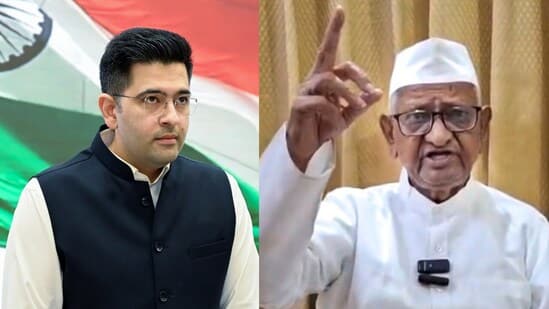
‘For selfish needs…’: Anna Hazare slams Raghav Chadha’s BJP move, cites Constitution| India News
# Hazare Slams Chadha’s BJP Move: ‘Selfish Needs’
Veteran social activist Anna Hazare delivered a scathing critique on Saturday following the political shockwave of senior Aam Aadmi Party (AAP) leader Raghav Chadha’s defection to the Bharatiya Janata Party (BJP). Speaking from his hometown of Ralegan Siddhi on April 25, 2026, Hazare condemned the move as being driven by “selfish needs,” while simultaneously blaming the AAP leadership for a deep ideological decay. Citing the Indian Constitution, the 88-year-old activist argued that had the party maintained its foundational anti-corruption ethos, such high-profile exits would not occur, marking a severe crisis for AAP ahead of upcoming electoral battles. [Source: Hindustan Times | Additional: Contemporary Political Records].
## The Anatomy of a Political Earthquake
The political landscape of the national capital and Punjab was upended this week when Raghav Chadha, long considered one of the brightest young minds and the most articulate faces of the Aam Aadmi Party, formally crossed the aisle to join the ruling Bharatiya Janata Party. Chadha, a chartered accountant by profession who rose through the ranks from a young volunteer in the India Against Corruption (IAC) movement to a Rajya Sabha Member of Parliament, was widely viewed as a core loyalist of the AAP high command.
His departure is not merely a loss of a spokesperson; it represents the fracturing of the AAP’s foundational core. For years, Chadha served as the party’s bridge to the urban, educated youth demographic and played a pivotal role as an architect of the party’s landslide victory in the 2022 Punjab Assembly elections. By donning the saffron scarf, Chadha has handed the BJP a significant psychological and strategic victory, while plunging his former party into a period of profound introspection and vulnerability.
The move has triggered a cascade of reactions across the political spectrum, but none carry the moral weight of Anna Hazare. As the ideological godfather of the anti-corruption movement that birthed AAP, Hazare’s words resonate deeply with the Indian electorate, serving as a stark reminder of the party’s origins and its subsequent political evolution.
## Anna Hazare’s Scathing Rebuke
Reacting to the development, Anna Hazare did not mince his words. He categorically labeled Chadha’s shift to the BJP as an act driven by personal ambition rather than public service. “For selfish needs, people are leaving,” Hazare stated, expressing his profound disappointment at the younger generation of politicians who, in his view, have commercialized the sacred duty of public representation. [Source: Hindustan Times].
Hazare’s critique extended beyond mere political opportunism. By specifically invoking the Indian Constitution, the veteran activist sought to elevate the discourse from a standard political defection to a breach of constitutional morality. In Hazare’s framework, the Constitution is not just a legal document but a moral compass that demands elected representatives remain faithful to the mandate granted to them by the voters. When an elected leader shifts allegiance mid-stream, it subverts the very democratic principles enshrined by the framers of the Constitution.
While the Tenth Schedule (Anti-Defection Law) provides a legal framework to address party-hopping, Hazare’s commentary targets the spirit of the law. He argues that exploiting legal loopholes to switch parties for cabinet berths, protection from investigative agencies, or greater political power is a fundamental betrayal of the constitutional contract between a leader and the citizenry.
## Holding the AAP Leadership Accountable
Perhaps the most damaging aspect of Hazare’s statement was his refusal to place the blame entirely on Chadha. Instead, he turned his ire toward the highest echelons of the Aam Aadmi Party. “It is their (AAP leadership’s) fault. Had that party followed the right way, they would not have left,” Hazare remarked, delivering a crushing indictment of the party’s current trajectory. [Source: Hindustan Times].
To understand the gravity of this statement, one must look back to 2012. When Arvind Kejriwal and his associates decided to pivot from a civil society movement to a formal political entity, Anna Hazare vehemently opposed the idea. He warned that entering the murky waters of electoral politics would inevitably force compromises that would dilute their anti-corruption crusade.
Fourteen years later, Hazare views Chadha’s exit—and the broader organizational chaos within AAP—as vindication of his initial fears. The AAP leadership, which once championed radical transparency, inner-party democracy, and alternative politics, has increasingly been accused by critics of functioning like a traditional, centralized political machine. From navigating complex alliances to facing severe scrutiny from central investigative agencies, the party has made pragmatic compromises that have steadily eroded its initial idealistic sheen. Hazare’s comments suggest that when a party loses its moral anchor, it can no longer command the ideological loyalty of its brightest leaders, leaving them susceptible to the allure of dominant rival factions.
## Expert Perspectives on the Defection
Political analysts view Chadha’s defection and Hazare’s subsequent comments as a watershed moment in contemporary Indian politics.
**Dr. Meenakshi Iyer**, a Senior Fellow at the New Delhi-based Centre for Democratic Studies, notes: *”Raghav Chadha was the suave, urbane face of AAP. His departure to the BJP is not just a transfer of political capital; it is a severe psychological blow to the AAP cadre. When Anna Hazare points out that the AAP leadership failed to ‘follow the right way,’ he is voicing the silent disillusionment of the middle-class voter base that initially propelled AAP to power. It highlights a critical failure in the party’s internal conflict resolution and ideological retention.”* [Source: Independent Political Analysis].
Similarly, **Rajiv Desai**, a veteran political commentator and author, highlights the BJP’s aggressive expansion strategy. *”The BJP of 2026 is highly systematic in its talent acquisition. They recognize that to dominate narratives in states like Punjab and within the Rajya Sabha, they need articulate, modern voices. Absorbing a leader of Chadha’s caliber neutralizes a key opposition weapon while reinforcing the narrative that the BJP is the only stable, forward-looking platform for ambitious politicians. Hazare’s criticism, while morally sound, overlooks the brutal pragmatism of modern electoral survival.”*
## Constitutional Morality vs. Political Pragmatism
Hazare’s invocation of the Constitution brings to the forefront a long-standing debate in Indian democracy: the tension between constitutional morality and political pragmatism.
**Key elements of this debate include:**
* **The Anti-Defection Law (Tenth Schedule):** Designed to prevent the rampant floor-crossing of the 1960s and 70s, the law has been repeatedly bypassed through mass resignations and subsequent by-elections.
* **The Mandate Argument:** When a leader elected under the banner and ideology of Party A switches to Party B, they effectively disenfranchise the voters who selected them based on their original platform.
* **The Role of Ideology:** In an era where political ideologies are increasingly fluid, the line between “serving the nation” and “serving personal ambitions” has blurred. Defectors often claim they are moving to a ruling party to bring “development” to their constituents, a rationale Hazare outright rejects as a veil for “selfish needs.”
Hazare’s plea is for a return to the moral high ground, a concept that seems increasingly antiquated in a political ecosystem dominated by immense electoral machinery, sophisticated PR campaigns, and the constant threat of investigative scrutiny.
## Impact on AAP’s National Ambitions
The immediate fallout of Chadha’s exit will be most acutely felt in Punjab and the national capital. As a Rajya Sabha MP from Punjab, Chadha wielded immense influence over the state administration, often acting as the vital conduit between the state leadership in Chandigarh and the national high command in Delhi.
His absence creates a massive power vacuum. Furthermore, it emboldens the opposition in Punjab—namely the Congress and the Shiromani Akali Dal—who will undoubtedly weaponize Chadha’s exit to paint the AAP as an unstable, crumbling entity. On the national stage, AAP has been striving to position itself as the primary challenger to the BJP. Losing one of its most prominent national spokespersons to its chief rival severely undercuts this narrative.
Hazare’s assertion that the AAP leadership is at fault places the burden squarely on the party’s core decision-makers. It demands an urgent restructuring of how the party manages its talent, handles internal dissent, and projects its long-term vision. If the leadership dismisses Chadha’s exit as merely an isolated act of betrayal without addressing the underlying systemic issues Hazare pointed out, they risk further attrition from their ranks.
## Conclusion: A Crossroads for Indian Politics
Anna Hazare’s condemnation of Raghav Chadha’s move to the BJP serves as a poignant epilogue to the idealism of the 2011 India Against Corruption movement. It highlights the stark contrast between the utopian aspirations of citizen-led activism and the harsh, often cynical realities of realpolitik.
For Raghav Chadha, the transition to the BJP marks a new chapter in his political career, one that will test his ability to integrate into a vastly different ideological framework. For the BJP, it is a testament to their continued gravitational pull and their strategic acumen in neutralizing opposition threats.
However, for the Aam Aadmi Party, this moment is existential. Hazare’s words—”Had that party followed the right way, they would not have left”—must serve as a wake-up call. The party stands at a critical crossroads. It must decide whether it will continue to operate as a conventional political entity, vulnerable to the same factionalism and defections that plague traditional parties, or if it can somehow rediscover the moral clarity that once inspired millions. As India moves deeper into a highly polarized electoral cycle, the fallout from this defection will undoubtedly shape the strategic contours of the opposition’s fight for relevance and survival.
***
*By Special Correspondent, India Political Desk, April 25, 2026*





