
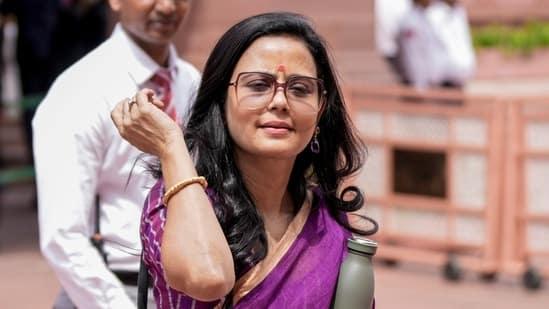
'He'd rather be part of BJP's crimes': TMC MP Mahua Moitra on AAP's Raghav Chadha| India News
# TMC’s Moitra Slams Chadha Over AAP Exit
**By Political Correspondent, National Desk | April 25, 2026**
**NEW DELHI** — Trinamool Congress (TMC) Member of Parliament Mahua Moitra launched a scathing attack on Saturday, targeting former Aam Aadmi Party (AAP) leader Raghav Chadha following his abrupt resignation from the party. Speaking to reporters a day after Chadha and several other AAP Rajya Sabha MPs officially parted ways with the Arvind Kejriwal-led faction, Moitra stated, “He’d rather be part of BJP’s crimes,” signaling a sharp deterioration in opposition solidarity. The dramatic Friday exodus has triggered a political earthquake in the national capital, raising questions about the future of AAP and the broader opposition dynamics against the ruling Bharatiya Janata Party (BJP).
## The Exodus: A Massive Blow to AAP
On Friday, April 24, 2026, the political landscape of New Delhi shifted dramatically when Raghav Chadha, alongside a faction of sitting AAP Rajya Sabha Members of Parliament, formally submitted their resignations from the party’s primary membership [Source: Hindustan Times]. The departure of Chadha—once considered the suave, articulate, and fiercely loyal face of the AAP’s younger generation—marks one of the most severe internal crises the party has faced since its inception.
**Key Facts Regarding the Resignations:**
* **Timing:** The resignations come at a critical juncture as political parties begin preliminary positioning for upcoming state assembly elections.
* **Scale:** While exact numbers of the splinter group remain fluid, the coordinated exit of multiple Upper House MPs significantly diminishes AAP’s legislative leverage in Parliament.
* **Silence from Leadership:** As of Saturday morning, the AAP high command has maintained a cautious silence, with only second-tier spokespersons issuing brief statements calling the departures “unfortunate.”
The immediate impact of this exodus is a severely weakened Aam Aadmi Party in the Rajya Sabha. AAP has historically utilized its Upper House numbers to vigorously oppose the BJP-led National Democratic Alliance (NDA) on crucial legislative bills. This sudden reduction in numbers not only demoralizes the party cadre but also forces a strategic recalibration for the party’s leadership in both Delhi and Punjab.
## Mahua Moitra’s Scathing Critique
The most explosive reaction to the defections did not come from within AAP, but from the Trinamool Congress. Mahua Moitra, known for her fiery parliamentary speeches and unrelenting criticism of the BJP, did not mince words when asked about Chadha’s departure.
“It is deeply disappointing but entirely unsurprising,” Moitra remarked during a press briefing. “When push comes to shove, some individuals abandon their ideological compass. He’d rather be part of BJP’s crimes than stand and fight for the democratic soul of this country.” [Source: Hindustan Times]
Moitra’s phrasing highlights a prevailing sentiment among certain opposition leaders: the belief that politicians abandoning opposition ranks are invariably doing so to seek shelter under the ruling party’s umbrella. Her comments reflect the broader frustrations of the opposition bloc, which has struggled to maintain a cohesive front amidst persistent internal fractures and external pressures.
## The Shadow of Central Agencies
Moitra’s usage of the word “crimes” is a thinly veiled reference to the opposition’s long-standing allegation that the BJP utilizes central investigative agencies—such as the Enforcement Directorate (ED) and the Central Bureau of Investigation (CBI)—to coerce political adversaries into submission.
For years, opposition leaders have accused the NDA government of operating a “washing machine” system, wherein politicians facing corruption probes are allegedly granted a reprieve upon joining or aligning with the BJP [Additional Source: Public Political Commentary].
While Chadha has not officially announced an intention to join the BJP, the timing of his exit—amidst a continuing slew of investigations targeting various AAP leaders over historical excise policy and administrative issues—has fueled rampant speculation.
The BJP has consistently and vehemently denied these allegations. Ruling party spokespersons maintain that the central agencies operate with absolute independence and that the anti-corruption drive is an uncompromising pillar of their governance. According to the BJP, the fragmentation of opposition parties like AAP is solely the result of internal contradictions, ideological bankruptcy, and failed leadership, rather than external coercion.
## Raghav Chadha’s Political Trajectory
To understand the magnitude of Friday’s development, one must look at Raghav Chadha’s meteoric rise within the Aam Aadmi Party. A chartered accountant by profession, Chadha joined the anti-corruption movement that birthed AAP and quickly rose through the ranks due to his sharp financial acumen and articulate media presence.
**Chadha’s Milestones within AAP:**
1. **Media Strategist:** Served as the national spokesperson, successfully defending the party during complex controversies.
2. **Legislative Success:** Won the Rajinder Nagar assembly seat in Delhi with a substantial margin.
3. **Punjab Architect:** Played a pivotal co-architect role in AAP’s historic landslide victory in the 2022 Punjab Assembly elections.
4. **Rajya Sabha Elevation:** Was nominated to the Rajya Sabha from Punjab, becoming one of the youngest MPs in the Upper House.
His departure is not merely a loss of a parliamentary seat; it is a significant “brain drain” for AAP. Chadha was deeply involved in the party’s legal and electoral strategies. His exit, particularly with a cohort of other MPs, suggests a deeply rooted dissatisfaction with the party’s current trajectory or leadership structure, which analysts suggest has been struggling to adapt to the grueling demands of national expansion.
## Shifting Sands of the Opposition Bloc
The AAP rebellion occurs against the backdrop of a highly volatile opposition ecosystem. Over the past few years, alliances have been formed and broken as regional powers vie for dominance while attempting to counter the BJP’s formidable electoral machinery.
Moitra’s sharp critique of Chadha also underscores the delicate and often competitive relationship between the TMC and AAP. Both parties share a common enemy in the BJP but have frequently clashed over territorial expansion and claims to being the legitimate ideological alternative to the ruling dispensation.
*Table: Recent Dynamics in Opposition Unity*
| Faction | Current Strategy | Internal Challenges | Stance on Defectors |
| :— | :— | :— | :— |
| **AAP** | Defensive consolidation in Delhi & Punjab | Top-tier leadership exits, legal battles | Views them as betrayers under pressure |
| **TMC** | Aggressive regional dominance in Bengal | Friction with other regional parties | Highly vocal, accuses defectors of complicity |
| **BJP (Ruling)** | Expanding footprint in newer states | Managing influx of regional leaders | Welcomes integration, cites ideological wins |
By publicly castigating Chadha, Moitra is attempting to control the narrative, framing the AAP MPs’ exit not as a failure of the opposition’s ideology, but as individual moral failings in the face of pressure.
## Expert Perspectives on the Realignment
Political analysts are divided on the long-term implications of this development, though most agree it represents a watershed moment for AAP.
Dr. Sameer Verma, a New Delhi-based political scientist and author, views the development as a symptom of structural fatigue within AAP. “The AAP was built on a hyper-centralized model of leadership. When the core team faces sustained administrative and legal friction, the periphery begins to detach. Raghav Chadha’s exit indicates that the new-generation leaders feel their political futures are stagnating under the current organizational crisis,” Dr. Verma notes.
Conversely, analysts focusing on the broader national picture see the validity in the opposition’s concerns regarding the political environment. “Mahua Moitra’s rhetoric, while aggressive, highlights a genuine anxiety within opposition ranks,” explains independent political commentator, Nandita Sen. “The sheer frequency of high-profile exits from opposition parties across the board creates an atmosphere of distrust. Even if Chadha’s reasons are purely organizational, the immediate public perception—fueled by statements like Moitra’s—will inevitably link the move to the broader trend of political capitulation.”
## What Lies Ahead for the Defectors
The immediate question dominating Lutyens’ Delhi is: What is Raghav Chadha’s next move?
Legally, under the Tenth Schedule of the Indian Constitution (Anti-Defection Law), resigning from the party upon whose ticket they were elected to the Rajya Sabha usually necessitates resigning from the parliamentary seat itself, unless the defecting faction constitutes at least two-thirds of the legislative party. Given the numbers, it is likely that the defecting MPs may have to face by-elections or rely on re-nomination by a new political home.
If Chadha and his cohort formally join the BJP, it would grant the ruling party a significant psychological victory, particularly in Punjab, where the BJP has been striving to establish a formidable, independent presence following its split from the Shiromani Akali Dal years ago. Chadha’s deep understanding of Punjab’s political calculus could be an invaluable asset to any party he aligns with.
Alternatively, the splinter group could attempt to float an independent front or align with another regional player, though historical precedents suggest that independent splinter groups struggle to survive the polarized nature of modern Indian politics.
## Conclusion
The departure of Raghav Chadha and his colleagues from the Aam Aadmi Party is far more than a routine political shift; it is a testament to the immense pressures and shifting allegiances characterizing Indian politics in 2026.
Mahua Moitra’s fiery accusation that Chadha would “rather be part of BJP’s crimes” ensures that this split will not fade quietly into the background. It sets the stage for a bitter, drawn-out narrative war between a fractured opposition crying foul over alleged institutional coercion, and a ruling party looking to capitalize on its rivals’ disarray.
For the AAP, the coming weeks will require deep introspection and rapid damage control to prevent a cascading effect on its lower-rung cadres. For Raghav Chadha, the transition from an anti-establishment crusader to an unaffiliated political free agent will test his individual political capital. As the dust settles on Friday’s exodus, the true impact of this realignment on the parliamentary math and electoral strategies of 2026 will soon become unavoidably clear.





