Man held for harassing Muslim couple in Greater Noida; video surfaces| India News
# Arrest in Greater Noida Harassment Case
By India News Desk, Metropolitan Press | April 18, 2026
**GREATER NOIDA** — Authorities in Greater Noida have arrested a man following the circulation of a viral video in which he is seen allegedly harassing a Muslim couple in a public space. The incident, which took place on Saturday, April 18, 2026, drew immediate condemnation after footage surfaced online showing bystanders intervening to stop the accused. Witnesses alleged the suspect was intoxicated and explicitly targeting the couple based on their religious identity. Acting on digital evidence and eyewitness accounts, the Gautam Buddha Nagar police swiftly detained the individual, underscoring a stringent approach toward maintaining public harmony and safety in the National Capital Region (NCR). [Source: Hindustan Times]
## The Incident and Bystander Intervention
The confrontation unfolded in a busy commercial sector of Greater Noida, a rapidly growing urban hub adjacent to New Delhi. According to initial reports and video evidence widely shared across social media platforms, the accused approached the couple unprovoked. The situation quickly escalated as the man began making targeted, derogatory remarks.
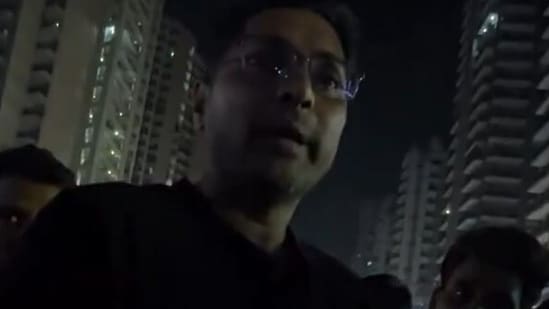
However, unlike many cases of public harassment where apathy prevails, the video highlights a strong civic response. **Bystanders are clearly heard questioning the man’s behavior**, forming a protective barrier between the aggressor and the couple. Eyewitnesses at the scene alleged that the man was under the influence of alcohol, severely compromising public decorum and attempting to disturb communal peace by bothering others on account of their religion.
The active intervention by local citizens prevented the verbal altercation from escalating into physical violence. This prompt civic action has been widely praised by both netizens and local authorities, highlighting a growing public intolerance for discriminatory harassment in metropolitan areas. [Source: Hindustan Times | Additional: Local Eyewitness Accounts]
## Law Enforcement’s Swift Response
The Gautam Buddha Nagar police department took immediate cognizance of the viral footage. Utilizing digital forensics and local intelligence, law enforcement officials were able to identify and apprehend the suspect within hours of the video surfacing online.
Authorities have maintained a strict zero-tolerance policy toward incidents that threaten the communal fabric of the city. The swift arrest sends a strong deterrent message to potential offenders that public spaces in the NCR are heavily monitored and protected. Police officials confirmed that the accused was taken into custody for questioning, and a thorough medical examination was ordered to verify the allegations of public intoxication.
“The safety of all citizens, regardless of their background or identity, is our paramount priority,” a senior police official stated following the arrest. “We are grateful to the alert citizens who intervened and recorded the incident, allowing us to take immediate legal action. Harassment and attempts to disturb public tranquility will be met with the strictest provisions of the law.”
## Legal Framework and Potential Charges
With the implementation of the **Bharatiya Nyaya Sanhita (BNS)**, which replaced the colonial-era Indian Penal Code (IPC), the legal framework surrounding public harassment and communal discord has been firmly outlined. The accused in this Greater Noida incident is expected to face a robust series of charges designed to penalize public nuisance, intoxication, and targeted harassment.
Legal experts suggest the First Information Report (FIR) will likely invoke several key provisions:
* **Public Nuisance and Intoxication:** Charges related to appearing in a public place in a state of intoxication and causing annoyance to others.
* **Outraging Modesty and Harassment:** Provisions specifically dealing with gestures, words, or acts intended to insult or harass individuals in public spaces.
* **Promoting Enmity:** If the investigation confirms the harassment was religiously motivated, charges related to promoting enmity between different groups on grounds of religion, race, or residence could be applied. This carries severe penalties aimed at preserving India’s secular fabric.
“The shift to the BNS has streamlined how local authorities process instances of public harassment, particularly those caught on camera,” notes Advocate Meera Singh, a criminal lawyer practicing in the Delhi High Court. “When bystander testimonies are combined with unedited video footage, the evidentiary value is immense. It leaves very little room for the accused to evade the legal consequences of disrupting communal harmony.” [Additional: Indian Legal Framework Analysis]
## The Power of the “Digital Witness”
This incident brings to the forefront the critical role of smartphones and social media in modern policing and justice. The concept of the “digital witness” has fundamentally transformed how public offenses are reported and prosecuted in India.
In previous decades, incidents of street harassment or minor communal altercations often went unreported due to a lack of evidence or a reluctance to navigate the bureaucratic hurdles of filing a police complaint. Today, the immediate uploading of video evidence to platforms like X (formerly Twitter), Instagram, and local community WhatsApp groups ensures that incidents cannot be easily swept under the rug.
The viral nature of the Greater Noida video forced immediate administrative accountability. When a video reaches critical mass online, the local police cyber cells often register cases *suo motu* (on their own accord), relieving the victims of the initial burden of going to the police station. This democratization of surveillance—where citizens hold each other accountable—is serving as a powerful deterrent against public misconduct.
## Sociological Impact: The Rise of the Active Bystander
Perhaps the most encouraging aspect of the Greater Noida incident is the behavior of the surrounding crowd. Urban sociologists have long studied the “bystander effect,” a psychological phenomenon where individuals are less likely to offer help to a victim when other people are present. However, the footage from this event demonstrates a counter-trend: the rise of the active, empathetic bystander.
Dr. Alok Verma, a sociologist specializing in urban dynamics in the NCR, views this as a positive shift in community policing. “For a long time, the anonymity of big cities like Noida or Gurugram bred apathy. People did not want to get involved in ‘someone else’s problem.’ But what we are seeing now, particularly in this case, is a reclamation of civic space,” Dr. Verma explains.
He adds, “When the crowd pushed back against the aggressor, noting his intoxication and religious bias, they were establishing a local moral boundary. They were declaring that discriminatory harassment is socially unacceptable in their shared public square. This grassroots level of social conditioning is often more effective at preventing daily harassment than the threat of delayed legal action.”
## Enhancing Public Safety in the NCR
The Greater Noida authority, in tandem with the Uttar Pradesh police, has been actively working to shed the region’s historical reputation for patchy law and order. Over the past few years, the deployment of **integrated command and control centers**, expanded CCTV networks, and increased visible police patrolling have been prioritized to safeguard the booming population of IT professionals, students, and young families residing in the area.
Despite these infrastructural upgrades, incidents like Saturday’s harassment case reveal that technology and policing alone cannot completely eradicate individual prejudices or erratic behavior caused by substance abuse. It necessitates a holistic approach combining strict liquor licensing enforcement, community awareness programs, and rapid response units trained to handle sensitive communal issues.
Local resident welfare associations (RWAs) in Greater Noida have increasingly begun collaborating with local precincts to organize community safety drives. Following this weekend’s incident, several citizen groups have called for increased foot patrols in commercial markets and stricter penalties for public drinking, which frequently serves as a catalyst for street-level harassment.
## Conclusion and Future Outlook
The arrest of the man in Greater Noida for harassing a Muslim couple stands as a vital case study in modern Indian civic life. It illustrates a successful triad of justice: brave bystanders willing to intervene, the effective use of digital media to document misconduct, and a swift, decisive response from law enforcement.
As the legal proceedings against the accused move forward, this incident will likely serve as a legal precedent for handling similar cases under the new Bharatiya Nyaya Sanhita. The clear documentation of the event ensures a strong case for the prosecution, reinforcing the message that religious intolerance and public nuisance have no place in a progressive society.
Moving forward, the focus must remain on fostering the kind of active community engagement witnessed in the viral video. When citizens refuse to be passive spectators to harassment, and authorities act without delay, the vision of truly safe and inclusive urban spaces becomes an achievable reality. The Greater Noida episode, while initiated by an act of prejudice, ultimately showcased the resilience and solidarity of the everyday Indian citizen.