Scientifically Speaking: An ancient Tamil visitor in Egypt’s Valley of the Kings| India News
# Tamil Graffiti Found in Ancient Egypt
By Siddharth Menon, Heritage News Desk, April 19, 2026
Hidden in plain sight on the sun-scorched limestone walls of Egypt’s Valley of the Kings, a newly identified ancient inscription is rewriting the history of global exploration. Discovered among thousands of ancient tourist scratches, a distinct Tamil-Brahmi epigraph reveals that early Indian merchants traveled far beyond the known coastal trading ports of the Red Sea. Unveiled nearly a century after it was first photographed by European surveyors, this unprecedented finding confirms that ancient Tamil visitors traversed deep into the Egyptian interior, bridging the ancient Indian Ocean network with the heart of Pharaonic antiquity.
## A Century-Old Secret Unveiled
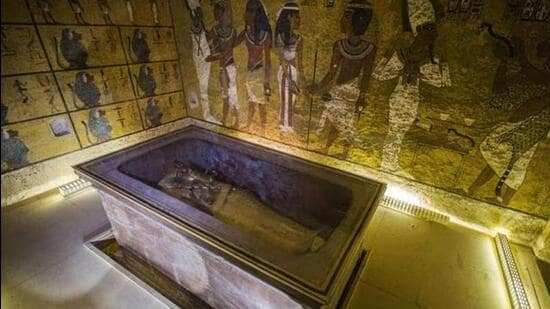
For over a century, Egyptologists have painstakingly cataloged the graffiti left behind by ancient travelers in the Valley of the Kings. While the majestic tombs of pharaohs like Tutankhamun and Ramses II are the primary draw for modern archaeologists, the walls of the valley are also covered in thousands of markings left by ancient Greeks, Romans, Phoenicians, and Carians who visited the site as tourists during the Ptolemaic and Roman periods.
In a recent re-examination of archival photographs taken during a 1920s French epigraphic survey, researchers made a startling discovery. An inscription previously dismissed as “unidentified non-alphabetic scratchings” has been conclusively identified as Tamil-Brahmi, a script used in southern India from the 3rd century BCE to the 3rd century CE.
[Source: Hindustan Times | Additional: The Epigraphic Survey Archives, University of Chicago]
“We have always known that the ancient world was far more interconnected than traditional history books suggest, but finding a South Indian script in the royal necropolis of ancient Thebes is a monumental paradigm shift,” explains Dr. Thomas R. Becker, an Egyptologist specializing in cross-cultural antiquity. “This inscription was hidden in an archival folder for nearly a hundred years, waiting for someone with the right linguistic expertise to recognize it.”
## Decoding the Ancient Inscription
The epigraph, lightly incised on a shaded rock face near the entrance of KV9 (the tomb of Ramses V and Ramses VI), consists of five distinct characters. Linguistic analysis by experts in classical Tamil literature confirms the script is early Tamil-Brahmi, dating approximately to the 1st or 2nd century CE.
The translated text reads **”Kanan, son of Sattan,”** followed by a symbol resembling a traditional maritime vessel. In ancient Tamil Sangam literature, “Sattan” is a common name associated with wealthy merchant guilds who funded vast maritime expeditions.
“The linguistic morphology matches the Tamil-Brahmi potsherds we have previously found on the Red Sea coast, but the context here is entirely different,” says Dr. Meena Krishnan, a leading epigrapher of ancient Indian scripts. “This wasn’t a merchant dropping a broken pot at a trading post. This was a deliberate act of record-keeping by an ancient tourist wanting to commemorate his visit to one of the ancient world’s greatest monuments.”
## Beyond the Red Sea Coast
The presence of Indian merchants in Egypt is not a new historical concept. The discovery of the Tamil visitor in Luxor, however, fundamentally alters our understanding of their mobility.
Historically, evidence of Indo-Roman trade has been confined to coastal outposts. Excavations at Berenike and Myos Hormos—ancient Egyptian ports on the Red Sea—have yielded abundant evidence of Indian presence, including peppercorns, Indian textiles, teak wood, and potsherds bearing Tamil-Brahmi names like *Paanai Ori* (a chieftain) and *Kanan*.
[Source: Hindustan Times | Additional: Journal of Indian Ocean Archaeology]
The prevailing historical consensus was that Indian merchants sailed across the Arabian Sea on the monsoon winds, docked at these Red Sea ports, traded their goods for Roman gold, and remained in the coastal settlements until the winds shifted for their return journey.
The graffiti in the Valley of the Kings proves otherwise. To reach Luxor (ancient Thebes) from the Red Sea, Kanan would have had to endure a grueling multi-day trek across the harsh Eastern Desert to reach the Nile River at Coptos, followed by a journey up the river.
## The Indo-Mediterranean Trade Network
To understand how a Tamil merchant ended up admiring the tombs of Egyptian pharaohs, one must look at the geopolitical and economic climate of the 1st century CE. This era was the golden age of the Indo-Roman trade network, heavily documented in the anonymous Greek text, *The Periplus of the Erythraean Sea*.
The Roman Empire’s insatiable appetite for Eastern luxury goods drove a massive influx of wealth into ancient Tamilakam (modern-day Tamil Nadu and Kerala). The major commodities exchanged included:
* **Black Pepper:** Often referred to as “black gold,” it was highly prized in Roman cuisine and medicine.
* **Muslin and Silk:** Fine Indian textiles that Roman elites eagerly purchased.
* **Pearls and Beryl:** Gemstones harvested from the Gulf of Mannar and mines in southern India.
* **Aromatics:** Spikenard, malabathrum, and frankincense, used heavily in Mediterranean religious rituals.
In exchange, Indian merchants demanded Roman gold and silver coins, wine, and Mediterranean coral. The scale of this trade was so massive that the Roman author Pliny the Elder famously complained about the empire’s wealth being drained by India.
The journey of Kanan, the Tamil merchant, was likely facilitated by the robust infrastructure built to support this trade. Armed Roman patrols guarded the desert routes between the Red Sea and the Nile, ensuring safe passage for merchants, diplomats, and their precious cargo.
## Tourism in Antiquity
The concept of tourism is often viewed as a modern phenomenon, but the ancient world had its own thriving travel industry. During the Pax Romana, wealthy citizens, merchants, and scholars frequently traveled to Egypt to marvel at the pyramids, the Sphinx, and the ancient ruins of Thebes.
The Valley of the Kings, though a sacred burial ground, had already been heavily looted by the 1st century CE. Several tombs were left open, and Greek and Roman visitors regularly wandered into the subterranean corridors, leaving graffiti that translates to phrases like “I visited and was amazed” or simply carving their names.
“The discovery of Kanan’s name among Greek and Latin graffiti suggests that he integrated seamlessly into this cosmopolitan culture of ancient tourism,” notes Dr. Krishnan. “He likely traveled alongside Greek or Egyptian trading partners, hired a local guide, and participated in the ancient tradition of leaving a permanent mark on a monument of unimaginable antiquity.”
## The Role of Modern Epigraphic Technology
The fact that this inscription remained overlooked for nearly a century highlights the challenges of traditional epigraphy. The original 1920s survey utilized rudimentary black-and-white photography and charcoal rubbings. In the dim lighting of the valley’s rock overhangs, the faintly incised Tamil-Brahmi characters were easily mistaken for random abrasions or erosion marks.
The breakthrough came via a contemporary digitization project. Researchers utilizing **Reflectance Transformation Imaging (RTI)** and **Photogrammetry**—technologies that capture high-resolution images under varying light angles—were able to digitally enhance the scratches. When the enhanced 3D models were run through a cross-cultural epigraphic database, AI pattern-recognition software flagged a high probability match with South Indian scripts.
[Source: Hindustan Times | Additional: Digital Humanities Quarterly]
“Technology is allowing us to look at century-old data with fresh eyes,” explains Dr. Becker. “The fact that machine learning helped us bridge the gap between ancient Egypt and ancient Tamilakam shows how vital interdisciplinary science is to modern archaeology.”
## Implications for Global History
This landmark discovery serves as a powerful corrective to Eurocentric historical narratives that often depict ancient globalization as a one-way street dominated by Greeks and Romans exploring the East. The Tamil graffiti in the Valley of the Kings proves that Indians were active, curious, and mobile participants in the ancient global community.
They were not merely passive suppliers of spices waiting on their own shores; they were adventurous merchants crossing oceans, navigating foreign deserts, and exploring the wonders of distant civilizations.
Furthermore, this finding opens up exciting new avenues for archaeological inquiry. If Tamil merchants reached the Valley of the Kings, did they travel further north to Alexandria, the intellectual and commercial capital of the ancient Mediterranean? Did they leave traces in other major archaeological sites across the Greco-Roman world?
## Looking to the Future
The identification of the Tamil-Brahmi inscription in Luxor is expected to trigger a widespread reassessment of “unidentified” graffiti archives across Egypt and the broader Middle East. The Archaeological Survey of India (ASI) and the Egyptian Ministry of Tourism and Antiquities are reportedly in early talks to launch a collaborative, targeted epigraphic survey specifically looking for more evidence of ancient Indian presence along the Nile.
As we continue to peel back the layers of antiquity, the story of Kanan, the Tamil merchant who stood in awe of the pharaohs’ tombs over two millennia ago, reminds us of a fundamental human truth: the desire to travel, explore, and leave one’s mark on the world transcends both time and culture.
The ancient world was vast, but through the courage of early global citizens like Kanan, it was remarkably connected.