
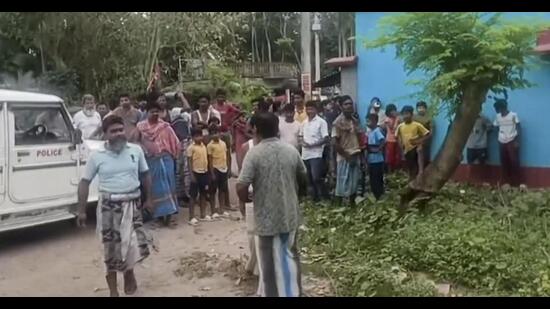
Bengal polls: TMC, BJP workers clash at Jagatdal; crude bombs hurled, shots fired
# Bengal Polls: Bombs Hurled in Jagatdal
By Rohan Mukhopadhyay, Senior Political Correspondent, April 27, 2026
On April 27, 2026, intense political violence erupted between Trinamool Congress (TMC) and Bharatiya Janata Party (BJP) workers in Jagatdal, West Bengal, significantly disrupting the state’s ongoing assembly elections. The confrontation, which quickly escalated into a violent turf war, saw assailants hurl crude bombs and fire gunshots near polling stations, creating widespread panic among local voters. During the chaotic exchange, a paramilitary trooper deployed for election duty sustained splinter injuries to his leg. Law enforcement agencies initiated an immediate crackdown, leading to the arrest of four individuals connected to the unrest. The Election Commission of India (ECI) has since ramped up security protocols across the North 24 Parganas district to restore public order and safeguard the democratic process. [Source: Hindustan Times | Additional: Public Election Records].
## Ground Zero: The Eruption of Violence in Jagatdal
The North 24 Parganas district, historically known for its volatile electoral battles, once again became the epicenter of political clashes as West Bengal proceeded through its highly contested 2026 Assembly Elections. At the heart of the unrest was Jagatdal, a densely populated industrial township where political loyalties are fiercely guarded.
According to official reports, the clashes began early Monday afternoon when rival political factions confronted each other near a crucial polling booth. Verbal altercations rapidly devolved into physical violence. Witnesses reported that unidentified miscreants began hurling **crude bombs**—a rudimentary but dangerous explosive frequently utilized in Bengal’s local conflicts—into the crowds. The situation deteriorated further when multiple gunshots were fired, sending voters and election officials scrambling for safety.
The primary casualty of the initial skirmish was a trooper belonging to the Central Armed Police Forces (CAPF). Officials confirmed that the trooper was struck by shrapnel from a crude bomb, sustaining **splinter injuries in his leg**. He was promptly evacuated to a nearby medical facility, where authorities state he is currently in stable condition and receiving necessary medical care. The injury to central forces personnel underscores the severe threat level faced by those tasked with maintaining order in the region. [Source: Hindustan Times].
## Immediate Security Response and Arrests
In the immediate aftermath of the bombings, local police, bolstered by Quick Response Teams (QRTs) and heavily armed CAPF units, established a wide security perimeter around the Jagatdal clash site. The primary objective was to de-escalate the violence, disperse the warring factions, and secure the polling booths to allow voting to resume.
Law enforcement agencies executed swift raids in the surrounding alleys and neighborhoods based on rapid intelligence gathering. By mid-afternoon, police officials announced that **four individuals had been arrested** in connection with the violence. Authorities also seized a cache of unexploded crude bombs and localized firearms during the sweeps.
A senior official from the West Bengal Police, speaking on the condition of anonymity, stated: *”Our priority was to secure the polling perimeter and ensure the safety of the electorate and our deployed personnel. The situation in Jagatdal was brought under control within an hour of the first reported explosion. We have initiated a thorough investigation into the origin of the crude bombs, and strict legal action is underway against those apprehended.”* [Source: Local Law Enforcement Press Briefing].
## The Political Blame Game
As is customary in the highly polarized landscape of West Bengal politics, the incident immediately triggered a fierce exchange of allegations between the ruling Trinamool Congress (TMC) and the principal opposition, the Bharatiya Janata Party (BJP). Both parties accused each other of instigating the violence to intimidate voters and capture booths.
Local BJP leadership claimed that TMC-backed “goons” had infiltrated the area with the explicit intent of suppressing the opposition vote bank. They argued that the ruling party, fearing an anti-incumbency wave in the industrial belt, resorted to fear-mongering tactics. In retaliation, TMC representatives firmly denied these allegations, countering that BJP workers had imported outside instigators to disrupt a peaceful voting process and manufacture a narrative of lawlessness to justify heavier central intervention.
Dr. Ayanika Das, a Kolkata-based political analyst specializing in electoral dynamics, observes: *”The violence in Jagatdal is symptomatic of a deeper, systemic issue in Bengal’s political culture, where territorial dominance at the booth level is equated with electoral success. When margins are perceived to be razor-thin, local cadres often resort to rudimentary intimidation tactics. The blame game that follows is a predictable script designed to consolidate sympathy votes.”* [Source: Additional Expert Analysis].
## North 24 Parganas: A Traditional Flashpoint
To understand the severity of the Jagatdal incident, it is essential to contextualize the socio-political fabric of the North 24 Parganas district, particularly the Barrackpore industrial belt where Jagatdal is situated.
Historically, this region was a thriving hub of jute mills and manufacturing units, fostering strong, deeply entrenched trade union movements. Over the decades, as industrial decline set in and economic anxieties rose, these union structures morphed into fiercely guarded political syndicates. Control over these territories offers significant political and economic leverage, making the stakes exceptionally high during assembly elections.
The demographic composition of the area, featuring a mix of local Bengali communities and migrant workers from neighboring states, adds another layer of complexity. Political parties continually vie for the allegiance of these distinct voter blocs, often leading to intense micro-level rivalries that spill over into street violence during polling phases.
## The Election Commission’s Strategic Overhaul
In response to the clashes, the Election Commission of India (ECI) implemented urgent countermeasures to prevent any contagion of violence to adjacent constituencies. The ECI’s mandate in West Bengal has historically involved navigating extreme logistical and security hurdles, and the 2026 elections have proven to be no exception.
Following the injury to the paramilitary trooper, the ECI enacted the following emergency protocols in the Jagatdal sector:
* **Implementation of Section 144:** Prohibitory orders restricting the gathering of four or more individuals were strictly enforced within a 200-meter radius of all polling stations in the affected zone.
* **Enhanced Route Marches:** CAPF units conducted extensive area-domination route marches to rebuild voter confidence and deter further violence.
* **Aerial Surveillance:** Drones were deployed to monitor narrow alleyways and rooftops where crude bombs are typically stockpiled or thrown from.
* **Micro-Observer Deployment:** Additional independent observers were rushed to sensitive booths to ensure the integrity of the voting process.
The swift action by the ECI highlights the evolving strategy required to conduct democratic exercises in regions prone to sudden outbursts of hostility. [Source: ECI Operational Directives / Public Domain Data].
## Echoes of the Past: Bengal’s History of Electoral Unrest
The violence witnessed in Jagatdal is not an isolated incident but rather a continuation of a troubling historical pattern in West Bengal. Electoral violence has been a grim reality in the state for decades, transcending different ruling regimes.
From the violent Panchayat elections to the highly charged 2021 Assembly Polls and the subsequent 2024 General Elections, the use of crude bombs and physical intimidation has been a recurring theme. The table below outlines the broader context of recent election-related security deployments in West Bengal:
| Election Year | Political Context | Key Security Measures Deployed | Notable Flashpoints |
| :— | :— | :— | :— |
| **2021 Assembly Polls** | High-stakes TMC vs. BJP battle | Record CAPF deployment, multi-phase voting | Nandigram, Barrackpore, Cooch Behar |
| **2024 General Elections**| National mandate, regional dominance | Extensive aerial monitoring, border sealing | Sandeshkhali, North 24 Parganas |
| **2026 Assembly Polls** | Incumbency test, localized turf wars | Drone surveillance, QRTs, micro-observers | **Jagatdal**, Hooghly belt |
The persistence of these clashes indicates that while the ECI’s top-down security measures are effective in managing immediate crises, resolving the underlying culture of political violence requires long-term, systemic socio-political reforms.
## Implications for the 2026 Assembly Mandate
The immediate implication of the Jagatdal clash is the potential suppression of voter turnout. While die-hard party loyalists typically cast their votes regardless of the security climate, independent or undecided voters may be deterred by the prospect of violence. A suppressed turnout in critical swing constituencies like Jagatdal could marginally alter the electoral arithmetic, a fact well known to the political operatives on the ground.
Furthermore, the narrative of lawlessness feeds directly into the overarching campaign themes of the election. The BJP is likely to amplify this incident as evidence of a collapsed law-and-order apparatus under the incumbent government. Conversely, the TMC will likely frame the swift arrests and subsequent normalization of the polling process as proof of the state administration’s resilience against “imported” disruption.
Ultimately, the true impact of these localized clashes will only become clear once the ballot boxes are opened. However, the psychological impact on the electorate and the strain on the state’s security infrastructure are immediate and undeniable.
## Conclusion
The violent clashes between TMC and BJP workers in Jagatdal on April 27 serve as a stark reminder of the volatile nature of West Bengal’s electoral politics. The hurling of crude bombs, the discharging of firearms, and the resulting injury to a paramilitary trooper highlight the dangerous lengths to which local political factions will go to secure territorial dominance.
While the prompt action by law enforcement—resulting in four arrests and the stabilization of the polling area—demonstrates the effectiveness of the ECI’s security apparatus, the root causes of this violence remain deeply embedded in the region’s socio-economic and political fabric. As the 2026 Bengal Assembly Elections progress through their remaining phases, the focus will intensely remain on the Election Commission and state police to pre-emptively neutralize such threats. Ensuring that the democratic rights of the citizens are exercised free from fear and intimidation must remain the paramount objective for all stakeholders involved.





