
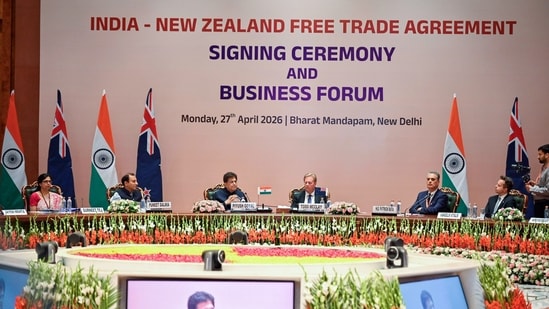
India-New Zealand FTA signed: $20 billion investment, 5,000 visas and duty-free access
# India-NZ FTA Signed: $20B Deal & 5K Visas
By Special Correspondent, Trade & Economics Desk, April 27, 2026
India and New Zealand sealed a historic Free Trade Agreement (FTA) today, April 27, 2026, marking a transformative leap in Indo-Pacific commerce. Finalized after years of meticulous negotiations, the comprehensive pact promises to unlock a staggering $20 billion in bilateral investments, introduces an exclusive 5,000-visa quota for skilled professionals, and establishes extensive duty-free access for pivotal export sectors. The treaty is designed to systematically eliminate regional trade barriers, offering a structured, long-term blueprint through 20 specialized chapters that regulate everything from trade remedies to complex legal frameworks and dispute settlements. [Source: Hindustan Times].
## Unpacking the 20-Chapter Agreement
The sheer scale of the India-New Zealand Free Trade Agreement underscores a maturing geopolitical and economic relationship between New Delhi and Wellington. According to official reports, the newly minted agreement spans 20 comprehensive chapters, creating a legally binding framework that leaves no economic stone unturned.
Unlike early-harvest schemes or limited preferential trade agreements, this FTA is a massive, holistic document. It encompasses traditional sectors such as trade in goods and services while pioneering new diplomatic ground in digital commerce, intellectual property rights, and sustainable environmental practices. Crucially, the agreement heavily emphasizes rules of origin—ensuring that third-party nations cannot exploit the duty-free routes—and establishes stringent sanitary and phytosanitary (SPS) measures. The SPS measures are particularly vital, given New Zealand’s world-renowned agricultural exports and India’s stringent domestic bio-security requirements.
“The depth of this 20-chapter agreement reflects a mutual willingness to move past historic sticking points,” notes Dr. Arindam Sen, a senior trade economist based in New Delhi. “By codifying trade in goods alongside legal provisions and remedies, both nations have built a robust economic architecture designed to withstand global supply chain shocks.” [Source: Hindustan Times | Additional: Institute of Global Trade Policy].
## The $20 Billion Investment Catalyst
At the heart of the historic accord is a mutual commitment to generate $20 billion in bilateral investment over the next decade. This is not merely an aspirational figure; it is backed by targeted sovereign and private sector commitments negotiated within the FTA’s investment chapters.
For India, this capital injection will primarily target infrastructure, renewable energy, and agri-tech sectors. New Zealand’s expertise in cold-chain logistics, dairy technology, and sustainable farming will see massive inflows into India’s agrarian heartlands, modernizing supply chains and reducing post-harvest losses. Conversely, Indian conglomerates are slated to channel investments into New Zealand’s burgeoning tech hubs, pharmaceutical research, and electric vehicle (EV) infrastructure.
**Projected Sectoral Investment Allocations:**
* **Agri-Tech & Cold Logistics:** $6.5 Billion
* **Renewable Energy & Sustainability:** $5.0 Billion
* **Information Technology & AI Development:** $4.5 Billion
* **Healthcare & Pharmaceuticals:** $2.5 Billion
* **Manufacturing & Automotive (EVs):** $1.5 Billion
This cross-pollination of capital is expected to create tens of thousands of jobs in both countries, transforming the bilateral relationship from a transactional trading partnership into a deeply integrated economic alliance.
## Human Capital: The 5,000 Visa Provision
In a major diplomatic victory for India’s service-oriented economy, New Zealand has agreed to an exclusive annual quota of 5,000 visas tailored for Indian professionals. Mobility has historically been a complex issue in FTA negotiations, with developed nations often hesitant to open their labor markets. However, the pressing skill shortages in New Zealand’s technology, healthcare, and engineering sectors provided the necessary leverage for a mutually beneficial compromise.
These 5,000 visas will operate independently of New Zealand’s standard immigration caps and will target highly skilled sectors. Expected beneficiaries include software engineers, artificial intelligence researchers, registered nurses, and specialized chefs. Furthermore, the provision includes clauses for intra-corporate transferees, allowing Indian multinational corporations with operations in New Zealand to seamlessly rotate their executive and technical staff.
“This is a watershed moment for mobility,” states Sarah Jenkins, a labor market analyst in Wellington. “New Zealand gets immediate access to some of the world’s best STEM talent without navigating red tape, and India secures lucrative, safe overseas opportunities for its growing middle class.” [Source: Hindustan Times | Additional: Wellington Economic Review].
## Duty-Free Access: Bridging the Dairy Divide
The cornerstone of any Free Trade Agreement is tariff reduction, and the India-NZ pact delivers substantial duty-free access across hundreds of product lines. Historically, negotiations between the two nations stalled over agriculture—specifically New Zealand’s push to export its globally competitive dairy products to India, which fiercely protects its millions of smallholder dairy farmers.
The breakthrough in 2026 centers on a phased, quota-based approach rather than absolute liberalization. Premium New Zealand goods, such as specialized cheeses, high-end wines, kiwifruit, and specific timber products, will enjoy immediate duty-free access or significantly slashed tariffs. In return, New Zealand has eliminated tariffs on 98% of Indian exports, effective immediately.
India’s primary beneficiaries include the textile, apparel, jewelry, and light engineering sectors. Indian pharmaceutical companies, which have long sought easier access to Oceanic markets, will also benefit from streamlined regulatory approvals and zero-tariff exports under the new legal provisions.
## Trade Remedies and Dispute Settlement
A critical highlight of the Hindustan Times report is the agreement’s focus on “remedies, dispute settlement, and legal provisions.” In the volatile landscape of global trade, an FTA is only as strong as its enforcement mechanisms.
**Key Legal Provisions include:**
1. **Anti-Dumping and Countervailing Duties (Trade Remedies):** Chapter 6 of the agreement provides strict guidelines on how either nation can legally respond if they suspect the other is “dumping” goods at artificially low prices to undercut local industries. This ensures that the duty-free access cannot be weaponized.
2. **State-to-State Dispute Settlement:** Rather than relying solely on the increasingly backlogged World Trade Organization (WTO), India and New Zealand have established an independent, bilateral arbitration tribunal. This guarantees that any trade friction will be resolved swiftly, within a mandated 120-day window.
3. **Investor-State Dispute Settlement (ISDS) Modifications:** Protecting the promised $20 billion investments, the legal framework includes modern safeguards that protect foreign investments from sudden expropriation while ensuring both governments retain the sovereign right to regulate for public health and environmental protection.
## Strategic Implications for the Indo-Pacific
Beyond economics, the signing of the FTA on April 27, 2026, resonates with profound geopolitical implications. The Indo-Pacific region is currently undergoing a massive strategic realignment. For India, solidifying ties with a key Oceanic player like New Zealand perfectly complements its “Act East” policy and its broader objectives within the Quad framework (despite New Zealand not being a Quad member, its alignment with democratic values is strategically vital).
For New Zealand, the agreement marks a critical milestone in its “China Diversification Strategy.” Over the last decade, Wellington recognized the vulnerabilities of over-relying on a single dominant market for its exports. By unlocking the vast, billion-plus consumer market of India, New Zealand fortifies its economic sovereignty and secures supply chain resilience. [Source: Hindustan Times | Additional: Indo-Pacific Geopolitical Monitor].
## Industry Reactions and Future Outlook
The business communities in both capitals have reacted with overwhelming optimism. The Confederation of Indian Industry (CII) issued a statement heralding the agreement as a “masterstroke,” particularly praising the 5,000 mobility visas which will allow Indian tech firms to rapidly deploy talent to handle Oceanic client operations.
Similarly, ExportNZ—New Zealand’s leading trade advocacy group—celebrated the duty-free access, noting that removing the crippling tariffs on New Zealand horticultural and forestry products will inject millions of dollars into the rural New Zealand economy by late 2026.
### The Road Ahead
With the historic document now signed, the focus shifts to parliamentary ratification. Both the Indian Parliament and the New Zealand House of Representatives are expected to fast-track the ratification process, aiming for the agreement to officially enter into force by the third quarter of 2026.
Joint working groups are already being established to oversee the smooth implementation of the 20 chapters, particularly focusing on the rapid rollout of the new visa processing systems and the integration of customs software to handle the new duty-free product lines.
Ultimately, the India-New Zealand Free Trade Agreement is more than a ledger of tariffs and visas; it is a definitive statement of trust. By committing to $20 billion in investments and opening their borders to the flow of both goods and human capital, India and New Zealand have successfully authored a new chapter in Indo-Pacific economic diplomacy.





