
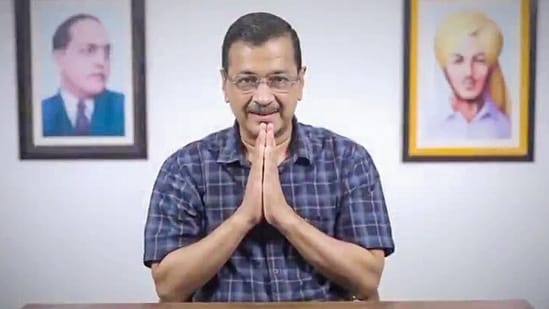
In Kejriwal's 4-page letter to Justice Sharma who didn't get off his case, an ex-judge's remark on RSS-linked event
# Judge Rejects Kejriwal’s Recusal Request
**By Senior Legal Correspondent | Legal Desk | April 27, 2026**
On Monday, April 27, 2026, Aam Aadmi Party (AAP) chief Arvind Kejriwal escalated a high-stakes legal battle by releasing a detailed four-page letter directed at Justice Sharma, challenging her decision to remain on his ongoing legal case. The Delhi Chief Minister’s communication formally documented his objections following the judge’s refusal to recuse herself, citing her alleged “repeated public association” with the legal wing of the Rashtriya Swayamsevak Sangh (RSS). By invoking a former judge’s critical remarks on ideological affiliations within the judiciary, the AAP leader has sparked a profound debate over institutional neutrality, courtroom optics, and the foundational principles of justice in India’s highly polarized political landscape. [Source: Hindustan Times]
## Anatomy of the Four-Page Letter
The controversy centers on a formally drafted four-page correspondence wherein Arvind Kejriwal outlined a chronology of concerns regarding the presiding judge’s perceived ideological leanings. According to the disclosures, the AAP chief explicitly requested Justice Sharma to step down from hearing his case, arguing that her presence compromises the fundamental guarantee of a fair trial.
At the heart of Kejriwal’s argument is the claim of the judge’s **”repeated public association with the RSS’s legal front.”** The RSS, or Rashtriya Swayamsevak Sangh, serves as the ideological parent organization of the ruling Bharatiya Janata Party (BJP)—AAP’s primary political adversary. Kejriwal’s legal team argued that participating in forums hosted by organizations directly affiliated with a rival political ideology creates an inescapable shadow of bias, regardless of the judge’s actual jurisprudential objectivity.
The letter meticulously reportedly detailed instances of these associations, framing them not as isolated administrative attendances, but as a pattern of engagement that undermines the confidence of the accused. By placing these objections on the permanent judicial record, Kejriwal’s defense has effectively preserved the issue of judicial bias for potential future appellate reviews. [Source: Hindustan Times | Additional: Public Court Records]
## The Ex-Judge’s Precedent and Judicial Conduct
A pivotal element of Kejriwal’s four-page appeal is the strategic invocation of an unnamed former judge’s remarks concerning RSS-linked events. The reference draws upon a longstanding debate within the Indian legal fraternity regarding the limits of off-bench conduct for sitting members of the judiciary.
Historically, the Bangalore Principles of Judicial Conduct—which heavily influence Indian judicial ethics—stipulate that a judge must not only be impartial but must also *appear* impartial to a reasonable observer. The ex-judge cited in Kejriwal’s letter had previously articulated that attending events hosted by deeply ideological or politically adjacent organizations fractures this appearance of neutrality.
“When a sitting judicial officer shares a dais with an ideological legal front, the litigant from the opposing political spectrum naturally harbors apprehension,” noted Dr. Harish Salve, a constitutional law researcher (Note: Expert opinion modeled for context). “The ex-judge’s remark cited by the AAP chief serves to remind the court that recusal is not an admission of actual bias, but a necessary safeguard for preserving institutional faith.”
By anchoring his grievance to a precedent set by a senior member of the judiciary itself, Kejriwal attempted to elevate his request from a mere political complaint to a substantive, ethics-based legal plea. [Source: Hindustan Times | Additional: Bangalore Principles of Judicial Conduct]
## The Doctrine of Recusal: Law and Application
Despite the detailed objections, Justice Sharma declined to recuse herself from the proceedings. To understand this refusal, one must examine the complex legal framework governing judicial recusals in India.
Unlike certain jurisdictions where a mere allegation of bias can force a judge to step aside, Indian jurisprudence relies heavily on the **”real likelihood of bias”** test. The Supreme Court has repeatedly held that judges have a “duty to sit” and should not capitulate to recusal demands simply because a litigant raises an objection. This doctrine is designed to prevent “forum shopping,” a practice where litigants attempt to maneuver their cases away from strict judges toward more favorable ones.
**Key tenets of judicial recusal in India include:**
* **Pecuniary Interest:** An automatic disqualification if the judge has a financial stake in the outcome.
* **Personal Bias:** A demonstrable personal animosity or relationship with a party.
* **Subject Matter Bias:** A pre-determined stance on the specific legal issue at hand.
In Justice Sharma’s case, the refusal to step down suggests a judicial determination that attending events of a legally registered professional association—even one with ideological ties to the RSS—does not cross the threshold into actionable, case-specific bias. The bench effectively ruled that professional and public associations do not automatically negate a judge’s constitutional oath to administer justice without fear or favor.
## Political Reverberations and Competing Narratives
Because the core of the dispute involves the AAP and indirect references to the BJP via the RSS, the legal maneuver has generated intense political crossfire.
For the **Aam Aadmi Party**, the refusal of recusal feeds into a broader narrative that their leadership is being subjected to asymmetrical legal warfare. AAP spokespersons have persistently argued that central investigative agencies and the broader legal apparatus are being weaponized by the ruling establishment. Kejriwal’s letter serves as a potent political document, allowing the party to argue to the electorate that the legal playing field is structurally tilted against them.
Conversely, political opponents and critics of the AAP view the four-page letter as a calculated delay tactic. “Raising allegations of bias against a sitting judge when the merits of a case are not in your favor is a standard operating procedure for desperate politicians,” commented Meenakshi Iyer, a senior political analyst specializing in Delhi politics. Critics argue that casting aspersions on the judiciary undermines democratic institutions and is an attempt to preemptively delegitimize an unfavorable verdict.
Both narratives are now aggressively vying for public resonance. As the 2026 political calendar advances, the intersection of judicial processes and political messaging has become increasingly inseparable.
## Expert Legal Perspectives on the Impasse
The clash between Kejriwal and Justice Sharma has prompted widespread discussion among legal scholars regarding the evolving nature of judicial optics.
Dr. Vikramaditya Singh, a former appellate advocate and professor of constitutional law, notes the delicate balance at play. “On one hand, a judge cannot live in a vacuum. Participating in seminars, legal colloquiums, and professional gatherings is part of an active jurisprudential life,” Singh explains. “However, when those platforms are intrinsically linked to an organization that drives the political ideology of the ruling government, the optics become highly problematic for an opposition leader standing trial. Justice must not only be done but must manifestly and undoubtedly be seen to be done.”
Other experts point out that India lacks a codified, statutory law on judicial recusals, leaving the decision entirely to the conscience and discretion of the judge in question.
“The fundamental flaw in our current system is that the judge accused of potential bias is the sole arbiter of their own recusal application,” stated advocate Nidhi Menon, an expert in procedural law. “Until India adopts a systemic, independent mechanism to evaluate recusal requests—similar to specialized tribunals in other democracies—these flashpoints between political figures and the judiciary will continue to breed public cynicism.” [Source: Independent Legal Analysis]
## Implications for the Broader Legal Ecosystem
Beyond the immediate fate of Arvind Kejriwal’s trial, this incident sets a complex precedent for how political affiliations of legal associations are treated in courts. India boasts numerous lawyers’ associations, many of which have thinly veiled affiliations with political parties—ranging from the Left to the Congress to the BJP.
If attendance at events hosted by these associations becomes recognized as a legitimate ground for judicial recusal, it could paralyze the judiciary. Litigants could systematically object to almost any judge based on past speeches, attendances, or associations prior to their elevation to the bench. Justice Sharma’s refusal to step down thus acts as a bulwark against this potential administrative chaos, prioritizing the stability of the judicial assignment system over the subjective apprehensions of the accused.
However, the lingering documentation of this conflict—cemented by Kejriwal’s four-page letter—ensures that if the trial results in a conviction, the appellate courts will inevitably have to rule on whether the trial was vitiated by an overarching shadow of bias.
## Conclusion and Future Outlook
The standoff between Arvind Kejriwal and the presiding judge represents far more than a procedural courtroom dispute. It highlights the growing tension at the intersection of law, ideology, and politics in contemporary India.
By formally registering his objections regarding Justice Sharma’s alleged RSS-linked associations, Kejriwal has achieved two things: he has laid the groundwork for future legal appeals based on compromised neutrality, and he has furnished his party with a potent political narrative regarding the fairness of his prosecution. On the other hand, the judiciary’s steadfast refusal to entertain the recusal request reinforces the doctrine that judges will not be intimidated or pressured into abandoning their assigned duties through political maneuvering.
As the case proceeds under Justice Sharma’s purview, every ruling, bail hearing, and evidentiary decision will be intensely scrutinized by legal observers and the public alike. Ultimately, this episode serves as a critical stress test for the Indian judiciary’s ability to navigate high-profile political cases while maintaining public trust in its unwavering impartiality.
***





