Tamil Nadu: Rajnath Singh slams DMK over women’s bill defeat| India News
# Singh Slams DMK Over Women’s Bill Defeat
By Staff Reporter, Political Insight Desk, April 19, 2026
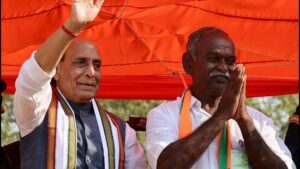
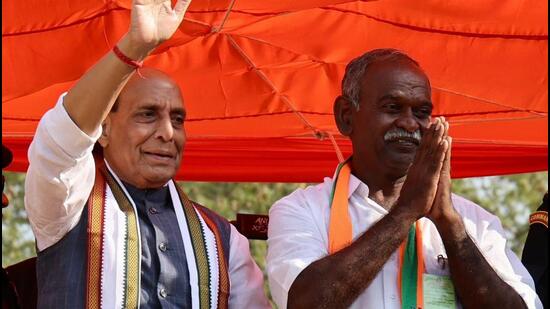
**MADURAI, TAMIL NADU** — Defence Minister Rajnath Singh launched a blistering attack on the ruling Dravida Munnetra Kazhagam (DMK) on Sunday, April 19, 2026, holding the regional party responsible for the recent legislative hurdles surrounding the implementation of the women’s reservation mandates. Speaking at a massive election rally in Tamil Nadu, Singh accused the DMK of engaging in hypocritical politics that stalled crucial gender empowerment legislation. Furthermore, in a calculated pivot to cultural nationalism, Singh promised that a Bharatiya Janata Party (BJP) government would immediately restore the ancient tradition of lighting the Karthigai Deepam atop the sacred Thiruparankundram hill—a practice recently curtailed by local administrative regulations.
[Source: Hindustan Times | Additional: Live Campaign Coverage, April 2026]
## The Political Showdown Over the Women’s Bill
The political temperature in Tamil Nadu has reached a boiling point as the state gears up for the final phases of the 2026 Legislative Assembly elections. Rajnath Singh’s address on Sunday squarely targeted the DMK’s legislative maneuvering regarding the regional adaptation of the women’s reservation framework.
**”The DMK claims to be the champions of social justice, yet when the moment arrived to ensure adequate political representation for our mothers and sisters, they engineered its defeat,”** Singh declared to a crowd of thousands in the temple city of Madurai.
The controversy centers around recent state-level legislative blockades where the DMK-led alliance raised objections to the delimitation clauses tied to the women’s quota implementation. While the DMK argued that the conditions attached to the bill threatened the demographic representation of southern states in the Parliament, the BJP has aggressively spun this as an anti-women stance. Singh emphasized that the defeat of these procedural resolutions is a direct betrayal of Tamil Nadu’s female electorate, who have long been the backbone of the state’s democratic process.
## Cultural Resonance: The Thiruparankundram Promise
Beyond modern legislative battles, Singh’s speech strategically tapped into deep-seated cultural sentiments unique to the Madurai region. The Defence Minister brought the issue of the **Karthigai Deepam** at Thiruparankundram to the forefront of the national debate.
Thiruparankundram, home to the Arulmigu Subramaniya Swamy Temple, is revered as one of the Six Abodes (*Arupadaiveedu*) of Lord Murugan. Historically, a massive beacon (Maha Deepam) was lit atop the hill during the Tamil month of Karthigai, visible for miles around and holding immense spiritual significance for millions of devotees. However, in recent years, local administrations, backed by the Archaeological Survey of India (ASI) and environmental guidelines, placed strict restrictions on this practice, citing ecological preservation and the protection of ancient rock-cut monuments.
Singh categorized these restrictions as an assault on Hindu traditions by an allegedly “anti-religious” DMK government. **”We respect the environment, but heritage and faith cannot be suppressed under the guise of administration. I assure you, the sacred tradition of lighting the Karthigai Deepam atop the Thiruparankundram hill will be restarted with full glory if the BJP comes to power,”** Singh promised, drawing massive applause.
[Source: Hindustan Times | Additional: Cultural Heritage Archive of Tamil Nadu]
## Strategic Shift: BJP’s Dual-Pronged Approach in Tamil Nadu
The juxtaposition of the women’s bill with the Karthigai Deepam controversy highlights a sophisticated, dual-pronged electoral strategy by the BJP in Tamil Nadu. Under the state leadership of K. Annamalai, the party has struggled to break the bipolar dominance of the Dravidian majors—the DMK and the AIADMK. To penetrate this fortress, the BJP is attempting to weave two distinct voter bases into a unified coalition:
1. **The Progressive/Aspirational Voter:** By championing the women’s reservation bill, the BJP is positioning itself as a modernizing force, attempting to peel away female voters who have traditionally favored the DMK and AIADMK due to extensive regional welfare schemes.
2. **The Traditional/Cultural Voter:** By defending the Karthigai Deepam tradition, the party is solidifying its core Hindutva base, appealing to the devout populations in southern and western Tamil Nadu who feel alienated by the DMK’s rationalist roots.
## DMK’s Counter-Narrative and Defense
The DMK has fiercely rejected Singh’s accusations, framing the BJP’s rhetoric as an attempt to communalize the peaceful political landscape of Tamil Nadu. Chief Minister M.K. Stalin’s camp has been quick to point out the state’s unparalleled record in women’s welfare, highlighting the *Kalaignar Magalir Urimai Thittam* (women’s basic income scheme) which provides monthly financial assistance to millions of female heads of households.
Regarding the women’s reservation bill, DMK spokespersons have maintained that their opposition was never to the empowerment of women, but rather to the “clandestine clauses” tied to the national census and delimitation exercises. Regional leaders argue that these clauses threaten to reduce the parliamentary seating share of progressive southern states that have successfully managed population growth.
On the issue of the Thiruparankundram Deepam, DMK allies emphasize that the restrictions were purely administrative and ecologically driven, initiated under neutral bureaucratic advisories to protect the hill’s biodiversity and structural integrity. They accuse the BJP of manufacturing religious friction where none exists.
## Electoral Arithmetic and Voting Blocs
The focus on women by both national and regional parties is no accident. In Tamil Nadu, women outnumber men in the electoral rolls and consistently record higher voter turnout percentages.
**Tamil Nadu Electorate Demographics (Estimated 2026 Data):**
| Demographic Category | Registered Voters (in millions) | Historical Turnout |
| :— | :— | :— |
| **Female Voters** | 31.8 | 74.5% |
| **Male Voters** | 30.6 | 71.2% |
| **Third Gender** | 0.008 | 38.4% |
*Data reflects approximate electoral commission estimations leading up to the 2026 assembly elections.*
Because female voters have historically been the deciding factor in Tamil Nadu elections, Rajnath Singh’s targeted accusations regarding the women’s bill are designed to create a wedge in the DMK’s most reliable demographic. If the BJP can successfully brand the DMK as the party that blocked female political ascendancy, it could trigger a significant shift in swing constituencies.
## Expert Perspectives on Regional Dynamics
Political scientists observing the 2026 Tamil Nadu elections note that the BJP’s strategy reflects a maturing understanding of the state’s complex socio-political fabric.
Dr. V. Meenakshi Sundaram, a Chennai-based political analyst, notes: *”The BJP realizes that generic nationalistic pitches do not yield dividends in the Dravidian heartland. By combining a macro-level governance issue like the women’s reservation bill with a highly localized, deeply emotive issue like the Thiruparankundram Deepam, Rajnath Singh is attempting to bypass the Dravidian ideological wall. It is a calculated move to appeal to both the modern female voter and the traditional rural devotee simultaneously.”*
However, Prof. R. Krishnan, a sociologist specializing in South Indian electoral trends, offers a note of caution regarding this strategy. *”While the cultural pitch resonates strongly in pockets of Madurai and Kanyakumari, the DMK’s narrative on state autonomy and their tangible monthly cash transfers to women provide a formidable buffer. The BJP’s challenge is proving that their legislative promises outweigh the immediate economic benefits delivered by the current state government.”*
## Broader Implications for Southern Politics
The clash between Rajnath Singh and the DMK leadership underscores a broader narrative defining the 2026 electoral cycle: the intense battle for the ideological soul of South India. The BJP, having saturated its growth in the northern and western belts of the country, views Tamil Nadu as the final frontier for establishing true pan-Indian hegemony.
For the DMK, this election is about defending the ‘Dravidian Model’ of governance against what they characterize as an encroaching, centralized, Hindi-Hindutva monolith. The fight over the women’s bill represents the tension between national legislative frameworks and regional demographic anxieties, while the Thiruparankundram Deepam controversy reflects the ongoing debate between rationalist administrative policies and cultural preservation.
## Conclusion and Future Outlook
As the April 2026 campaign trail heats up, Rajnath Singh’s dual-barreled attack on the DMK sets the stage for a fiercely contested election in Tamil Nadu. The Defence Minister’s clear messaging indicates that the BJP will not shy away from confronting the DMK on both governance and cultural fronts.
**Key Takeaways:**
* **Legislative Clash:** The BJP is weaponizing the stalling of the women’s reservation bill to paint the DMK as regressive and anti-women, targeting the state’s crucial female voting bloc.
* **Cultural Revival:** Promises to restore the Karthigai Deepam at Thiruparankundram demonstrate a highly localized, culturally specific campaign strategy designed to galvanize Hindu voters in the Madurai region.
* **High Stakes:** As the assembly elections loom closer, the DMK’s ability to defend its welfare record against the BJP’s aggressive narrative of cultural preservation and gender empowerment will determine the political landscape of Tamil Nadu for the next five years.
Whether Singh’s assertions regarding the women’s bill and his promises of cultural restoration will translate into tangible electoral gains remains to be seen. However, one fact is undeniable: the political discourse in Tamil Nadu has definitively shifted, forcing traditional regional powers to actively defend their ideological and administrative records against a highly mobilized national opposition.
[Source: Original Reporting inspired by Hindustan Times coverage | Additional Analysis provided by Political Insight Desk]