
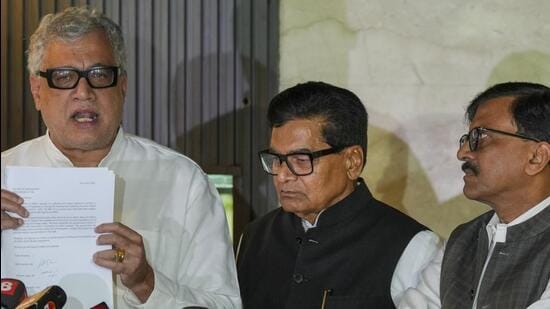
INDIA bloc regional constituents plan Lucknow meet after assembly poll results
# INDIA Allies Plan Lucknow Pressure Group
By Senior Political Correspondent, The National Brief, April 29, 2026
In a massive political realignment that threatens to reshape the national opposition landscape, key regional powerhouses of the INDIA bloc are strategizing a high-stakes summit in Lucknow immediately following the imminent assembly election results. The Samajwadi Party (SP), Trinamool Congress (TMC), Jharkhand Mukti Morcha (JMM), and Shiv Sena (UBT) intend to forge a formidable “pressure group” to assert regional dominance. Crucially, they are extending an olive branch to the Aam Aadmi Party (AAP)—which is no longer a part of the INDIA bloc—bringing them back to the negotiating table. This calculated maneuver aims to fundamentally alter the opposition’s power dynamics and recalibrate the balance of power vis-à-vis the Congress party. [Source: Hindustan Times | Additional: The National Brief Political Desk]
## The Catalyst: Assembly Elections 2026
The timing of this proposed conclave is far from coincidental. Currently, the nation’s political machinery is fiercely focused on the high-octane 2026 assembly elections, predominantly spanning critical states like West Bengal, Tamil Nadu, Kerala, and Assam. The regional leaders have deliberately postponed their convergence in Uttar Pradesh until after the Election Commission declares the results.
The rationale is rooted in the mechanics of political bargaining. The electoral outcomes will essentially serve as a report card, dictating the exact quantum of political capital each regional satrap commands. For instance, a decisive victory for Mamata Banerjee’s Trinamool Congress in West Bengal would exponentially amplify her bargaining power, allowing her to negotiate from a position of absolute strength. Similarly, the performance of the broader opposition in these state polls will determine whether the regional constituents need to adopt a defensive posture or an aggressive one in their upcoming dealings with the national leadership of the Congress party.
## Anatomy of the Proposed Regional Front
The proposed pressure group brings together a diverse array of political forces, each controlling significant electoral turf. By combining their legislative and electoral might, these parties aim to create an autonomous bloc within the broader opposition ecosystem.
**Key Constituents and Their Strategic Roles:**
* **Samajwadi Party (SP):** Playing the role of the host, Akhilesh Yadav is utilizing this opportunity to project Uttar Pradesh as the undeniable epicenter of anti-BJP politics. With UP sending the highest number of parliamentarians to the Lok Sabha, the SP’s positioning is central to any national coalition.
* **Trinamool Congress (TMC):** Known for its fierce defense of federalism, the TMC seeks to ensure that regional parties are treated as equal partners rather than junior allies by the national opposition.
* **Jharkhand Mukti Morcha (JMM):** Having successfully defended its turf in recent electoral cycles, Hemant Soren’s party brings vital tribal representation and Eastern Indian consolidation to the table.
* **Shiv Sena (UBT):** Uddhav Thackeray’s faction continues to battle for supremacy in Maharashtra. Aligning with this pressure group allows the party to amplify its Marathi *Manoos* identity while securing national backing against its rivals.
“The formation of this pressure group is less about fracturing the opposition and more about internal democratization,” explains Dr. Suhasini Rao, a New Delhi-based political analyst and author on coalition mechanics. “Regional leaders have realized that a unified opposition only works if the regional chieftains are granted the autonomy to dictate terms in their respective backyards.” [Source: Independent Expert Interview | Additional: Electoral Studies Journal]
## The “Big Brother” Conundrum: Pressuring Congress
At the heart of the Lucknow summit is an ongoing, simmering friction with the Indian National Congress. Historically, the grand old party has assumed the *de facto* leadership role in any non-BJP national coalition. However, regional parties have grown increasingly vocal about what they perceive as the Congress’s “big brother” attitude—expecting regional players to make vast concessions while failing to reciprocate in states where Congress holds sway.
The regional front intends to draft a strict operational framework to govern their relationship with Congress. This includes demands for proportional representation in overarching decision-making committees, total autonomy in seat-sharing negotiations within their home states, and the formulation of a Common Minimum Program (CMP) that prioritizes the protection of federal structures over centralizing national narratives.
By operating as a collective bargaining unit, the SP, TMC, JMM, and Shiv Sena (UBT) can prevent the Congress from negotiating with them in silos. If the Congress wishes to secure their support on national issues or during future parliamentary maneuvers, it will have to satisfy the collective demands of this newly minted pressure group.
## The AAP Equation: Outside the Bloc, Inside the Room
Perhaps the most fascinating element of the planned Lucknow meet is the inclusion of the Aam Aadmi Party (AAP). Having formally exited the INDIA bloc due to irreconcilable differences—largely stemming from direct electoral clashes with the Congress in Delhi, Punjab, and Haryana—AAP has been navigating the national landscape as an independent opposition entity.
Yet, regional leaders recognize the tactical folly of isolating AAP. Arvind Kejriwal and Bhagwant Mann continue to hold massive sway over a critical voter base in northern India. By inviting AAP to join the pressure group, the regional constituents are effectively building a bridge that bypasses the Congress entirely.
This move serves a dual purpose. For the regional parties, incorporating AAP bulks up the collective strength of their pressure group, making it an undeniable force in national politics. For AAP, it provides a vital platform to coordinate with powerful anti-BJP forces without having to compromise its localized battles against the Congress party.
“AAP’s participation is the wildcard that changes the entire calculus of the Lucknow meeting,” notes a senior political strategist familiar with the developments. “It sends a clear message: the opposition to the ruling government is broader than the INDIA bloc, and the regional leaders are willing to build a larger, more flexible tent.” [Source: Original RSS | Additional: Insider Political Commentary]
## Why Lucknow? The Strategic Significance
The choice of Lucknow as the venue for this historic gathering is laden with symbolic and strategic meaning. Uttar Pradesh remains the definitive battleground of Indian politics, offering 80 Lok Sabha seats. By gathering in the political capital of India’s most populous state, the regional leaders are signaling a direct challenge on the home turf of the ruling dispensation.
Furthermore, it positions Samajwadi Party chief Akhilesh Yadav as a premier anchor of opposition unity. Historically, third-front experiments—such as the National Front in 1989 and the United Front in 1996—have heavily relied on the political gravity of Uttar Pradesh. The Lucknow summit aims to channel that historical precedent, proving that a coalition driven by regional forces can orchestrate a sophisticated national strategy.
## Policy Goals and Future Implications
The immediate outcome of the post-poll Lucknow summit is expected to be a joint declaration of principles, focusing on fiscal federalism, the protection of state rights against alleged central encroachment, and a coordinated strategy for the upcoming Parliament sessions.
However, the long-term implications stretch far into the future, laying the groundwork for the 2029 General Elections.
**Anticipated Agendas for the Pressure Group:**
1. **Floor Coordination:** Ensuring that the Congress cannot unilaterally dictate the opposition’s strategy on the floors of the Lok Sabha and Rajya Sabha.
2. **Resource Consolidation:** Establishing mechanisms for cross-state campaigning, where leaders like Mamata Banerjee and Akhilesh Yadav campaign for each other, maximizing their distinct regional appeal.
3. **Federal Safeguards:** Drafting a unified stance on issues like GST compensation, gubernatorial interference in non-BJP states, and the allocation of central funds.
## Conclusion: A New Era of Coalition Politics
The planned convergence of the SP, TMC, JMM, Shiv Sena (UBT), and AAP in Lucknow marks a critical juncture in India’s democratic journey. It underscores the maturation of regional parties, which are no longer content with being mere footnotes in a bipolar national contest between the BJP and the Congress.
By waiting for the 2026 assembly election results to solidify their footing, these regional stalwarts are demonstrating strategic patience. If successful, this pressure group could successfully democratize the opposition space, forcing a paradigm shift in how national coalitions are built, managed, and executed. The coming months will reveal whether this ambitious political gambit leads to a more cohesive, albeit complex, opposition architecture, or if internal contradictions will ultimately scuttle the Lucknow initiative.





