
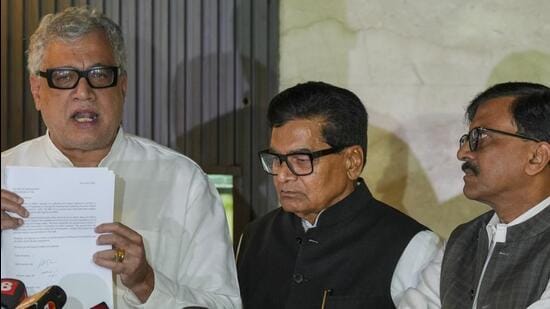
INDIA bloc regional constituents plan Lucknow meet after assembly poll results
# INDIA Allies Plan Lucknow Meet Post-Polls
By Senior Political Correspondent, National Desk | April 29, 2026
Regional heavyweights of the opposition INDIA bloc are scheduled to convene a high-stakes strategic meeting in Lucknow immediately following the upcoming assembly election results. According to insider reports, leaders from the Samajwadi Party (SP), Trinamool Congress (TMC), Jharkhand Mukti Morcha (JMM), and Shiv Sena (UBT) aim to form a formidable “pressure group” to renegotiate power dynamics within the national opposition. Significantly, the Aam Aadmi Party (AAP)—which recently distanced itself from the primary INDIA alliance structure—is also slated to participate. This unprecedented consolidation of regional forces seeks to challenge the centralized decision-making of the Congress party and recalibrate the opposition’s master strategy ahead of the next parliamentary cycle. [Source: Hindustan Times]
## The Lucknow Conclave: A New Center of Gravity
The choice of Lucknow as the venue for this crucial meeting is highly symbolic. As the capital of Uttar Pradesh—India’s most politically crucial state, sending 80 members to the Lok Sabha—Lucknow serves as the home turf for **Akhilesh Yadav** and the Samajwadi Party. By hosting this summit, the SP is positioning itself as the anchor of regional resistance, not just against the ruling National Democratic Alliance (NDA), but also as a balancing force against the Congress’s traditional “big brother” attitude within the opposition.
Political insiders suggest that the primary objective of this conclave is the formalization of a sub-coalition or “pressure group.” For months, murmurs of discontent have rippled through the regional ranks of the INDIA bloc. Regional leaders have privately and publicly expressed frustration over what they perceive as delayed seat-sharing formulas, lack of cohesive joint campaigning, and unilateral narrative-setting by the national leadership in New Delhi.
By banding together, the SP, TMC, JMM, Shiv Sena (UBT), and AAP intend to create a collective bargaining unit. When these parties speak with one voice, their combined electoral footprint across Uttar Pradesh, West Bengal, Jharkhand, Maharashtra, Punjab, and Delhi represents a massive vote bank that the Congress simply cannot afford to alienate. [Source: Hindustan Times | Additional: Regional Coalition Dynamics 2026]
## AAP’s Surprise Return to the Regional Equation
Perhaps the most startling revelation from the proposed Lucknow meeting is the inclusion of the **Aam Aadmi Party (AAP)**. Led by **Arvind Kejriwal**, AAP had previously stepped away from the formal INDIA bloc structure following intense factionalism and localized rivalries with the Congress in key northern states like Punjab and Delhi.
However, AAP’s participation in the Lucknow conclave highlights a pragmatic shift in Indian politics. While AAP may no longer be a formal constituent of the Congress-led INDIA bloc, its ideological opposition to the ruling Bharatiya Janata Party (BJP) remains absolute. The regional leaders recognize that any non-BJP front is mathematically and electorally weaker without AAP’s administrative stronghold in Delhi and Punjab.
“AAP’s involvement suggests a transition from rigid national alliances to fluid, issue-based regional networking,” notes Dr. Meenakshi Iyer, a senior political analyst specializing in coalition structures. “The regional chieftains are essentially telling the Congress: ‘If you cannot accommodate AAP, we will create a parallel framework that does.’ It is a masterclass in coalition leverage.”
## The “Pressure Group” Blueprint
What exactly does a “pressure group” entail in the context of the INDIA bloc? According to sources close to the development, this inner circle does not seek to dismantle the INDIA bloc. Instead, it aims to establish a set of non-negotiable terms for future cooperation. The proposed blueprint for this regional front includes several core demands:
* **Proportional Representation in Leadership:** Moving away from a Congress-centric leadership model to a rotating chair or a formalized presidium where regional leaders have equal veto power.
* **State-Specific Autonomy:** Ensuring that the dominant regional party in any given state dictates the campaign narrative, candidate selection, and resource allocation without interference from national headquarters.
* **Common Minimum Program (CMP) Revisions:** Drafting an updated socio-economic policy document that heavily favors federalism, greater devolution of financial resources to states, and localized welfare schemes over centralized manifesto promises.
* **Unified Action Outside Parliament:** Coordinating grassroots protests, legal challenges, and media narratives independently of the Congress framework when regional interests are threatened.
## Decoding the Electoral Map: Strength in Numbers
To understand the weight of this proposed Lucknow front, one must look at the electoral geography controlled by these five parties.
| Party | Primary Stronghold | Key Leader | Regional Status |
| :— | :— | :— | :— |
| **Samajwadi Party (SP)** | Uttar Pradesh | Akhilesh Yadav | Primary Opposition |
| **Trinamool Congress (TMC)** | West Bengal | Mamata Banerjee | Ruling Party |
| **Aam Aadmi Party (AAP)** | Punjab, Delhi | Arvind Kejriwal | Ruling Party |
| **Jharkhand Mukti Morcha (JMM)** | Jharkhand | Hemant Soren | Ruling Party |
| **Shiv Sena (UBT)** | Maharashtra | Uddhav Thackeray | Primary Opposition Alliance |
Combined, these parties influence states that send over 200 Members of Parliament to the Lok Sabha. **Mamata Banerjee’s** TMC in West Bengal and **Hemant Soren’s** JMM in Jharkhand have successfully defended their turfs against aggressive campaigns by the ruling national party. Meanwhile, **Uddhav Thackeray’s** faction of the Shiv Sena commands immense emotional and electoral capital in Maharashtra. When unified, this bloc transforms from a disjointed group of state-level operators into a national powerhouse capable of dictating terms. [Source: Hindustan Times | Additional: Election Commission Data Archives]
## State Elections 2026: The Ultimate Catalyst
The timing of the Lucknow conclave is far from coincidental. It is scheduled precisely *after* the results of the pivotal Spring 2026 state assembly elections. These elections—featuring high-stakes battles in states like West Bengal, Assam, Kerala, and Tamil Nadu—are widely viewed as a mid-term referendum on both the ruling NDA and the opposition’s viability.
For the TMC, defending West Bengal is a matter of existential importance. If Mamata Banerjee secures another decisive mandate, her bargaining power within the national opposition will skyrocket. Similarly, the performance of the Congress in states where it faces direct contests will heavily influence the power dynamics at the Lucknow table.
“Regional parties are waiting for the assembly election scorecards,” explains Rajan Trivedi, a senior political commentator and author. “If the regional satraps hold their ground while the national opposition falters, the Lucknow meeting will serve as a coronation of a new opposition high command. They are essentially waiting for the data to back up their demands for a larger share of the political pie.”
## The Congress Conundrum
For the Grand Old Party, the developments in Lucknow present a complex political conundrum. On one hand, a strong, consolidated regional front is essential for taking on the formidable election machinery of the NDA. On the other hand, the formation of this pressure group signals a direct challenge to the Congress’s historical claim as the natural leader of the secular opposition.
The Congress will likely have to make significant concessions to keep this pressure group aligned with the broader INDIA bloc. This could mean sacrificing seats in key states, conceding the prime ministerial narrative, or publicly endorsing regional leaders for pivotal national roles. Failure to accommodate these demands could lead to a permanent fracturing of the anti-incumbency vote, a scenario that historically benefits the ruling establishment.
## Strategic Implications for the Ruling NDA
While the opposition grapples with internal realignments, the ruling BJP and its NDA allies are closely monitoring the situation. A fragmented opposition has traditionally worked in the NDA’s favor, allowing them to sweep multi-cornered contests. However, if the Lucknow conclave successfully creates a tight, disciplined regional alliance that coordinates seat-sharing without the friction of national party interference, the NDA could face a formidable localized challenge in the Hindi heartland, the East, and the West.
BJP strategists are likely to frame the Lucknow meeting as evidence of the INDIA bloc’s inherent instability, pointing to the return of AAP and the shifting alliances as opportunistic politics. The narrative of “strong, stable national leadership versus chaotic, opportunistic regional alliances” will undoubtedly feature heavily in the ruling party’s upcoming campaigns.
## Conclusion and Future Outlook
The planned Lucknow meeting of the SP, TMC, JMM, Shiv Sena (UBT), and AAP marks a watershed moment in India’s coalition politics of the late 2020s. By moving to form a dedicated pressure group, these regional titans are signaling the end of an era where a single national party could dictate opposition strategy by default.
As the dust settles on the 2026 assembly elections, all eyes will turn to Uttar Pradesh’s capital. The success or failure of this conclave will not merely determine the internal hierarchy of the INDIA bloc; it will likely draft the overarching political blueprint for the next general elections. Whether this pressure group acts as the glue that strengthens a unified front or the wedge that shatters it remains the defining political question of the year.
One thing is certain: the era of unquestioned national leadership within the opposition has ended, and the age of aggressive, unapologetic regional assertion has officially begun.





