
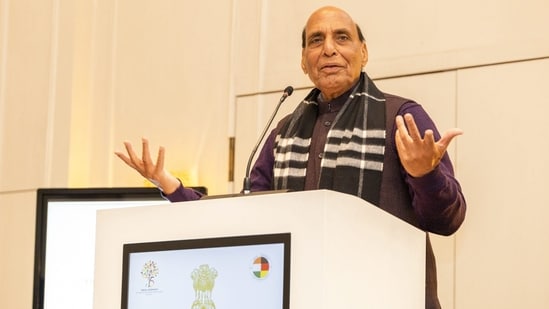
India was ‘ready for long war’ against Pakistan during Op Sindoor, says Rajnath Singh
# India Ready for Long War During Op Sindoor
**By Defence Correspondent, National Desk** | **April 30, 2026**
Indian Defence Minister Rajnath Singh revealed on Thursday that the nation was fully mobilized and prepared for a prolonged military conflict with Pakistan during the execution of “Operation Sindoor.” Speaking at a high-level national security symposium in New Delhi, Singh clarified that India’s strategic posture has evolved from localized containment to absolute escalation readiness. Addressing the evolving nature of asymmetric warfare, Singh emphasized that terrorism is not merely an “anti-national act” but a highly complex, multi-dimensional threat. Consequently, he argued, it can only be neutralized through a comprehensive strategy that attacks its financial, ideological, and logistical roots. This stark policy declaration signals a definitive shift in New Delhi’s defense doctrine against cross-border terrorism. [Source: Hindustan Times | Additional: National Security Archives].
## Unveiling the Strategy Behind Operation Sindoor
Operation Sindoor represents one of the most significant counter-terror military posturings by the Indian Armed Forces in recent years. While exact operational details of the tactical maneuvers remain classified, military analysts characterize the operation as a comprehensive, multi-theatre mobilization designed to dismantle entrenched terrorist launchpads along the Line of Control (LoC) while simultaneously preparing for conventional retaliation.
Historically, India’s responses to cross-border provocations—such as the 2016 surgical strikes following the Uri attack and the 2019 Balakot airstrikes following the Pulwama tragedy—were defined by their brevity and localized scope. These operations were specifically calculated to remain below the threshold of conventional war. However, Rajnath Singh’s latest disclosure suggests that during Operation Sindoor, the Indian defense establishment consciously abandoned the self-imposed limitation of a short, sharp strike.
**Key strategic shifts observed during this period included:**
* **Forward Deployment:** Accelerated deployment of strike corps to offensive staging areas.
* **Air Superiority Readiness:** High-alert status for forward airbases with round-the-clock combat air patrols (CAP).
* **Naval Blockade Protocols:** The Indian Navy’s Carrier Battle Groups were reportedly positioned to assert maritime dominance in the northern Arabian Sea, ready to choke vital supply lines if the conflict escalated.
“The statement by the Defence Minister is a public acknowledgment of ‘Escalation Dominance,'” notes Dr. Vikram Sahay, a senior military strategist at a New Delhi-based think tank. “By signaling a willingness to engage in a long war, India effectively neutralized Pakistan’s nuclear overhang, which Islamabad has traditionally used as a shield to conduct proxy warfare.”
## The Paradigm Shift: Embracing the ‘Long War’ Doctrine
The willingness to engage in a “long war” marks a pivotal evolution in Indian military doctrine. For decades, the global international community and regional defense analysts operated on the assumption that any conventional war between nuclear-armed neighbors India and Pakistan would be short, intense, and rapidly mediated by global powers like the United States or the United Nations.
Rajnath Singh’s comments completely disrupt this geopolitical calculus. By structurally preparing the military for a protracted conventional conflict, India is communicating a new threshold of tolerance. The logistics behind such preparedness require massive stockpiling of ammunition, secure and resilient supply chains, and a robust domestic defense manufacturing sector.
Over the last five years, India’s emergency procurement protocols and the push for *Aatmanirbhar Bharat* (Self-Reliant India) in defense have yielded substantial results. The military has significantly enhanced its War Wastage Reserves (WWR), ensuring that the armed forces can sustain intense combat operations for extended periods without relying heavily on emergency foreign imports.
“When the Defence Minister says the country was ready for a long war, it is backed by empirical logistical improvements,” explains retired Lieutenant General R.K. Sharma. “We have seen the integration of theater commands, the indigenous induction of long-range artillery, and the stockpiling of precision-guided munitions. The adversary knows this is no longer a hollow threat.”
## The Multi-Dimensional Nature of Modern Terrorism
A significant portion of Singh’s address focused on the anatomy of modern asymmetric warfare. “Terrorism is not only an anti-national act,” Singh articulated, noting that the threat has metastasized beyond physical infiltration across the border. He stressed that a kinetic military response is only one piece of a much larger puzzle.
Today’s terror networks are hybrid entities. They operate in the shadows of the dark web, utilize cryptocurrencies for untraceable funding, and weaponize social media algorithms to radicalize youth. Addressing this requires a synchronized effort across multiple governmental ministries.
India’s evolved multi-dimensional counter-terrorism framework targets several key domains:
1. **Kinetic Operations:** Traditional military and paramilitary operations to eliminate active militants and destroy physical infrastructure.
2. **Financial Asphyxiation:** Working with global bodies like the Financial Action Task Force (FATF) and utilizing domestic agencies like the Enforcement Directorate (ED) and the National Investigation Agency (NIA) to dismantle hawala networks, illicit narcotics trade, and shadow NGOs.
3. **Cyber Counter-Intelligence:** Neutralizing digital propaganda, tracking encrypted communications, and preventing cyber-attacks on critical national infrastructure.
4. **Socio-Political Integration:** Investing heavily in the economic development of border regions, particularly in Jammu & Kashmir, to alienate terrorist sympathizers and provide viable economic alternatives to the youth.
The Defence Minister’s remarks underscore a realization that defeating a proxy war requires exhausting the adversary militarily, economically, and diplomatically.
## Geopolitical Fallout and Regional Stability
The explicit admission of a “long war” readiness has profound implications for regional stability in South Asia. Historically, Pakistan’s Inter-Services Intelligence (ISI) has relied on the doctrine of “bleeding India with a thousand cuts,” assuming that India’s response would always be restrained by the fear of nuclear escalation. Operation Sindoor and the subsequent policy declarations have fundamentally altered this risk assessment.
The international community’s response to India’s hardened stance has been a mix of quiet apprehension and tacit understanding. Global powers, particularly the United States and strategic allies in the European Union, have increasingly aligned with India’s perspective on cross-border terrorism. The global focus on counter-terrorism has allowed New Delhi greater diplomatic leeway to undertake robust defensive measures.
However, the specter of a prolonged conflict in a nuclearized zone remains a point of concern for regional security analysts. China’s role as an “all-weather ally” to Pakistan adds another layer of complexity. An escalated, protracted conflict on India’s western front could potentially tempt opportunistic maneuvers on the northern borders, necessitating a comprehensive two-front war readiness from the Indian military.
### Strategic Domains of India’s Counter-Terror Architecture
| Domain | Agency/Instrument | Strategic Objective |
| :— | :— | :— |
| **Military/Tactical** | Armed Forces, Rashtriya Rifles | Neutralize active threats; secure borders against infiltration. |
| **Financial/Legal** | NIA, ED, Global FATF Diplomacy | Choke terror funding; dismantle narcotics-terror nexus. |
| **Cyber/Information** | CERT-In, NTRO | Counter digital radicalization; protect national digital infrastructure. |
| **Diplomatic** | Ministry of External Affairs | Isolate state sponsors of terrorism on international forums. |
## Upgrading the Arsenal: The Modernization Drive
The confidence exuded by Rajnath Singh is intrinsically linked to the rapid modernization of the Indian Armed Forces. A “long war” cannot be sustained on rhetoric alone; it requires cutting-edge hardware, superior intelligence, surveillance, and reconnaissance (ISR) capabilities, and absolute logistical supremacy.
In recent years, the Ministry of Defence has aggressively pursued capability enhancement. The induction of advanced multi-role fighter jets, the deployment of indigenous Light Combat Helicopters (LCH) specifically designed for high-altitude warfare, and the integration of swarm drone technologies have redefined tactical operations. Furthermore, the establishment of a robust satellite network dedicated to military surveillance has provided ground commanders with real-time, actionable intelligence, effectively eliminating the element of surprise for cross-border infiltrators.
Additionally, the restructuring of the military into integrated theater commands aims to ensure seamless synergy between the Army, Navy, and Air Force. This jointness is a critical prerequisite for sustaining long-term conventional operations and managing the vast logistical tail required for a prolonged conflict. By emphasizing domestic defense production, India is actively insulating its military supply chains from global geopolitical shocks and sanctions, a lesson starkly learned from recent global conflicts in Eastern Europe and the Middle East.
## Future Outlook: A Resolute Defense Posture
Defence Minister Rajnath Singh’s candid disclosure regarding Operation Sindoor is more than a historical recount; it is a clear articulation of India’s contemporary strategic doctrine. By publicly declaring a state of readiness for a protracted war, New Delhi has drawn a non-negotiable red line concerning national security and territorial integrity.
The emphasis on tackling the “multiple dimensions” of terrorism highlights a mature, comprehensive understanding of modern warfare. It proves that India is no longer reacting to terror incidents as isolated criminal acts, but rather treating them as components of a systematic, state-sponsored proxy war that demands a whole-of-nation response.
Moving forward, this assertive posture is likely to dictate the rhythm of India-Pakistan relations. While diplomatic channels may remain cautiously open, the underlying message is unequivocal: the era of strategic restraint has been permanently replaced by a policy of proactive deterrence. For the international community, the takeaway is clear—India’s threshold for terror has plummeted to zero, and its capacity and willingness to wage a sustained, multi-domain conflict to protect its sovereignty is at an unprecedented high.





