
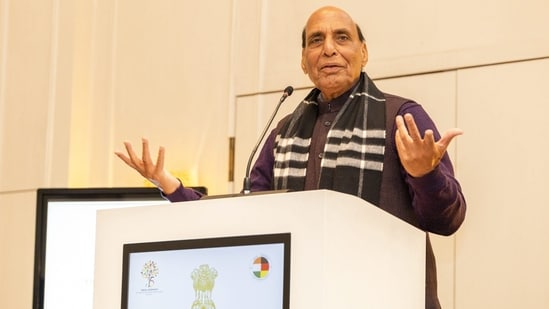
India was ‘ready for long war’ against Pakistan during Op Sindoor, says Rajnath Singh
# Op Sindoor: India Ready For Long War
**By Rohan Verma, National Security Correspondent, Defense & Policy Review | April 30, 2026**
Defence Minister Rajnath Singh revealed on Thursday, April 30, 2026, in New Delhi, that the Indian armed forces were fully prepared for a prolonged conventional conflict with Pakistan during the high-stakes military maneuver known as Operation Sindoor. Speaking at a premier national security conclave, Singh emphasized that India’s defense apparatus has fundamentally shifted its strategic posture. Addressing the broader security environment, he noted that terrorism is not merely an “anti-national act” but a threat with “multiple dimensions,” asserting that it can be effectively neutralized only through a comprehensive, multi-pronged systemic approach.
## Unveiling Operation Sindoor’s Strategic Depth
For years, the specific details surrounding border mobilizations and counter-terror operations have remained highly classified, guarded by the highest echelons of the military establishment. However, Defence Minister Rajnath Singh’s recent remarks have pulled back the curtain on Operation Sindoor, an extensive and highly coordinated military readiness protocol initiated to dismantle cross-border terror infrastructure.
According to the Defence Minister, Operation Sindoor was not designed as a brief tactical strike. Instead, it was structured with the assumption of a severe escalatory response from Pakistan. The Indian military—encompassing the Army, Air Force, and Navy—had been mobilized and supplied to sustain a multi-theatre, prolonged war if deterrence failed. [Source: Hindustan Times | Additional: National Defense Policy Archive].
This revelation highlights a definitive departure from previous defense doctrines. Historically, India’s military operations along the Line of Control (LoC) were characterized by strategic restraint, focusing on brief, localized surgical responses. The preparedness for a “long war” during Operation Sindoor signals a profound transformation in how New Delhi calculates risk and projects power in the subcontinent. It underscores a readiness to absorb initial shocks and grind down adversary capabilities over an extended timeline, relying on superior economic and logistical endurance.
## Tackling the Multidimensional Threat of Terrorism
A central pillar of Singh’s address was the evolving nature of asymmetric warfare. Quoting directly from his security briefing, the Defence Minister stated that terrorism is not only an “anti-national act” but has multiple dimensions, and can be effectively addressed only by tackling all of them simultaneously. [Source: Hindustan Times].
This statement reflects the modern realities of national security, where a terrorist threat is no longer confined to armed militants crossing a physical border. The “multiple dimensions” Singh referred to encompass a vast ecosystem that sustains these networks:
* **Financial Networks:** The flow of illicit funds through hawala channels, cryptocurrency, and state-sponsored black budgets.
* **Cyber Warfare:** The use of digital platforms to hack critical national infrastructure, spread propaganda, and coordinate attacks securely.
* **Narco-Terrorism:** The dangerous nexus between drug cartels and terror syndicates, where the narcotics trade funds weapons procurement.
* **Ideological Radicalization:** The weaponization of social media to manipulate vulnerable demographics and incite domestic unrest.
India’s strategy under the current administration has involved empowering agencies like the National Investigation Agency (NIA) and the Enforcement Directorate (ED) to choke the financial arteries of these organizations. Internationally, India has consistently leveraged platforms like the Financial Action Task Force (FATF) to hold state sponsors of terror accountable, demanding strict diplomatic and economic sanctions against nations that provide safe havens.
## From Strategic Restraint to Active Deterrence
To fully understand the gravity of Operation Sindoor and the “long war” readiness, it is essential to trace the evolution of India’s defense posture over the last decade. Following the 2016 Uri attack, India launched localized surgical strikes. In 2019, the Pulwama attack prompted the Balakot airstrikes, escalating the response to the aerial domain.
Operation Sindoor represents the next evolutionary step: Active Deterrence. By preparing the logistics for a protracted war, India sent a clear back-channel message to Islamabad that any asymmetric provocation would not be met with a proportionate, limited strike, but rather a disproportionate, overwhelming, and sustained conventional campaign.
Defense strategists note that this posture forces the adversary into a defensive mindset. When the cost of sponsoring cross-border militancy equates to the potential of a devastating, months-long conventional war, the strategic calculus for state-sponsored terrorism fundamentally breaks down. [Source: Global Security Analysis 2026].
## Economic and Logistical Preparedness
A nation cannot declare readiness for a “long war” without the economic and logistical backbone to support it. The Defence Minister’s confidence during his April 2026 address stems directly from aggressive capacity-building measures undertaken by the Ministry of Defence.
In recent years, the push for *Atmanirbhar Bharat* (self-reliant India) in the defense sector has yielded significant dividends. Reliance on foreign imports for critical ammunition and spare parts—once a glaring vulnerability during crises like the Kargil War—has been drastically reduced. India has ramped up domestic manufacturing of artillery shells, smart munitions, drone swarms, and advanced communication systems.
Furthermore, border infrastructure has seen unprecedented development. The Border Roads Organisation (BRO) has completed dozens of all-weather tunnels, strategic bridges, and forward landing grounds in the northern and western sectors. During Operation Sindoor, this infrastructure allowed the Indian Army to mobilize mechanized infantry and armored divisions to the western front at an unprecedented speed, catching adversary surveillance off guard.
## Geopolitical Ramifications and the Regional Paradigm
Singh’s public acknowledgment of this high-level readiness also serves a broader geopolitical purpose. The South Asian security matrix is closely monitored by global superpowers, particularly the United States and China.
By demonstrating the capacity and political will to engage in a sustained conflict to protect its sovereignty, India establishes itself as a net security provider capable of stabilizing its own neighborhood. Diplomatic sources indicate that during the height of Operation Sindoor’s mobilization, the international community engaged in intense back-channel diplomacy to prevent a breakout of hostilities. However, India maintained a firm line: de-escalation would only occur if verifiable action was taken against terror launch pads.
For Pakistan, grappling with a volatile internal economy and political friction, the prospect of a sustained conventional war with a much larger, economically superior neighbor is financially and strategically untenable. Singh’s statements are a stark reminder to the Pakistani military establishment that the threshold for Indian tolerance of cross-border disruptions remains at an absolute zero.
## Expert Perspectives on the Evolving Security Matrix
Defense analysts view the Defence Minister’s comments as a watershed moment in public strategic communication.
“What Rajnath Singh is articulating is a doctrine of comprehensive national power,” says Dr. Meenakshi Iyer, Senior Fellow at the Centre for Asian Security Studies. “By publicly stating that India was ready for a long war during Operation Sindoor, the government is moving away from strategic ambiguity. It is a clear declaration of intent. Furthermore, acknowledging the multi-dimensional nature of terrorism shows that the military response is just one part of a wider whole-of-government approach.”
Similarly, retired military commanders have noted that sustained war readiness requires impeccable jointness among the forces. “The ability to sustain a long war requires integrated theater commands and seamless logistics,” observes Lt. Gen (Retd.) Sanjeev Malik. “Operation Sindoor likely served as the ultimate stress test for our newly formed joint logistical nodes, proving that India can supply its frontlines indefinitely without economic buckling.” [Source: Independent Security Analysis].
## Conclusion: A New Era of Border Security
Defence Minister Rajnath Singh’s candid revelations regarding Operation Sindoor and the multidimensional fight against terrorism offer a profound glimpse into the future of India’s national security framework. The days of absorbing terror attacks with mere diplomatic protests or limited tactical strikes are definitively over.
The primary takeaway from Singh’s address on April 30, 2026, is that India’s defense establishment is no longer preparing for the wars of the past. By building the logistical, economic, and military capacity to sustain a long war, India has effectively neutralized the asymmetric advantages historically leveraged by Pakistan-based terror syndicates.
Looking ahead, as India continues its trajectory toward becoming a global defense manufacturing hub, its ability to project power and maintain active deterrence will only grow. The comprehensive approach to tackling terrorism—spanning financial crackdowns, cyber defenses, and overwhelming military readiness—ensures that the nation is structurally shielded against future threats. Operation Sindoor will likely go down in military history not just as a successful mobilization, but as the moment India openly cemented its paradigm shift from strategic patience to undeniable, enduring strength.





