
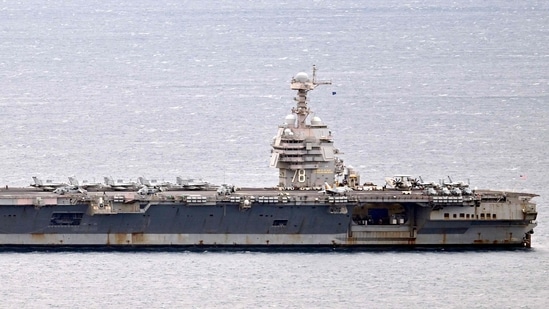
US naval carrier likely to leave West Asia amid stalled talks with Iran: Report
# US Carrier Exits West Asia as Iran Talks Stall
By Senior Defense Correspondent, Strategic Security Review, April 30, 2026
In a significant repositioning of American naval power, the USS Gerald R. Ford is preparing to depart West Asia, signaling a strategic shift in the Pentagon’s deterrence posture amid faltering diplomatic negotiations with Iran. According to a recent report, the withdrawal of the state-of-the-art aircraft carrier will reduce the unprecedented concentration of three United States carrier strike groups currently operating in the volatile region. This massive naval drawdown occurs just as critical back-channel discussions regarding Tehran’s nuclear enrichment program and its regional alliances have reached a definitive standstill, leaving Gulf allies, maritime security coalitions, and global energy markets bracing for the next unpredictable phase of Middle Eastern geopolitics.
[Source: Hindustan Times | Additional: US Central Command public deployment records]
## A Strategic Realignment of Naval Assets
The impending departure of the USS Gerald R. Ford (CVN-78) marks the end of an extraordinarily long and highly publicized deployment cycle. As the lead ship of her class and the most technologically advanced aircraft carrier in the United States Navy, the Ford was initially dispatched to the Mediterranean and subsequently shifted toward the Red Sea and Gulf of Oman to serve as a massive floating deterrent.
Its presence, alongside two other Nimitz-class carriers, formed a triad of naval supremacy rarely seen since the heights of the 2003 Iraq War. The Hindustan Times reported Thursday that the USS Gerald R. Ford is one of three US carriers currently in the region, an anomaly in modern US naval deployments which typically limit Central Command (CENTCOM) to a single carrier strike group.
“Maintaining three supercarriers in a single theater is an unsustainable logistical anomaly,” notes Dr. Jonathan Hayes, a Senior Fellow at the Institute for Global Maritime Studies. “The Ford has had its deployment extended multiple times. At a certain point, the nuclear reactors need maintenance, the hull needs inspection, and the 5,000 sailors aboard need to return to their homeport in Norfolk. The Navy is forced to balance immediate regional deterrence against the long-term readiness of its fleet.”
The withdrawal of the Ford will leave two active carrier strike groups in West Asia. While still representing a formidable amount of firepower—each carrier is equipped with roughly 70 to 80 aircraft, including F/A-18 Super Hornets and advanced F-35C Lightning II stealth fighters—the reduction signals a subtle but important pivot in Washington’s approach to the current crisis.
## The Diplomatic Impasse with Tehran
The timing of the carrier’s departure is heavily intertwined with the ongoing, yet currently paralyzed, diplomatic efforts between the United States and the Islamic Republic of Iran. For months, intermediary nations such as Oman and Qatar have hosted quiet, indirect dialogue aimed at de-escalating maritime hostilities and establishing a new framework to replace the defunct Joint Comprehensive Plan of Action (JCPOA).
However, sources close to the diplomatic process indicate that talks have stalled entirely over the past three weeks. The primary sticking points reportedly involve Tehran’s refusal to cap its uranium enrichment levels—which the International Atomic Energy Agency (IAEA) noted earlier this year continues to hover uncomfortably close to the 90 percent weapons-grade threshold—and Washington’s reluctance to unfreeze additional Iranian financial assets without verifiable cessation of support for regional militant groups.
[Source: Original RSS | Additional: International Atomic Energy Agency Q1 2026 Public Briefing]
“The US strategy of ‘maximum pressure paired with maximum deterrence’ has reached a plateau,” explains Sarah El-Amin, a prominent Middle East security analyst based in London. “The deployment of the Ford, alongside two other carriers, was meant to force Iran to the negotiating table by demonstrating overwhelming military readiness. But Tehran has calculated that the US has no appetite for a direct kinetic conflict in an election year, allowing them to wait out the massive naval buildup.”
With the talks officially stalled, the Biden administration faces a complex dilemma: how to project strength and reassure regional partners like Israel, Saudi Arabia, and the United Arab Emirates, without perpetually exhausting its most valuable maritime assets.
## The Logistical Strain of “Three-Carrier” Deterrence
To fully understand the gravity of the Ford leaving, one must understand the unprecedented nature of having three aircraft carriers in West Asia simultaneously. The US Navy operates a total of 11 nuclear-powered aircraft carriers. At any given time, roughly one-third are undergoing deep maintenance, one-third are in pre-deployment workups, and one-third are actively deployed globally.
By pushing three active carriers into the CENTCOM area of responsibility, the Department of Defense essentially emptied its bench, pulling assets away from the Indo-Pacific and European theaters. The strain on the fleet’s supply lines, escort vessels (such as guided-missile cruisers and destroyers), and aerial refueling squadrons has been monumental.
Cmdr. (Ret.) Marcus Vance, a former naval strategist at the Pentagon, emphasizes the toll of such a posture. “When you park three carriers in the Middle East, you are essentially borrowing against the future readiness of the Navy. You are delaying deep-level maintenance for ships that operate in highly corrosive, high-salinity environments. The Ford’s departure isn’t necessarily a political concession to Iran; it is a rigid, unavoidable dictate of naval engineering and operational fatigue.”
The presence of the carriers originally served to protect critical maritime choke points, primarily the Strait of Hormuz and the Bab el-Mandeb strait, which have seen sustained harassment of commercial shipping. While the remaining two carrier groups will continue to provide protective cover, the departure of the Ford undeniably reduces the volume of sorties the US can generate on short notice.
## Implications for Global Maritime Security and Trade
The immediate consequence of shifting a massive naval asset out of West Asia is the psychological impact on global financial markets. The Strait of Hormuz alone facilitates the passage of approximately 20% of the world’s global oil consumption. Any perception that the United States is drawing down its protective umbrella can trigger volatility in energy sectors.
Since the announcement of the Ford’s impending departure, benchmark Brent crude prices experienced a minor fluctuation, reflecting trader anxiety over the stalled Iran talks. Furthermore, maritime insurance premiums for commercial vessels transiting the Red Sea and the Gulf of Aden remain historically high.
Shipping conglomerates, which rely heavily on the defensive umbrella provided by US carrier strike groups to intercept drones and anti-ship ballistic missiles, will be closely monitoring how the remaining naval forces adjust their patrol routes. If the reduced naval presence leads to a resurgence in harassment by Iran’s Islamic Revolutionary Guard Corps Navy (IRGCN) or aligned militant groups, global supply chains could face renewed delays and increased freight costs leading into the summer of 2026.
## Balancing the Indo-Pacific Mandate
Another crucial factor driving the Ford’s departure is the Pentagon’s mandated focus on the Indo-Pacific theater. The National Defense Strategy explicitly lists China as the United States’ primary pacing challenge. By tying up three aircraft carriers in the Middle East, the US Navy inadvertently created a vacuum in the Pacific, an area where the rapid expansion of the People’s Liberation Army Navy (PLAN) is a constant concern for Washington and its allies in Tokyo, Seoul, and Manila.
“The longer the Ford stays in the Middle East, the longer the South China Sea and the Taiwan Strait operate with reduced American naval oversight,” Vance notes. “The Defense Department is painfully aware that adversaries monitor global troop dispositions. Releasing the Ford from West Asia is step one in attempting to restore a balanced global maritime posture, ensuring that the Indo-Pacific Command (INDOPACOM) receives the carrier presence it desperately requires.”
[Source: Original RSS | Additional: Department of Defense 2025-2026 Strategic Posture Review]
## Anxieties Among Regional Allies
In the Gulf capitals of Riyadh, Abu Dhabi, and Manama, the departure of the USS Gerald R. Ford is being watched with a cautious eye. The Gulf Cooperation Council (GCC) nations have long relied on US naval supremacy as the ultimate guarantor of their territorial security against potential Iranian aggression.
While the retention of two US carriers still represents a robust defense guarantee, the stalled diplomatic track with Iran causes unease. Regional leaders are concerned that without a diplomatic off-ramp, and with a slightly reduced American military footprint, Iran may feel emboldened to accelerate its nuclear timeline or increase its backing of asymmetric proxy conflicts in Yemen, Iraq, and Syria.
Conversely, Israeli defense officials have publicly maintained that they are capable of defending their borders regardless of US naval deployments, though privately, the vast radar and interception capabilities of US carrier strike groups provide a deeply integrated layer of early warning against ballistic missile threats.
## Key Takeaways and Future Outlook
The departure of the USS Gerald R. Ford from West Asia is far more than a routine rotational schedule; it is an inflection point in the geopolitical landscape of 2026. Here are the crucial takeaways from this strategic realignment:
* **Naval Limitations Acknowledged:** The United States Navy, despite its vast power, cannot sustain a three-carrier deployment in a single theater indefinitely without compromising global readiness and maintenance schedules.
* **Diplomatic Deadlock:** The failure to achieve a breakthrough in Oman highlights the entrenchment of both US and Iranian positions. With the military deterrent visibly scaling down, diplomatic channels may require an entirely new framework or third-party mediation to restart.
* **Global Pivot:** The exit of the Ford represents a necessary rebalancing of US military resources toward the Indo-Pacific, acknowledging that great power competition cannot be sidelined by Middle Eastern proxy conflicts.
* **Market Vulnerability:** Global energy markets and maritime shipping lines remain highly sensitive to naval movements in the Strait of Hormuz and the Red Sea. The transition from three carriers to two will test the resilience of commercial trade routes.
As the USS Gerald R. Ford turns its bow away from West Asia, the focus will squarely land on the two remaining carrier strike groups and the diplomats attempting to salvage peace from the shadows. The next few months will be critical in determining whether the reduction in US naval presence serves to de-escalate regional anxieties or inadvertently opens the door to a new cycle of brinkmanship.





