
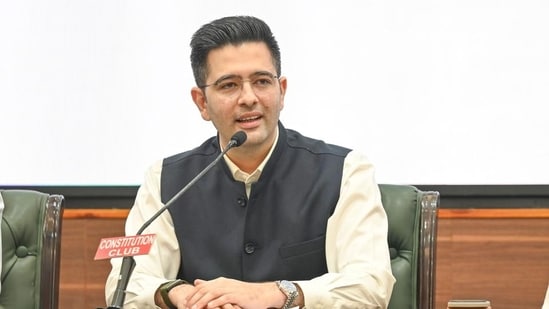
Raghav Chadha to meet President Murmu over ‘targeted action’ against MPs who quit AAP
# Chadha Meets President Over ‘Vendetta’
**By Senior Political Correspondent, National Desk**
**May 03, 2026**
Aam Aadmi Party (AAP) senior leader and Member of Parliament Raghav Chadha is scheduled to meet President Droupadi Murmu on Tuesday, May 5, 2026, to formally lodge a complaint regarding the alleged misuse of Punjab’s state machinery. Chadha claims that the state apparatus is being weaponized to execute targeted “political vendetta” against former AAP Members of Parliament and senior leaders who have recently resigned to join the rival Bharatiya Janata Party (BJP). This high-level intervention underscores the escalating political volatility in northern India, where shifting allegiances and retaliatory governance continue to heavily disrupt the regional balance of power.
[Source: Hindustan Times | Additional: Public records on Punjab politics up to April 2026]
## The Anatomy of the Alleged Vendetta
The core of Raghav Chadha’s upcoming representation to Rashtrapati Bhavan revolves around the accusation that the ruling government in Punjab is systematically targeting its political defectors. According to the statements leading up to this scheduled meeting, the AAP asserts that the defection of its MPs to the BJP is not an organic political transition, but rather the result of coercion, a phenomenon the party frequently labels as “Operation Lotus.” Conversely, the AAP is now being accused of using the Punjab Police and the state Vigilance Bureau to harass those who have chosen to cross the aisle.
While the AAP governs Punjab under the leadership of Chief Minister Bhagwant Mann, the recent exodus of high-profile leaders has placed the administration on the defensive. Chadha’s narrative suggests a complex duality: while the AAP at the national level accuses the BJP of misusing central agencies like the Enforcement Directorate (ED) and the Central Bureau of Investigation (CBI) to poach opposition leaders, the defecting MPs claim that the AAP is utilizing the exact same playbook at the state level. Chadha’s meeting is strategically designed to flip this narrative, arguing that the true victims of institutional misuse are the democratic processes themselves, though the framing is heavily contested by the defectors.
Instances of state police arriving at the residences of defected leaders, the sudden reopening of dormant vigilance inquiries, and the abrupt withdrawal of state-sponsored security details have been cited as primary examples of this alleged vendetta. By bringing this to the President, Chadha aims to draw national attention to the vulnerabilities faced by political representatives and the immediate consequences of switching party loyalties in a highly polarized environment.
## The Defection Wave: A Shifting Punjab Landscape
To understand the urgency of Tuesday’s presidential meeting, one must analyze the broader context of Punjab’s political ecosystem leading into mid-2026. The Aam Aadmi Party secured a historic, sweeping mandate in the 2022 Punjab Assembly elections, decimating traditional powerhouses like the Indian National Congress and the Shiromani Akali Dal (SAD). However, managing the complexities of a border state burdened by agrarian distress, drug trafficking concerns, and a massive fiscal deficit has proven challenging.
Capitalizing on these administrative friction points, the BJP has mounted an aggressive expansion strategy in Punjab. Historically a junior partner to the SAD, the BJP is now aiming to establish an independent, formidable footprint in the state. This strategy has visibly involved the induction of prominent leaders from rival parties. Over the late 2025 and early 2026 period, several AAP parliamentarians and state-level figures jumped ship, citing ideological disillusionment and a lack of developmental progress under the AAP regime.
Chadha and the AAP high command maintain that these exits were strictly engineered through central intimidation. However, the subsequent state-level backlash against these defectors has created a constitutional quagmire. The defecting leaders allege that the moment they announced their resignations, the Punjab state machinery was unleashed upon them—ranging from the scrutiny of their business interests to the alleged harassment of their immediate families and associates.
## Engaging the Highest Office: Constitutional Avenues
The decision to approach President Droupadi Murmu is a calculated, high-stakes maneuver. Under the framework of the Indian Constitution, the President serves as the guardian of the republic’s democratic ethos. While law and order is strictly a State Subject under the Seventh Schedule, systemic misuse of state machinery can invoke federal concerns.
Chadha’s memorandum is expected to urge the President to seek a detailed report from the Governor of Punjab regarding the state’s law enforcement activities over the past quarter. Article 355 of the Constitution mandates the Union to ensure that the government of every State is carried on in accordance with constitutional provisions. While demanding the dismissal of a state government (Article 356) is an extreme and highly unlikely outcome, formally flagging the breakdown of impartial governance serves as a powerful political optics tool ahead of future electoral battles.
[Source: Constitutional Law precedents regarding Center-State relations | Additional: Historical analyses of Article 356 usage]
## Expert Perspectives on Federal Friction
Political analysts and constitutional experts view this development as a symptom of a deeper malaise in India’s contemporary democratic architecture. The intertwining of police forces with political agendas has been a long-standing criticism across the political spectrum.
“What we are witnessing in Punjab is the classic weaponization of state mechanisms, a tactic that sadly has bipartisan precedent,” notes Dr. Rajeshwar Singh, an independent political scientist specializing in North Indian electoral dynamics. “When the AAP protests against central agencies, they hold the moral high ground. But if allegations that they are using the Punjab Vigilance Bureau to exact revenge on defectors are proven true, it severely compromises their foundational anti-corruption, pro-democracy narrative.”
Legal scholar Neha Trivedi highlights the limitations of the Anti-Defection Law (Tenth Schedule) in preventing these scenarios. “The Tenth Schedule penalizes defection by stripping the legislator of their current seat, but it does nothing to prevent the toxic environment of coercion and post-defection retaliation. Until law enforcement agencies are fundamentally decoupled from political executive control, politicians will continue running to the President to arbitrate what are essentially partisan gang wars,” Trivedi explains.
## Administrative Paralysis vs. Genuine Enforcement
The Punjab government has vehemently denied the allegations of political vendetta. Representatives of the Bhagwant Mann administration assert that the state’s anti-corruption drive is entirely blind to political affiliations. According to the state’s defense, if a legislator is found to possess assets disproportionate to their known sources of income, or if they are implicated in illicit mining or liquor trade syndicates, the law must take its natural course—regardless of whether that legislator currently sits with the AAP, the BJP, or the Congress.
This creates a complex narrative battle. On one hand, the AAP can project itself as an uncompromising crusader against corruption, willing to prosecute even its former stalwarts. On the other hand, the sheer timing of these investigations—often initiated mere days after a legislator publicly questions the party leadership or aligns with the BJP—casts a heavy shadow of doubt over the impartiality of the Punjab Police and the Vigilance Bureau.
## BJP’s Counter-Narrative and Future Ramifications
The BJP, operating primarily from the Center, has seized upon the AAP’s internal crises to paint the regional party as structurally unstable. BJP spokespersons have repeatedly stated that the leaders leaving the AAP are doing so because they feel “suffocated” by the party’s centralized command structure operating out of New Delhi, which they claim fundamentally undermines the autonomy of the Punjab state unit.
By portraying the AAP as a vindictive entity that punishes dissent through state-sponsored intimidation, the BJP hopes to alienate the AAP from the crucial swing voters in Punjab. The ongoing friction is likely to dominate the discourse in the upcoming parliamentary sessions and set a tense baseline for the 2027 Punjab Assembly elections. The BJP aims to present itself as the sole bastion of stability and development in a state weary of perpetual political theatrics.
Furthermore, this dispute highlights a growing crisis in Indian federalism. When political disputes bypass standard judicial mechanisms and elevate directly to the President’s office, it reflects a deep-seated lack of trust in regional law enforcement and judicial impartiality. Chadha’s move is as much about protecting the AAP’s optics as it is about putting the BJP on notice that the AAP will utilize every constitutional lever available to push back against perceived poaching.
## Conclusion: Key Takeaways and the Outlook
Raghav Chadha’s scheduled meeting with President Droupadi Murmu is a critical flashpoint in the ongoing war of attrition between the Aam Aadmi Party and the Bharatiya Janata Party. The key takeaways from this developing story include:
* **Escalation of Defection Politics:** The seamless transition of MPs between ideologically opposed parties continues to erode the spirit of the anti-defection laws, prompting aggressive retaliatory measures at the state level.
* **Weaponization of Agencies:** The allegations reflect a mirrored reality—while opposition parties accuse the Center of misusing the ED and CBI, the Center’s allies accuse state governments of misusing local police and vigilance units.
* **Impact on Punjab’s Governance:** The constant political maneuvering threatens to derail vital administrative functions in Punjab, a state requiring urgent economic and structural reforms.
As May 5 approaches, political observers will be watching closely to see how the President responds to the AAP’s memorandum. Whether this leads to a formal inquiry by the Punjab Governor or merely serves as a high-profile entry in the broader political ledger, it firmly establishes that the battle for Punjab’s political soul will be fiercely and ruthlessly contested in the years to come.





