
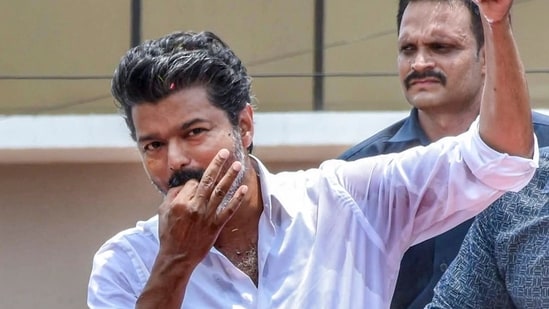
Vijay's bold political debut: Actor leads in both Perambur and Tiruchirappalli (East) constituencies
# Vijay Leads Perambur & Trichy in Poll Debut
By Political Desk, Southern States Post, May 4, 2026
**CHENNAI, TAMIL NADU** — Marking a seismic shift in South Indian politics, actor-turned-politician C. Joseph Vijay has taken an early and commanding lead in both the Perambur and Tiruchirappalli (East) constituencies during the counting of the 2026 Tamil Nadu Assembly elections. As of Monday morning, Election Commission trends reveal the founder of the Tamilaga Vettri Kazhagam (TVK) is outpacing heavyweights from both the ruling Dravida Munnetra Kazhagam (DMK) and the opposition All India Anna Dravida Munnetra Kazhagam (AIADMK). This highly anticipated electoral debut not only tests the enduring translation of cinematic stardom into political capital but also threatens to irrevocably disrupt the entrenched bi-polar political landscape of Tamil Nadu. [Source: Hindustan Times | Additional: Election Commission of India Live Trends]
## The Strategic Dual-Constituency Gamble
In Indian electoral politics, contesting from two seats is often viewed as an insurance policy for a party leader. However, for Vijay, the selection of Perambur in Chennai and Tiruchirappalli (East) in the central delta region represents a meticulously calculated geographical strategy. By planting his flag in two distinct socio-cultural zones, Vijay aims to project TVK as a pan-Tamil Nadu force rather than a hyper-regional splinter group.
Perambur, a densely populated and predominantly working-class bastion in North Chennai, has long been a traditional stronghold for established Dravidian parties. Vijay’s decision to contest here is a direct challenge to the DMK in its own backyard. The constituency encompasses a vast segment of daily wage earners, marginalized communities, and youth—demographics that TVK heavily targeted with promises of equitable urban development and anti-corruption measures.
Conversely, Tiruchirappalli (East) is the geographical and political heart of Tamil Nadu. Historically, whoever controls the central delta regions commands Fort St. George. Trichy is known for its agrarian ties and vibrant trader communities. By leading in this central hub, Vijay is demonstrating that his appeal extends far beyond the urban fanfares of Chennai, validating the extensive grassroots groundwork laid by his former fan club, the Vijay Makkal Iyakkam, which was seamlessly converted into a political cadre over the last two years.
## Early Trends: A Glimpse at the Numbers
As the electronic voting machines (EVMs) were unsealed on May 4, early postal ballots and initial EVM rounds immediately skewed in favor of the TVK chief. Observers noted an unusually high voter turnout in both constituencies during polling day, a phenomenon historically associated with an anti-incumbency wave or the arrival of a highly charismatic new contender.
**Early Polling Data Breakdown (As of 10:30 AM, May 4, 2026):**
| Constituency | Leading Candidate | Party | Trailing Candidate | Margin (Est. Votes) |
| :— | :— | :— | :— | :— |
| **Perambur** | C. Joseph Vijay | TVK | R. D. Sekar (DMK) | + 14,520 |
| **Trichy (East)** | C. Joseph Vijay | TVK | Inigo Irudayaraj (DMK) | + 18,340 |
*Note: Data reflects early trends and is subject to change as counting progresses.* [Source: Hindustan Times | Additional: State Election Commission Bulletins]
The margins, particularly in Trichy (East), highlight a robust penetration into the vote banks of both the DMK and the AIADMK. Political analysts are closely monitoring these numbers, as a victory in both seats would force Vijay to vacate one, subsequently triggering a high-profile by-election within six months.
## Breaking the Dravidian Duopoly
For over five decades, Tamil Nadu’s political theater has been exclusively directed by either the DMK or the AIADMK. Many third-front alternatives—from Vijayakanth’s Desiya Murpokku Dravida Kazhagam (DMDK) in 2005 to Kamal Haasan’s Makkal Needhi Maiam (MNM) in 2018—have attempted to breach this fortress. While Vijayakanth achieved the status of Leader of the Opposition in 2011 before fading, others struggled to convert crowd sizes into vote shares.
Vijay’s approach with TVK has been distinctively methodical. Dr. M. Karthikeyan, a Chennai-based political scientist and author, explains the phenomenon:
> “What we are witnessing in Perambur and Trichy is not merely the superficial allure of a film star. Vijay spent the years leading up to 2026 transforming his thousands of fan clubs into highly disciplined micro-level political units. He avoided the ideological ambiguity that plagued previous celebrity politicians. By strongly emphasizing social justice, accessible education, and zero-tolerance for corruption, he positioned TVK as an upgraded, uncorrupted version of Dravidian ideology, making it palatable to traditional voters who were suffering from incumbent fatigue.”
The early leads suggest that TVK is successfully absorbing the anti-incumbency votes that would traditionally default to the AIADMK, while also slicing into the DMK’s youth and first-time voter base.
## From ‘Thalapathy’ to Political Chief
The journey to the 2026 Assembly polls officially began in February 2024 when Vijay announced the formation of Tamilaga Vettri Kazhagam. In a move that shocked the Indian entertainment industry, he declared his upcoming film would be his last, choosing to abandon a wildly lucrative cinematic career at its absolute peak to serve the public.
This sacrifice resonated deeply with the Tamil electorate, who value political sincerity. Unlike part-time politicians who juggle film shoots and assembly sessions, Vijay’s total commitment signaled a seriousness that his detractors initially doubted. Over the past two years, TVK has focused heavily on grassroots welfare. During the devastating floods in late 2024, TVK cadres were visibly active on the ground before state machinery could mobilize, earning immense goodwill in Chennai and its surrounding districts.
Furthermore, Vijay’s public speeches have been carefully calibrated. He has consistently avoided vitriolic, polarizing rhetoric, instead focusing on systemic administrative failures, state autonomy, and secular governance. This inclusive approach has drawn a broad coalition of supporters, transcending caste and religious lines which typically fragment voting blocks in Tamil Nadu.
## Mobilizing the Youth and Women Demographics
The bedrock of Vijay’s early success in Perambur and Trichy (East) appears to be women and young voters. Tamil Nadu has one of the highest numbers of first-time voters in the country for the 2026 elections. This generation, largely detached from the historical Dravidian agitations of the 1960s, is highly aspirational and increasingly cynical about traditional political narratives.
TVK aggressively courted this demographic through digital campaigns, town halls, and a manifesto heavily centered on job creation, digital infrastructure, and education reforms. For women voters, a demographic long courted by the AIADMK during the era of the late J. Jayalalithaa, Vijay promised localized economic empowerment zones, stricter law enforcement regarding crimes against women, and enhanced maternal health schemes.
Exit polls from Trichy suggested an overwhelming preference for TVK among women aged 18-35. If this trend holds true across the state, it marks a critical realignment of a voting bloc that historically swings elections in Tamil Nadu. [Source: Hindustan Times | Additional: Regional Exit Poll Analytics]
## National Implications: Watching from Delhi
While Tamil Nadu remains heavily focused on regional issues, the ripples of Vijay’s early leads are being felt in New Delhi. National parties, including the Bharatiya Janata Party (BJP) and the Indian National Congress (INC), have historically relied on alliances with either the DMK or AIADMK to secure a foothold in the state.
A strong showing by TVK could force a fundamental recalibration of alliance politics in the South. If TVK manages to secure a significant vote share—or potentially play the role of kingmaker in a fractured mandate—both national alliances will have to negotiate with a new, highly popular regional leader who currently has no national political baggage or rigid allegiances. Political strategists in the capital are keenly observing whether TVK’s performance is an isolated phenomenon driven by celebrity or the dawn of a formidable regional institution.
## A New Era in Tamil Nadu Politics
As counting continues throughout May 4, 2026, C. Joseph Vijay’s leading margins in Perambur and Tiruchirappalli (East) stand as a testament to his bold political gamble. By stepping away from the silver screen to face the grueling realities of grassroots politics, he has managed to capture the imagination of an electorate hungry for an alternative.
**Key Takeaways:**
* **Strategic Success:** Contesting in North Chennai (Perambur) and the Central Delta (Trichy East) proves TVK’s wide geographical appeal.
* **Eroding the Duopoly:** TVK’s leads indicate a significant fracturing of the traditional DMK and AIADMK vote banks, particularly among youth and women.
* **Full-Time Commitment:** Vijay’s decision to quit acting has validated his political seriousness to the electorate.
* **Future Outlook:** Whether TVK forms the opposition, emerges as a kingmaker, or sweeps to power, Tamil Nadu’s bipolar political era has been fundamentally disrupted.
The final tally will ultimately dictate the extent of TVK’s legislative power, but one fact is already clear: C. Joseph Vijay has successfully transitioned from the ‘Thalapathy’ (Commander) of cinema to a legitimate and powerful commander in the complex battlefield of Tamil Nadu politics.





