
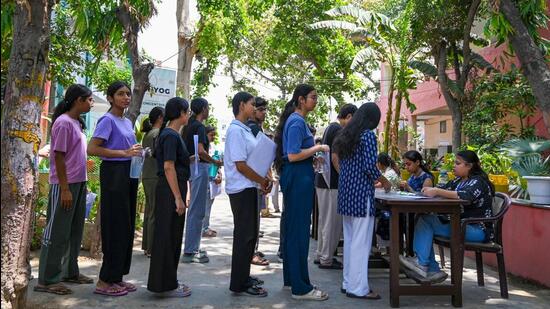
NEET UG Exam 2026: Girl told to remove ‘mala’ during NEET, probe on
# NEET Dress Code Row: NTA Probes Mala Removal
**By Staff Reporter, National Education Desk, May 04, 2026**
The National Testing Agency (NTA) has officially launched an inquiry after a female medical aspirant was allegedly forced to remove a religious ‘mala’ (beaded garland) before being permitted to enter a National Eligibility-cum-Entrance Test (NEET) examination centre. The incident, which occurred during the highly competitive undergraduate medical entrance exams, directly contradicts recent official guidelines. In a specific notice dated April 30, the NTA clearly clarified that candidates are allowed to wear customary articles of faith, “subject to reporting at the centre well in advance to enable frisking” [Source: Hindustan Times]. This latest confrontation highlights the persistent friction between rigorous anti-cheating protocols and the preservation of students’ religious freedoms.
## The Incident: A Clash of Exam Rules and Faith
The controversy erupted on Sunday morning as millions of students across India gathered at designated centres for **NEET-UG 2026**, the gateway to the nation’s premier medical and dental colleges. According to preliminary reports, a female candidate was halted at the security checkpoint by local invigilators and outsourced frisking staff. Despite her explaining that the ‘mala’ was a sacred religious item she had worn for years, security personnel insisted on its removal, citing strict metallic and accessory bans intended to prevent electronic malpractice.
The student’s family subsequently filed a formal grievance, prompting the NTA to announce a swift probe into the conduct of the centre’s superintendent and the local security team.
“When a student is moments away from writing the most crucial exam of their life, public humiliation over a religious artifact is deeply destabilizing,” notes Dr. Ramesh Iyer, an education rights activist and former medical professor. “The NTA has well-documented guidelines for these exact scenarios. The failure here is not in the policy, but in the glaring lack of ground-level sensitization among outsourced security personnel.” [Additional: Educational Policy Analysis].
## NTA’s Official Stance: The April 30 Notification Explained
The forced removal of the mala is particularly glaring given the NTA’s proactive attempts to prevent such misunderstandings. Recognizing the diversity of the roughly **2.4 million candidates** who appear for NEET annually, the NTA issued a comprehensive dress code clarification just days before the exam.
The April 30 notification specifically addressed customary, cultural, and religious attire. The directive unequivocally stated that candidates are permitted to wear articles of faith—which historically includes items like kirpans, karas, burqas, hijabs, and religious malas. However, this allowance was explicitly “subject to reporting at the centre well in advance to enable frisking” [Source: Hindustan Times].
To operationalize this, the NTA established a timeline:
* **Standard Reporting Time:** General candidates are advised to report by 1:00 PM for the 2:00 PM exam.
* **Customary Dress Reporting Time:** Candidates wearing articles of faith must report by 12:30 PM.
* **Frisking Protocol:** Early reporting allows staff to use handheld metal detectors and conduct isolated, private physical frisking without delaying the broader entry queue.
Despite the student reportedly arriving well within the stipulated early reporting window, the local exam centre staff bypassed the NTA’s protocol, defaulting instead to a blanket ban on all neckwear.
## Historical Context: Anti-Cheating Paranoia vs. Tradition
To understand the severity of NEET dress codes, one must look at the exam’s troubled history with high-tech cheating syndicates. The genesis of these draconian frisking measures dates back to the **AIPMT (All India Pre-Medical Test) 2015 paper leak**, where the Supreme Court of India ordered the cancellation and re-conduction of the exam after it was discovered that candidates had used micro-Bluetooth devices concealed in specially tailored clothing.
Since then, the NTA (which took over conducting NEET) instituted an uncompromising dress code. The standard rules prohibit:
* Full-sleeved clothing.
* Shoes with thick soles.
* Garments with large buttons, embroidery, or heavy pockets.
* All jewelry, metallic items, watches, and electronic devices.
However, the rigid enforcement of these rules has repeatedly crossed lines of human dignity and religious freedom.
| Year | Location | Incident Description | NTA/Government Response |
| :— | :— | :— | :— |
| **2017** | Kannur, Kerala | A female student was forced to remove her innerwear due to metal hooks triggering detectors. | Four teachers were suspended; NTA issued apologies. |
| **2022** | Kollam, Kerala | Multiple girls were forced to remove their undergarments before entering the exam hall. | Fact-finding committee formed; legal action taken against frisking staff. |
| **2024** | Rajasthan | Sikh candidates reported harassment over wearing the *Kara* and *Kirpan*. | Reiteration of rules allowing Sikh articles of faith with early arrival. |
| **2026** | Undisclosed | Female student forced to remove religious ‘mala’. | Immediate official probe launched by NTA. |
*(Table Source: Compiled from Historical Public News Records)*
## The Psychological Toll on Medical Aspirants
The NEET exam is widely considered one of the toughest and most stressful competitive examinations globally. The acceptance rate for government medical colleges in India hovers around a mere **3 to 4 percent**. Consequently, the psychological pressure on 17- and 18-year-old candidates is immense.
Clinical psychologists point out that pre-exam stress reaches its absolute peak at the entrance gate. “When a student is forced into a confrontation over a deeply personal or religious item right before an exam, their body triggers a fight-or-flight response,” explains Dr. Shalini Desai, a prominent adolescent psychologist in New Delhi. “The sudden spike in cortisol and adrenaline impairs the prefrontal cortex, which is responsible for logical reasoning and memory retrieval. Essentially, traumatizing a student at the gate fundamentally compromises their ability to perform fairly on the test.” [Additional: Psychological Insights on Exam Stress].
The removal of a religious ‘mala’—often tied or gifted by parents with prayers for success—can strip a candidate of their emotional anchor, leaving them severely distressed while attempting physics and biology problems.
## Legal Perspectives on Religious Articles in Exams
The recurring clashes at NEET exam centres also raise significant constitutional questions. Under **Article 25 of the Constitution of India**, all citizens are guaranteed the freedom of conscience and the right freely to profess, practice, and propagate religion. However, this right is subject to public order, morality, and health.
The legal debate centers on whether the banning of a mala, hijab, or cross constitutes a “reasonable restriction” in the interest of preventing exam malpractice. Legal experts argue that while the state has a legitimate interest in ensuring the integrity of an exam, the measures taken must be proportionate.
Advocate Vikram Singh, who has previously represented students in exam-related PILs (Public Interest Litigations), states: “The NTA’s April 30 notification actually represents a legally sound middle ground. By allowing customary items *conditional upon early frisking*, the NTA balances Article 25 rights with the administrative need for security. The legal violation occurs when local authorities act ultra vires—beyond their legal power—by ignoring the NTA mandate and enforcing arbitrary bans.” [Additional: Indian Constitutional Law Analysis].
The ongoing probe will likely examine whether the centre superintendent willfully ignored the NTA circular or if the failure stemmed from administrative incompetence.
## Systemic Flaws in Ground-Level Implementation
Despite the NTA’s well-drafted guidelines at the central level, the execution relies heavily on decentralized, local infrastructure. NEET is conducted in over **4,000 centres across more than 500 cities**, including remote tier-3 towns.
To manage security, the NTA often relies on the administrative staff of the host schools (usually Kendriya Vidyalayas or private institutions) and third-party private security agencies for frisking. This creates a severe breakdown in communication.
1. **Lack of Specialized Training:** Outsourced security guards are trained to detect metal and contraband, not to navigate the nuanced guidelines of religious accommodations. They often adopt a “better safe than sorry” approach, stripping candidates of everything to avoid personal reprimand from supervisors.
2. **Poor Dissemination of Circulars:** A notice issued on April 30 gives local exam coordinators only a few days to brief hundreds of temporary frisking staff before a May exam.
3. **Gender Sensitization Issues:** While the NTA mandates that female candidates must be frisked exclusively by female staff in closed enclosures, the pressure to process thousands of students quickly often results in rushed, insensitive handling.
“Until the NTA mandates compulsory, standardized video-training modules for every single person involved in the frisking process, these incidents will continue to make headlines,” warns a former senior official from the Ministry of Education.
## Conclusion: Moving Towards Inclusive Exam Centres
The forced removal of the mala during NEET 2026 is more than an isolated administrative hiccup; it is a symptom of a larger systemic disconnect between policy intent and ground reality. The NTA’s prompt initiation of a probe is a necessary first step in ensuring accountability [Source: Hindustan Times]. However, reactive investigations alone will not solve the underlying issue.
To prevent future trauma to medical aspirants, the examination body must bridge the communication gap with its outsourced personnel. Implementing mandatory sensitization drills, providing clear visual aids at exam gates detailing permitted customary items, and establishing an on-the-spot grievance redressal mechanism for students are vital reforms.
As India continues to produce some of the world’s finest medical professionals, it must ensure that the very first step of their journey—the entrance exam—is conducted with an unwavering commitment to both uncompromising integrity and fundamental human dignity. The outcome of the current NTA probe will hopefully set a strict precedent, ensuring that the April 30 guidelines are respected uniformly across the nation in all future examinations.





