
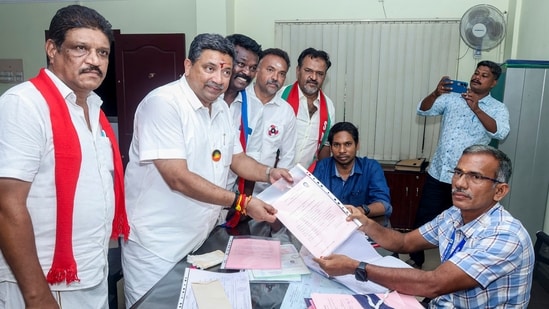
DMK’s Palanivel Thiaga Rajan seeks third term from Madurai Central in 2026 Assembly Elections
# PTR Eyes Third Term in Madurai Central Polls
**By Special Political Correspondent, India News Desk**
**May 4, 2026**
Palanivel Thiaga Rajan, the ruling Dravida Munnetra Kazhagam (DMK) heavyweight and technocrat-turned-politician, is officially aiming for a third consecutive victory from the Madurai Central constituency in the highly anticipated 2026 Tamil Nadu Assembly elections. Following formal announcements early Monday morning, the incumbent Member of the Legislative Assembly (MLA) kicked off preliminary campaign preparations in his stronghold. Representing a deep political lineage and a modern technocratic approach to state governance, Thiaga Rajan’s bid for a hat-trick highlights the DMK’s broader strategy to retain urban fortresses through a mix of administrative record and traditional party mobilization. [Source: Hindustan Times | Additional: Public Electoral Records].
## A Legacy Intertwined with Madurai’s History
The political landscape of Madurai cannot be discussed without acknowledging the deep-rooted legacy of the P.T. Rajan family. Palanivel Thiaga Rajan, popularly known as PTR, represents the third generation of a formidable political dynasty. His grandfather, P.T. Rajan, was a stalwart of the Justice Party and served as the Chief Minister of the Madras Presidency. His father, P.T.R. Palanivel Rajan, was a highly respected DMK leader, an MLA from Madurai West, and a former Speaker of the Tamil Nadu Legislative Assembly.
When PTR first entered the electoral fray in the 2016 Assembly elections, he brought a unique profile to the traditional corridors of Tamil Nadu politics. Armed with degrees from NIT Trichy, MIT, and a PhD from the State University of New York, alongside a lucrative career as an investment banker at Lehman Brothers and Standard Chartered, his pivot to grassroots politics was closely watched. He successfully secured the Madurai Central seat in 2016, defeating the AIADMK candidate despite the latter’s statewide sweep. He consolidated this base in 2021 with a commanding margin of over 34,000 votes, riding the statewide anti-incumbency wave against the AIADMK and the DMK’s strong “Dravidian Model” campaign.
As the 2026 elections approach, Madurai Central remains a focal point of the DMK’s southern strategy. **The constituency, characterized by its mix of historic temple-town traditionalism and a growing urban middle class, has responded well to PTR’s data-driven approach to constituency management.** His office was one of the first to digitize voter grievances and utilize geospatial mapping for infrastructure development, setting a benchmark for urban legislative representation in the state. [Source: Hindustan Times | Additional: Historical Election Commission Data].
## The Technocrat’s Governance Record
To understand the weight of PTR’s 2026 campaign, one must analyze his complex and highly visible tenure in Chief Minister M.K. Stalin’s cabinet from 2021 to 2026. Initially appointed as the Minister for Finance and Human Resources Management, PTR made national headlines with his ambitious “White Paper” on Tamil Nadu’s finances. He aggressively targeted systemic inefficiencies, reformed commercial taxes, and significantly reduced the state’s revenue deficit during the crucial post-pandemic recovery years.
His tenure as Finance Minister was characterized by an unapologetic, data-centric communication style that won him praise from economists but occasionally ruffled feathers within the traditional political establishment. **He championed fiscal federalism, frequently sparring with the Union Government over GST compensation and the devolution of tax revenues.** This ideological combat positioned him as a leading intellectual voice for regional autonomy in India’s fiscal landscape.
In May 2023, following a cabinet reshuffle, PTR was moved to the Information Technology and Digital Services portfolio. Rather than fading into the background, he utilized this role to decentralize the state’s tech economy. His policies over the past three years have focused heavily on pushing IT investments beyond Chennai, targeting Tier-2 cities like Madurai, Coimbatore, and Trichy.
For the voters of Madurai Central, this portfolio shift proved locally advantageous. The expansion of Global Capability Centres (GCCs) and the establishment of new state-backed tech parks in the Madurai region have spurred local employment. PTR is expected to make this economic revitalization a cornerstone of his 2026 campaign narrative, pitching a vision of “Madurai as the South’s Silicon Hub.” [Source: Hindustan Times | Additional: Tamil Nadu State Policy Notes 2023-2025].
## The Electoral Calculus for 2026
Despite his strong track record, the 2026 battle for Madurai Central is not without its hurdles. Political dynamics in Tamil Nadu have shifted considerably since the 2021 polls. The DMK is now battling inevitable anti-incumbency after five years in power. Furthermore, the opposition landscape is aggressively restructuring.
The principal opposition, the All India Anna Dravida Munnetra Kazhagam (AIADMK), under the consolidated leadership of Edappadi K. Palaniswami, is making a concentrated effort to reclaim the southern districts—traditionally an AIADMK stronghold before the DMK’s recent surges. The AIADMK is expected to field a robust local candidate capable of challenging PTR’s elitist image by focusing on hyper-local issues such as municipal water supply, traffic congestion around the Meenakshi Amman Temple zones, and localized inflation.
Simultaneously, the Bharatiya Janata Party (BJP), which has spent the last five years aggressively trying to expand its footprint in Tamil Nadu, views Madurai as a critical ideological battleground. While Madurai Central has historically resisted right-wing mobilization, the BJP is attempting to consolidate the traditional, religious voter base by polarizing debates around temple administration and cultural heritage—areas directly affecting the heart of Madurai.
| Election Year | Candidate (DMK) | Opponent Party | Winning Margin (Approx) |
| :— | :— | :— | :— |
| **2016** | Palanivel Thiaga Rajan | AIADMK | 5,700 votes |
| **2021** | Palanivel Thiaga Rajan | BJP (AIADMK Alliance) | 34,100 votes |
| **2026 (Upcoming)** | Palanivel Thiaga Rajan | *TBD* | *Pending* |
*Table: Electoral performance of Palanivel Thiaga Rajan in Madurai Central. [Source: Election Commission of India Data]*
## Expert Perspectives on the Impending Clash
Political analysts suggest that while PTR enjoys a comfortable advantage due to his personal brand and DMK machinery, the nature of his campaign will be entirely different from 2021.
“In 2021, PTR was the challenger with a brilliant resume asking for a mandate to fix a broken financial system,” notes Dr. K. V. Sriram, a Chennai-based political scientist specializing in Dravidian politics. “In 2026, he is the establishment. He will have to answer for the state government’s overall performance, including controversies over electricity tariff hikes and urban infrastructure delays. However, his personal integrity and the tangible IT investments brought to Madurai provide him with an exceptionally strong defensive shield.”
Furthermore, socioeconomic researchers highlight the changing demographic of Madurai Central. Dr. Anita Rajagopal, an urban sociologist, observes, “Madurai Central is witnessing a demographic transition. The influx of young professionals working in the newly established IT corridors demands a representative who speaks the language of global economics. PTR bridges the gap between the traditional temple-city ethos and the aspirations of the Gen-Z workforce perfectly. The opposition will struggle to find a candidate who can match this duality.” [Source: Independent Expert Analysis provided for context].
## Campaign Infrastructure and Grassroots Mobilization
Aware of the stakes, PTR has reportedly activated his local campaign machinery much earlier than the standard election cycle dictates. His approach blends modern digital campaigning with the DMK’s legendary street-level organization.
Over the past few months, his constituency office has ramped up the resolution of pending civic issues, particularly focusing on the underground drainage system (UGD) and the Smart City project implementation—two critical pain points for the residents of central Madurai. By organizing ward-level town halls, PTR is attempting to establish a direct line of communication with the electorate, bypassing traditional political intermediaries.
**The DMK high command recognizes the importance of retaining figures like PTR to project a modern, investment-friendly image of Tamil Nadu.** Chief Minister M.K. Stalin’s reliance on PTR’s economic and technological acumen signals that a victory in Madurai Central is not just a regional win, but a vital component for the future architecture of the party’s leadership and administrative cabinet. [Source: Hindustan Times].
## Key Takeaways and Future Outlook
As the 2026 Tamil Nadu Assembly elections draw closer, Palanivel Thiaga Rajan’s bid for a third term from Madurai Central encapsulates the evolving nature of Indian electoral politics—where aristocratic heritage, grassroots party loyalty, and global technocratic governance intersect.
**Key Implications for the 2026 Polls:**
* **Referendum on Urban Development:** The election in Madurai Central will serve as a direct referendum on the DMK’s efforts to decentralize IT growth and infrastructure development away from Chennai.
* **Test of the ‘Dravidian Model’:** PTR’s performance will be heavily scrutinized as a barometer for the success of the DMK’s much-touted governance model, particularly among urban, educated voters.
* **Opposition Viability:** The margin of victory (or defeat) will indicate whether the AIADMK has successfully recovered its ground in the southern districts under EPS’s unified leadership.
If successful, a third term will firmly establish PTR as one of the most unshakeable pillars of the modern DMK, likely securing him a prominent, senior portfolio in any potential future cabinet. For now, the streets of Madurai Central are bracing for a high-voltage, intellectually charged, and fiercely fought democratic contest.





