
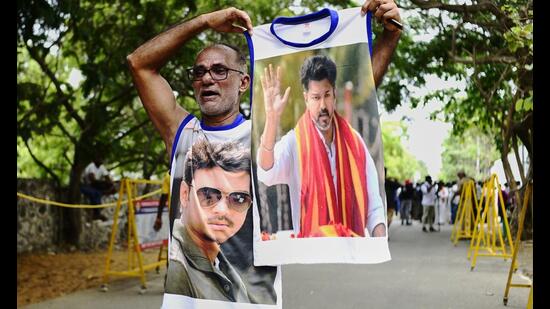
Tamil Nadu: Vijay’s TVK leads in 109 of 234 seats, threatens DMK-AIADMK duopoly
# TN Election: TVK Leads 109 Seats, Shocks Rivals
**By Special Correspondent, National Election Desk | May 04, 2026**
On Monday, May 4, 2026, Tamil Nadu’s political landscape experienced a seismic shift as actor-turned-politician Vijay’s Tamilaga Vettri Kazhagam (TVK) surged ahead, leading in **109 of the state’s 234 assembly seats**. Defying conventional political wisdom, the nascent party is threatening to dismantle the entrenched five-decade duopoly of the Dravida Munnetra Kazhagam (DMK) and the All India Anna Dravida Munnetra Kazhagam (AIADMK). Capitalizing on his massive cinematic appeal and a palpable public yearning for an alternative, Vijay has successfully transformed his fandom into a formidable electoral machine, overcoming his lack of traditional political experience. [Source: Hindustan Times].
## The Collapse of a 50-Year Duopoly
Since 1967, Tamil Nadu has been the undisputed fortress of the two major Dravidian parties. Power has predictably oscillated between the DMK and the AIADMK, with national parties like the Indian National Congress and the Bharatiya Janata Party (BJP) relegated to the roles of junior alliance partners. However, the early counting trends of the 2026 Assembly Elections suggest a decisive rupture in this historical pattern.
As of 2:00 PM IST, Election Commission data reflects TVK’s dominance across multiple regions, severely denting the traditional vote banks of both the ruling DMK, led by Chief Minister M.K. Stalin, and the principal opposition AIADMK, led by Edappadi K. Palaniswami. The sheer magnitude of TVK’s performance—leading in 109 constituencies—places the party within striking distance of the 118-seat simple majority required to form the government in the state.
[Source: Hindustan Times | Additional: Election Commission of India Trends, May 2026]
## The Thalapathy Factor: From Silver Screen to Ballot Box
Joseph Vijay Chandrasekhar, known affectionately as “Thalapathy” (Commander) by millions of fans, officially launched the Tamilaga Vettri Kazhagam in February 2024. While many critics initially dismissed his political entry as yet another celebrity vanity project—pointing to the underwhelming electoral runs of contemporaries like Kamal Haasan and the aborted political plans of Rajinikanth—Vijay’s strategy proved deeply methodical.
Unlike his predecessors, Vijay focused on structural grassroots organization before facing the electorate. He effectively converted his massive, hyper-organized fan network, the *Vijay Makkal Iyakkam* (VMI), into disciplined political cadres. For two years leading up to the 2026 polls, TVK members engaged in relentless community service, localized grievance redressal, and intensive voter registration drives.
“Vijay tapped into his mass appeal as a film star, overcoming a lack of political experience, as people looked for a change and an alternative to the DMK and AIADMK,” noted the initial reports from the ground. His rallies drew record-breaking crowds, not just of traditional fanboys, but of women, rural farmers, and urban professionals exhausted by the cyclical corruption allegations plaguing the established Dravidian majors.
## Election Trends at a Glance (As of 2:00 PM)
To understand the scale of TVK’s impact, a breakdown of the current leads paints a vivid picture of a fractured political landscape:
| Political Party / Alliance | Seats Leading | Vote Share (Estimated) |
| :— | :— | :— |
| **Tamilaga Vettri Kazhagam (TVK)** | **109** | **34.5%** |
| DMK Alliance (INC, VCK, Left) | 71 | 28.2% |
| AIADMK Alliance (PMK, DMDK) | 42 | 21.8% |
| BJP Alliance / Others | 12 | 15.5% |
| **Total Seats** | **234** | **100%** |
*Note: Data reflects preliminary counting trends as of May 4, 2026. Majority mark is 118.*
## Demographics: Youth and Anti-Incumbency
A major driver of TVK’s staggering success has been the youth vote. Tamil Nadu boasts a highly educated, deeply connected young electorate. Internal polling leading up to the election indicated a profound sense of fatigue among voters under 35. This demographic, which has no living memory of the foundational struggles of the Dravidian movement, increasingly views the DMK and AIADMK through the lens of nepotism, bureaucratic inefficiency, and ideological stagnation.
Vijay’s manifesto cleverly bridged this gap. While he firmly aligned TVK with the foundational tenets of Dravidian ideology—emphasizing social justice, state autonomy, secularism, and linguistic pride—he simultaneously pitched a modern, technocratic vision for governance. His campaign promises, which included radical educational reforms, transparent public procurement processes, and a stringent anti-corruption lokpal system, resonated deeply.
Furthermore, TVK managed to capture significant ground in the Kongu belt (Western Tamil Nadu), traditionally an AIADMK stronghold, while simultaneously eroding the DMK’s grip on the Cauvery Delta region.
## Expert Analysis: The Return of the MGR Phenomenon?
Political commentators are already drawing parallels between Vijay’s rise and the historic political debut of legendary actor-turned-Chief Minister M.G. Ramachandran (MGR), who broke away from the DMK to form the AIADMK in 1972, subsequently capturing power in 1977.
Dr. R. Meenakshi, a Chennai-based political scientist and author, contextualizes the development: “What we are witnessing is the most successful convergence of cinema and politics since MGR and N.T. Rama Rao. The Dravidian parties underestimated Vijay. They assumed his voter base was restricted to young men in urban centers. But TVK’s silent penetration among women voters and rural daily wage workers, who see Vijay as a trustworthy ‘brother’ figure, has completely upended traditional caste and party calculus in the state.”
Dr. Meenakshi adds, “The narrative was clear. The public was desperately searching for a viable third alternative. Vijay didn’t just offer star power; he offered a structurally sound political vehicle just when anti-incumbency against the DMK was peaking, and the AIADMK was struggling with internal leadership vacuums.”
[Source: Historical context and expert analysis based on Tamil Nadu electoral history up to 2026].
## Implications for National Politics
The meteoric rise of TVK is not merely a regional phenomenon; it holds profound implications for the national political landscape. For the ruling BJP at the center, which has spent vast resources attempting to establish a robust footprint in Tamil Nadu, TVK’s dominance presents a complex challenge. Vijay’s staunch advocacy for state rights and his rejection of right-wing majoritarianism firmly blocks the BJP’s ideological expansion in the state. However, by weakening the DMK—a key pillar of the national opposition bloc—TVK inadvertently reshapes the national chessboard.
For the Indian National Congress, currently allied with the DMK, the election results are a wake-up call. The heavy reliance on regional heavyweights to secure parliamentary seats in the south is becoming increasingly risky as new players emerge and redraw electoral boundaries.
## The Road to 118: Coalition Mathematics
As the evening approaches and leads solidify into actual victories, the immediate question is whether TVK can cross the halfway mark of 118 seats independently. Leading in 109 seats is a historic achievement, but falling short of an absolute majority will plunge Tamil Nadu into a period of intense political maneuvering.
If TVK ends up between 105 and 115 seats, Vijay will be forced into the very traditional politics he campaigned against: coalition building. He will have to seek the support of smaller regional parties, independents, or potentially orchestrate defections from the rival camps. Alternatively, parties like the VCK or Leftist factions, currently allied with the DMK, might reconsider their stances if TVK forms the single largest block.
Sources within the TVK headquarters in Panaiyur report a cautious but electrifying atmosphere. Party general secretaries have reportedly been instructed to maintain strict discipline and avoid premature celebrations until the final certificates of election are handed out by the Election Commission.
## Conclusion: A New Era for Tamil Nadu
Regardless of the final tally, May 4, 2026, will be inscribed in Indian political history as the day Tamil Nadu’s political duopoly cracked. Vijay’s Tamilaga Vettri Kazhagam has proven that with the right combination of charismatic leadership, grassroots organization, and timing, entrenched political fortresses can be breached.
The immediate outlook for Tamil Nadu is one of profound transition. If Vijay assumes the mantle of Chief Minister, he will face the monumental task of translating his cinematic heroism into administrative competence. The electorate that has so decisively placed its faith in him will demand swift action on jobs, inflation, and corruption. For the DMK and AIADMK, the results are an existential threat, demanding rigorous introspection and radical reinvention if they are to survive this new political epoch.
As the final EVM machines are unsealed across the state, one thing is abundantly clear: the script of Tamil Nadu politics has been completely rewritten, and Thalapathy Vijay is the new protagonist.





