
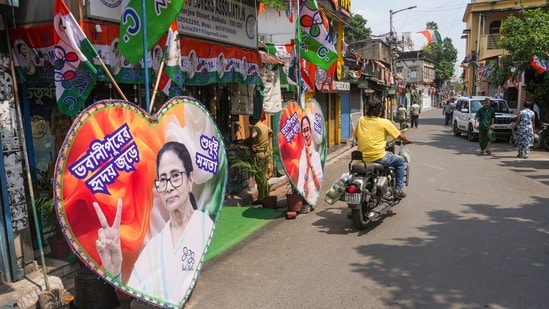
Who won West Bengal election: Full list of BJP, TMC leads and trails in high-stakes battle
# Bengal Election 2026: BJP Takes Massive Lead
By Staff Correspondent, National News Desk, May 04, 2026
On May 4, 2026, the Bharatiya Janata Party (BJP) took a commanding lead over the incumbent Trinamool Congress (TMC) in the fiercely contested West Bengal Assembly elections. Early counting trends released around 2:30 pm indicate the BJP surging ahead in at least 190 of the 293 constituencies currently being tallied across the state. This high-stakes electoral battle, closely monitored nationwide, suggests a potential historic transition of power in Kolkata. If current trajectories hold past the afternoon counting phases, the results will mark a significant political realignment and the end of Chief Minister Mamata Banerjee’s 15-year tenure. [Source: Hindustan Times]
## The Afternoon Tally: Decoding the Electoral Map
The West Bengal Legislative Assembly comprises 294 seats, with the majority mark required to form a government set at 148. According to the early afternoon data verified by the Election Commission and aggregated by national media networks, the BJP has comfortably crossed the halfway threshold in terms of leads. Out of the 293 seats where counting trends are firmly established, the BJP is leading in 190, leaving the incumbent TMC trailing significantly behind its historical averages.
**Current Election Trends (As of 2:30 PM, May 4, 2026):**
* **Total Seats Counting:** 293
* **BJP Leads:** 190
* **TMC Leads/Trails:** Data indicates the party is trailing in major historical strongholds.
* **Left/Congress Alliance:** Marginal presence in early trends.
The sheer volume of the BJP’s lead indicates a sweeping change in voter sentiment across multiple demographic lines and geographical regions. Areas that were previously considered impenetrable TMC fortresses in South Bengal are showing tight contests or outright BJP leads, while North Bengal and the western Jangalmahal regions appear to have heavily consolidated behind the national ruling party. [Source: Hindustan Times | Additional: Election Commission of India Counting Trends]
## Analyzing the Anti-Incumbency Factor
A dominant theme in the 2026 West Bengal election has been the natural fatigue associated with a three-term government. The Trinamool Congress, led by the charismatic Mamata Banerjee, swept to power in 2011 by dismantling the 34-year rule of the Left Front. After securing massive mandates in 2016 and 2021, the party entered the 2026 fray carrying the inevitable weight of long-term incumbency.
Throughout the campaign, the BJP heavily targeted the state government over allegations of systemic corruption, bureaucratic inefficiency, and concerns regarding local governance. The TMC countered these narratives by heavily promoting its extensive portfolio of state-sponsored welfare schemes, particularly those aimed at women and marginalized rural communities, such as the widely recognized *Lakshmir Bhandar* program.
However, the 2:30 pm counting trends suggest that the BJP’s localized messaging regarding employment generation, infrastructure development, and anti-corruption measures may have resonated more effectively with a critical mass of the electorate, particularly among younger voters and the urban middle class who have increasingly voiced concerns over industrial stagnation in the state.
## Strategic Inroads and Regional Shifts
The BJP’s electoral strategy for 2026 represented a significant evolution from its 2021 campaign, which, despite yielding a substantially increased vote share, fell short of forming the government. Over the past five years, the party focused heavily on micro-level booth management and strengthening its grassroots organizational structure across all 23 districts of West Bengal.
“What we are witnessing in these early trends is the culmination of years of sustained groundwork by the opposition in Bengal,” notes Dr. Arunabha Sen, a Kolkata-based political analyst and author. “In 2021, the BJP relied heavily on the centralized appeal of its national leadership. In 2026, they decentralized their approach, empowering state leaders to build localized coalitions and capitalize on micro-grievances at the panchayat and municipal levels.”
The shifting sands are most visible in two critical regions:
1. **North Bengal:** Historically a region with complex demographic dynamics, North Bengal has shown strong inclinations toward the BJP in recent parliamentary elections. The 2026 assembly trends indicate a near-total consolidation of this region for the BJP, driven by promises of infrastructural upgrades and resolutions to long-standing issues within the tea garden communities.
2. **Jangalmahal and the Tribal Belt:** The western districts of Purulia, Bankura, and West Midnapore have historically been swing regions. Early numbers indicate the BJP has successfully regained the tribal and semi-urban votes in these districts, overturning the TMC’s gains from the 2021 assembly polls.
## The Battle of Narratives: Identity vs. Development
The electoral battle in West Bengal has always been characterized by intense ideological and cultural narratives. The TMC’s campaign leaned heavily into Bengali sub-nationalism, portraying the party as the ultimate defender of the state’s unique cultural identity against outside political forces. Chief Minister Mamata Banerjee continuously emphasized federalism, accusing the central government of withholding state funds and discriminating against Bengal’s administrative machinery.
Conversely, the BJP focused its narrative on the concept of a “double-engine government”—the premise that having the same party in power at both the state and central levels accelerates economic development and ensures smoother implementation of central welfare schemes.
Dr. Sunita Chakraborty, a sociologist and election observer, contextualizes the shift: “If the 190-seat lead translates into final victories, it suggests a pragmatic shift in the Bengali electorate. Cultural identity remains vital, but immediate economic anxieties—particularly the demand for large-scale industrialization and private-sector job creation—appear to have taken precedence in the voting booth this year.” [Additional: Academic Analysis on Electoral Behavior in Eastern India]
## Economic Stagnation and the Youth Vote
A critical demographic driving the trends observed at 2:30 pm appears to be the youth vote. West Bengal, despite its rich intellectual and cultural heritage, has faced long-standing challenges regarding youth out-migration. Thousands of young professionals leave the state annually for metropolitan hubs like Bengaluru, Pune, and Hyderabad in search of better corporate opportunities.
The BJP consistently highlighted this brain drain throughout the campaign. Their manifesto promised aggressive industrial policies, tax incentives for tech firms, and a revitalized focus on the MSME (Micro, Small, and Medium Enterprises) sector. While the TMC highlighted its success in stabilizing rural economies and boosting agricultural output, the urban and semi-urban youth demographic appears to have gravitated toward the BJP’s macroeconomic promises.
Furthermore, several localized controversies over the past few years regarding state recruitment processes and educational sector administration provided the BJP with potent electoral ammunition, which they utilized effectively to consolidate the anti-incumbent youth vote.
## Implications for National Politics
The ramifications of a potential BJP victory in West Bengal extend far beyond the state’s borders, fundamentally altering the national political calculus. West Bengal sends 42 Members of Parliament to the Lok Sabha and has substantial representation in the Rajya Sabha. A BJP state government would eventually shift the balance of power in the upper house of Parliament, easing the passage of national legislation.
Moreover, the psychological impact of this high-stakes battle cannot be overstated. Mamata Banerjee has long been a linchpin of the national opposition bloc. Defeating her on her home turf would be a monumental ideological victory for the BJP, reinforcing its narrative of pan-Indian dominance and demonstrating an ability to breach the strongest regional fortresses.
For the broader opposition, a loss in West Bengal would necessitate a severe strategic reevaluation. It would underscore the limitations of relying solely on regional welfare populism and localized cultural appeals when confronted with a highly organized, resource-rich national party machinery capable of long-term electoral engineering.
## Conclusion: A Historic Transition Ahead?
As the sun sets on counting day, the initial trends that emerged at 2:30 pm are rapidly crystallizing into definitive mandates. The BJP’s lead in over 190 out of 293 counted seats points toward a decisive, perhaps overwhelming, majority in the West Bengal Assembly.
While the Trinamool Congress awaits the final declarations of results late into the evening, the sheer magnitude of the trailing margins in critical constituencies presents a near-insurmountable mathematical challenge.
**Key Takeaways:**
* **Decisive Mandate:** The 190-seat trend indicates a strong wave election, bypassing traditional fragmented voting patterns in the state.
* **End of an Era:** If the trends hold, it marks the end of Mamata Banerjee’s uninterrupted 15-year tenure as Chief Minister.
* **Policy Pivot:** A new administration is likely to pivot the state’s economic focus heavily toward federal alignment, rapid industrialization bids, and a complete overhaul of local administrative frameworks.
The 2026 West Bengal election will likely be recorded as a watershed moment in contemporary Indian political history. It highlights the dynamic nature of democratic mandates, the inescapable realities of anti-incumbency, and the ever-evolving priorities of the Indian voter. As official results continue to pour in, the nation watches intently as Bengal prepares for what appears to be a historic new chapter in its political journey.





