
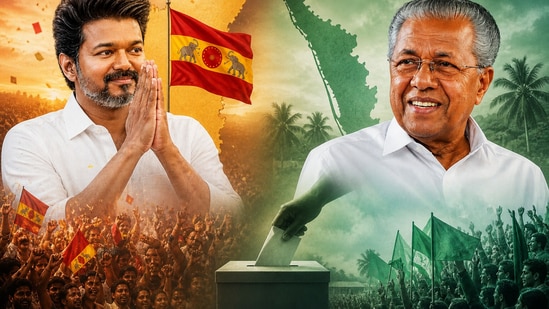
Vijay's win in Tamil Nadu; Kerala likely to oust LDF, but voters want Pinarayi Vijayan as CM: Axis My India exit poll
# Exit Polls: Vijay Sweeps TN, Kerala Ousts LDF
**By Special Correspondent, National Political Desk** | May 04, 2026
**New Delhi:** A political earthquake is poised to reshape the landscape of South India, according to the latest Axis My India exit polls released on Monday. Following record-breaking Assembly elections, actor-turned-politician Thalapathy Vijay’s fledgling party is projected to secure a historic, sweeping victory in Tamil Nadu, riding on an unprecedented 84.69% voter turnout. Meanwhile, in neighboring Kerala, the ruling Left Democratic Front (LDF) faces imminent defeat despite a robust 78.27% turnout across its 140 constituencies. In a fascinating electoral paradox, the data reveals that while Kerala’s voters are set to hand power to the opposition United Democratic Front (UDF), a definitive majority still prefers the incumbent LDF leader, Pinarayi Vijayan, as their Chief Minister. [Source: Hindustan Times]
## The ‘Thalapathy’ Wave: Tamil Nadu’s Historic Disruption
For over half a century, the political narrative of Tamil Nadu has been rigidly dictated by a bipolar contest between the Dravida Munnetra Kazhagam (DMK) and the All India Anna Dravida Munnetra Kazhagam (AIADMK). The 2026 Assembly elections appear to have conclusively shattered that duopoly.
The Axis My India exit poll projects an overwhelming mandate for Vijay’s Tamilaga Vettri Kazhagam (TVK), which he formally launched in early 2024 with his sights set firmly on the 2026 state elections. The most glaring indicator of this tectonic shift is the staggering voter turnout of **84.69%**, the highest ever recorded in the state’s democratic history. Traditionally, Tamil Nadu records a voter turnout hovering between 72% and 74%. Political analysts unanimously agree that a sudden surge of over 10% is indicative of a massive wave—either fiercely anti-incumbent or overwhelmingly pro-challenger. In this case, it appears to be both.
“What we are witnessing is the culmination of decades of latent voter fatigue with the entrenched Dravidian majors,” notes Dr. R. Kannan, a Chennai-based political scientist and author. “The youth demographic, comprising millions of first-time and second-time voters, turned up in unprecedented numbers. Vijay successfully transitioned his massive on-screen ‘Thalapathy’ persona into a credible off-screen political alternative, promising a corruption-free, tech-driven, and hyper-local governance model.” [Source: Independent Political Analysis]
If the exit poll predictions hold true on counting day, Vijay will replicate the legendary electoral debuts of cinema icons like M.G. Ramachandran (MGR) in Tamil Nadu and N.T. Rama Rao (NTR) in Andhra Pradesh. The incumbent DMK, led by M.K. Stalin, reportedly suffered from localized anti-incumbency, allegations of bureaucratic overreach, and a failure to capture the imagination of the Gen-Z electorate.
## Kerala’s Electoral Paradox: Rejecting the LDF, Revering the CM
Just across the Western Ghats, Kerala presents one of the most fascinating psychological studies in modern Indian psephology. The state recorded a robust voter turnout of **78.27% across all 140 constituencies**, a figure consistent with Kerala’s historically highly engaged and politically literate electorate.
According to the Axis My India projections, the ruling CPI(M)-led Left Democratic Front (LDF) is likely to be ousted, paving the way for the Congress-led United Democratic Front (UDF) to form the next government. This projection marks a return to Kerala’s traditional “revolving door” politics, a four-decade trend of alternating governments that was notably broken by Pinarayi Vijayan in 2021 when he secured a historic second consecutive term.
However, the exit poll highlights a remarkable contradiction: **While voters are decisively voting out LDF Members of the Legislative Assembly (MLAs), a significant majority still cite Pinarayi Vijayan as their preferred choice for Chief Minister.** [Source: Hindustan Times]
### Decoding the Pinarayi Phenomenon
How does a leader remain overwhelmingly popular while his government is voted out? The answer lies in the nuanced separation between macro-leadership and micro-governance in the minds of the Malayali voter.
1. **Macro-Leadership vs. Local Failures:** Pinarayi Vijayan is widely respected across party lines as a stern, capable administrator who expertly navigated Kerala through unprecedented crises, including the devastating 2018 floods, the Nipah virus outbreaks, and the COVID-19 pandemic. Voters trust his crisis management skills.
2. **Economic Stagnation and Debt:** Despite the Chief Minister’s strong image, the state’s financial health has been a persistent vulnerability. The LDF government faced mounting criticism over state debt, delayed pension payouts, and a perceived lack of aggressive industrial growth.
3. **Anti-Incumbency Against the Cabinet:** The exit polls suggest severe anti-incumbency at the constituency level. Voters expressed deep dissatisfaction with second-rung ministers and local LDF MLAs, accusing them of arrogance and administrative lethargy.
“The Kerala voter is highly sophisticated,” explains Sreedharan Pillai, a senior political commentator based in Thiruvananthapuram. “They are essentially saying, ‘We respect Comrade Pinarayi, but his team has failed to deliver on economic promises, and the state’s financial crisis requires a change of guard.’ It is an indictment of the LDF’s fiscal policies, not a rejection of Vijayan’s leadership stature.”
## Axis My India Methodology: Reading the Pulse
The Axis My India exit poll, known for its rigorous methodology and high historical accuracy rate under the guidance of psephologist Pradeep Gupta, utilized a massive sample size for the 2026 elections. By conducting face-to-face interviews across a stratified random sampling of all 234 constituencies in Tamil Nadu and 140 in Kerala, the agency claims a margin of error of merely +/- 3%.
### Projected Data Overview (Exit Poll Indicators)
| State | Total Seats | Voter Turnout | Projected Winner | Key Underlying Factor |
| :— | :—: | :—: | :— | :— |
| **Tamil Nadu** | 234 | **84.69%** | TVK (Thalapathy Vijay) | Massive youth mobilization; Anti-duopoly sentiment. |
| **Kerala** | 140 | **78.27%** | UDF (Congress-led) | Fiscal dissatisfaction; Localized anti-incumbency. |
*Note: Data derived from the Axis My India Exit Polls published May 2026. Official Election Commission of India results are pending.* [Source: Hindustan Times / Axis My India]
## Ramifications for the Traditional Heavyweights
The projected outcomes signal dire consequences for the established political fronts in both states.
In **Tamil Nadu**, a victory for Vijay would force a fundamental restructuring of the DMK and AIADMK. The DMK, banking heavily on its welfare schemes (like the *Magalir Urimai Thogai* basic income for women), seems to have miscalculated the depth of youth disillusionment. For the AIADMK, a poor showing could spark an existential crisis, raising questions about the party’s leadership vacuum post-Jayalalithaa. Furthermore, national parties like the BJP and Congress, who typically ride piggyback on the Dravidian majors, will find themselves marginalized by a new regional powerhouse fiercely protective of state autonomy.
In **Kerala**, a UDF victory provides a massive and much-needed shot in the arm for the Indian National Congress on a national level. Having struggled to maintain state governments, a win in Kerala would bolster the Congress’s financial and ideological resources. For the CPI(M), losing its last remaining bastion would relegate the Left to a marginal player on the national stage, forcing profound ideological and generational introspection.
## The National Implication Ahead of 2029
While Assembly elections are fought on state-specific issues, the outcomes in Tamil Nadu and Kerala will undoubtedly cast long shadows over the broader Indian political theater. South India remains a crucial battleground, acting as a regional counterweight to the politics of the Hindi heartland.
If Vijay forms the government in Tamil Nadu, he instantly becomes a national figure. His ideological stance—balancing unapologetic Tamil pride with an inclusive, welfare-oriented, and secular framework—will be closely monitored by the INDIA bloc and the NDA alike. He will hold significant bargaining power in future federal negotiations.
Conversely, the UDF’s expected resurgence in Kerala demonstrates that traditional anti-incumbency remains a potent force in Indian democracy, particularly when fueled by economic stagnation and grassroots-level voter fatigue.
## Conclusion: Awaiting the Final Verdict
Exit polls are, by definition, barometers of public mood rather than absolute verdicts. However, the sheer volume of the voter turnout—historic in Tamil Nadu at 84.69% and aggressively robust in Kerala at 78.27%—guarantees that the status quo is being violently shaken.
Whether Thalapathy Vijay can seamlessly transition from cinematic heroism to the Chief Minister’s office, and whether the UDF can successfully topple the formidable Pinarayi Vijayan despite his enduring personal popularity, will be definitively answered on counting day. Until then, South India remains at the precipice of a defining generational shift in its democratic journey.





