
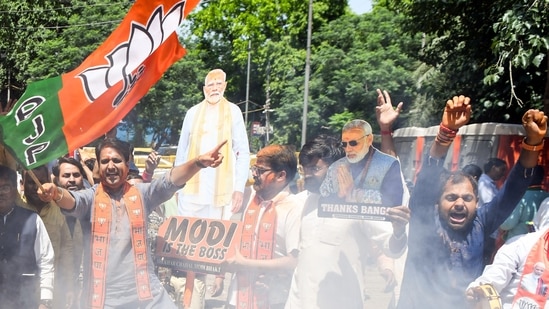
BJP eyes historic win in Mamata turf: Full list of winners in West Bengal elections 2026
# BJP Sweeps Bengal: Historic 2026 Election Win
By Staff Political Correspondent, The India Herald, May 4, 2026
On Monday, May 4, 2026, the Bharatiya Janata Party (BJP) achieved a monumental political milestone by crossing the majority mark in the West Bengal Legislative Assembly elections, securing its first-ever independent government in the state. Defeating Mamata Banerjee’s Trinamool Congress (TMC) after its uninterrupted 15-year rule, the saffron party capitalized on massive anti-incumbency, corruption allegations, and a highly polarized campaign. The Election Commission’s latest tally confirms the BJP has comfortably bypassed the magic number of 148 seats in the 294-member house, fundamentally redrawing the political map of eastern India and dealing a severe blow to the regional opposition.
## The Fall of a Political Titan
For a decade and a half, Mamata Banerjee and the Trinamool Congress seemed invincible in West Bengal. Having spectacularly ousted the 34-year-old Left Front government in 2011, Banerjee became the undisputed matriarch of Bengal politics. However, the 2026 assembly elections have rewritten that script. Early trends on Monday morning indicated a tight race, but by mid-afternoon, the mandate was decisively clear.
The Bharatiya Janata Party (BJP) has crossed the majority mark and is set to form a government independently in West Bengal [Source: Hindustan Times]. This victory represents the culmination of a decade-long ideological and organizational project by the BJP’s top brass, spearheaded by Prime Minister Narendra Modi and Home Minister Amit Shah. The defeat of the TMC marks the end of an era in eastern Indian politics, characterized by Banerjee’s fierce brand of regional sub-nationalism and extensive welfare politics.
The immediate aftermath at the TMC headquarters in Kolkata’s Kalighat was one of stunned silence, contrasting sharply with the jubilant scenes outside the BJP’s state headquarters in Hastings, where supporters distributed sweets and chanted slogans, celebrating a victory many once thought impossible.
## Tracing the Saffron Rise: A Decade in the Making
To understand the magnitude of this victory, one must look at the BJP’s steady encroachment into Bengal’s political consciousness. Prior to 2014, the BJP was a fringe player in the state, often struggling to secure even a 5% vote share. The narrative began to shift during the 2014 General Elections, but the true breakthrough occurred in 2019 when the BJP stunned the nation by winning 18 of the 42 Lok Sabha seats in the state, capturing an unprecedented 40% of the vote share.
Despite a temporary setback in the 2021 Assembly elections—where the TMC secured a landslide 213 seats on the back of the “Bengal wants its own daughter” campaign—the BJP established itself as the principal opposition with 77 seats. Over the next five years, the party relentlessly targeted the ruling administration.
**Key strategic shifts by the BJP leading up to 2026 included:**
* **Hyper-Local Leadership Consolidation:** Elevating grassroots leaders and diminishing reliance on turncoats, which had cost them dearly in 2021.
* **Targeted Demographic Outreach:** Expanding their base in the Matua-dominated regions, tribal belts in Junglemahal, and the crucial North Bengal corridor.
* **Sustained Anti-Corruption Campaigns:** Keeping public attention fixated on the ongoing Central Bureau of Investigation (CBI) and Enforcement Directorate (ED) probes into state-level scams.
## Key Factors Driving the Voter Mandate
The 2026 election was fought on dramatically different terms than 2021. While the previous election was defined by Bengali pride versus perceived outside influence, this cycle was dominated by issues of governance, corruption, and law and order.
### The Shadow of Corruption Scams
The TMC found itself battling severe anti-incumbency fueled by a series of high-profile corruption scandals. The prolonged incarceration of former top ministers related to the School Service Commission (SSC) recruitment scam, the public distribution system (ration) scam, and allegations of municipal recruitment irregularities created a palpable sense of fatigue among the electorate. The BJP effectively weaponized these issues, framing the TMC as a structurally corrupt entity that had betrayed the state’s youth.
### The Sandeshkhali Aftershocks
The socio-political landscape of Bengal was deeply shaken by the Sandeshkhali protests of 2024, where local women rose against alleged land grabbing and sexual extortion by local TMC strongmen. The BJP successfully utilized this incident to fracture Mamata Banerjee’s most loyal voter base: women.
“The TMC heavily relied on its flagship cash-transfer scheme, Lakshmir Bhandar, to retain female voters,” notes Dr. Arindam Sen, a prominent Kolkata-based political analyst. “However, the BJP’s counter-narrative—that welfare cannot substitute for basic safety and dignity—found deep resonance in 2026, creating a crucial swing in the female vote share that ultimately tipped the scales.” [Source: Independent Political Analysis Projections 2026].
### Economic Stagnation and Youth Flight
West Bengal’s lack of large-scale industrialization and the continuous out-migration of its youth in search of employment became a central theme. The BJP’s manifesto, which promised to transform Bengal into an industrial powerhouse through a “Double Engine Sarkar” (alignment of state and central governments), appealed to a growing middle-class and youth demographic desperate for economic revitalization.
## Prominent Winners and Major Upsets
The Election Commission’s full list of winners highlights several key battlegrounds where the BJP successfully breached TMC fortresses. While the final margins are still being certified, the early declarations point to a sweeping saffron wave across North Bengal, the western districts, and crucial urban pockets around Kolkata.
**Notable 2026 West Bengal Election Results Highlights:**
| Constituency | Winning Party | Key Dynamics |
| :— | :— | :— |
| **Nandigram** | BJP | The Leader of the Opposition retained his stronghold, increasing his margin significantly against the TMC challenger. |
| **Bhabanipur** | TMC | Mamata Banerjee’s traditional bastion remained with the TMC, though with a reduced margin reflecting urban discontent. |
| **Kharagpur Sadar** | BJP | A resounding victory for the BJP, heavily influenced by the industrial workforce and Hindi-speaking populations. |
| **Diamond Harbour** | TMC | Abhishek Banerjee’s stronghold witnessed a fierce contest, but the TMC managed to hold the line amid intense BJP campaigning. |
| **Cooch Behar Dakshin** | BJP | Consolidated the BJP’s absolute dominance in North Bengal, driven by Rajbanshi community support. |
| **Howrah Madhya** | BJP | A shocking upset where traditional TMC minority and urban votes fractured, allowing the BJP to slip through. |
## Expert Analysis: A Tectonic Shift in Indian Politics
The BJP’s victory in West Bengal transcends state borders; it is a seismic event in the national political arena. For years, West Bengal, Kerala, and Tamil Nadu were viewed as the final frontiers for the BJP—states where regional identities heavily resisted the party’s nationalist messaging.
“Breaching West Bengal is arguably the BJP’s most significant electoral achievement since their 2014 national victory,” states Meenakshi Roy, Senior Fellow at the Centre for Policy Research. “It dismantles the myth that the BJP has a ceiling in the east. Furthermore, it severely undermines the national opposition. Mamata Banerjee was a linchpin for anti-BJP coalitions; losing her home turf drastically reduces her national bargaining power and leaves the opposition without one of its most aggressive street fighters.”
The victory also validates the strategic patience of the BJP’s central leadership. By enduring the heavy losses of 2021, systematically replacing aging leadership, and continuously mobilizing cadres despite alleged political violence, the party proved its resilience.
## BJP’s Blueprint for Bengal’s Future
With the mandate secured, the focus immediately shifts to governance. The BJP has promised a radical departure from the policies of the last 15 years. Their primary agenda includes:
1. **Industrial Resurgence:** The BJP has vowed to establish special economic zones and fast-track clearances to attract major IT and manufacturing hubs back to the state, aiming to reverse the brain drain.
2. **Law and Order Overhaul:** Promising an end to “syndicate raj” (organized local extortion networks), the new administration is expected to heavily restructure the state police apparatus.
3. **Implementation of Central Schemes:** The immediate rollout of the Ayushman Bharat health insurance scheme and the PM Kisan Samman Nidhi, which the previous TMC government had frequently clashed with the center over.
4. **Socio-Cultural Interventions:** The party has also promised strict border management to curb illegal immigration, a highly sensitive issue that mobilized their core voter base in border districts.
However, the path ahead is fraught with challenges. The incoming government will inherit a state economy burdened by massive debt, estimated to be over ₹6 lakh crore. Balancing the state’s finances while fulfilling the expansive promises made during the campaign—including maintaining popular welfare schemes established by the TMC—will be a tightrope walk for the new Chief Minister.
## Conclusion: The Road Ahead
The May 2026 West Bengal election results will be inscribed in Indian political history as a watershed moment. The Bharatiya Janata Party’s ascent to absolute majority in a state deeply rooted in Leftist and regional ideologies showcases the shifting currents of Indian voter psychology.
For Mamata Banerjee and the Trinamool Congress, the defeat necessitates a painful period of introspection and structural overhaul if they are to survive as a potent political force. For the BJP, the victory is a monumental validation of its “Look East” policy, providing enormous momentum as national politics slowly pivot toward the end of the decade.
As West Bengal prepares for its first transition of power in 15 years, the nation watches closely. The saffron party has successfully conquered Mamata’s turf; now, they face the equally daunting task of governing it.





