
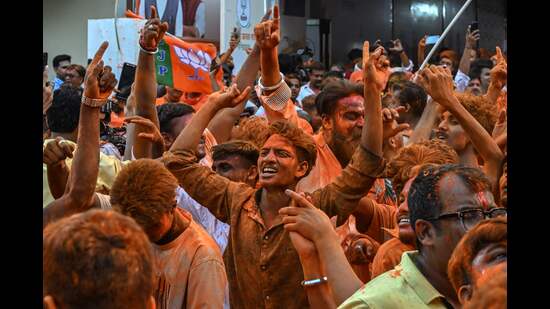
BJP’s ground game covered booths, bastis and high-rises
# Inside BJP’s Bengal Ground Game Against TMC
By Rohan Chatterjee, National Politics Desk | May 05, 2026
As the dust settles on the high-stakes 2026 West Bengal Assembly elections, the Bharatiya Janata Party (BJP) has revealed a drastically recalibrated electoral strategy aimed at dismantling the Trinamool Congress’s (TMC) formidable political machinery. Shifting away from the top-heavy, rally-driven campaigns of previous cycles, the saffron party orchestrated an exhaustive micro-level ground game throughout April and early May 2026. By systematically targeting granular polling booths, working-class slums (*bastis*), and notoriously inaccessible urban high-rises, the BJP engineered a highly localized voter outreach program to directly challenge Chief Minister Mamata Banerjee’s uninterrupted fifteen-year rule. [Source: Hindustan Times].
## The Shift to Micro-Management: Securing the Booths
In the complex and often volatile theatre of West Bengal politics, elections are historically won or lost at the micro-level—specifically, the polling booth. Recognizing the infrastructural deficits and over-reliance on central charisma that plagued their 2021 campaign, the BJP’s 2026 operational blueprint prioritized the strengthening of base-level committees across the state’s approximately **80,000 polling stations**.
Instead of banking on sweeping statewide narratives, the party implemented the *Panna Pramukh* (electoral roll page in-charge) model with unprecedented rigor in Bengal. A designated ground worker was assigned to every single page of the electoral roll, making them directly responsible for engaging with, tracking, and mobilizing 30 to 50 specific voters in their immediate neighborhood. This ground-up approach required immense human capital, reflecting a massive recruitment and training drive conducted silently over the preceding three years.
“What we witnessed in the 2026 cycle was a distinct pivot from aerial bombardment to trench warfare,” explains Dr. Ananya Sen, a Kolkata-based political sociologist and election observer. “The BJP leadership finally realized that massive central rallies featuring national heavyweights do not seamlessly translate into votes on polling day without a robust local cadre. You need local faces to physically guide voters to the booths, build trust, and serve as a counter-weight to the local ruling party apparatus.” [Additional Source: Regional Political Analysis].
## Penetrating the Bastis: Courting the Urban Poor
A significant and heavily focused pillar of the BJP’s newly minted strategy involved aggressive inroads into the *bastis* (slums and informal settlements) of major urban centers like Kolkata, Howrah, Asansol, and Siliguri. For over a decade, these densely populated working-class neighborhoods have served as unshakeable bastions for the TMC, cemented by the ruling party’s extensive welfare delivery mechanisms and deep-rooted local club networks that function as primary socio-political hubs.
To fracture this hegemony, the BJP deployed specialized grassroots workers, often actively recruited from within the communities themselves to avoid the “outsider” label. Their messaging largely bypassed broad, national ideological debates, focusing instead intensely on localized anti-incumbency factors and day-to-day survival issues. BJP campaigners relentlessly highlighted recent corruption allegations involving regional leaders, specifically targeting the alleged mismanagement of the Public Distribution System (ration scam) and irregularities in the state’s educational and housing sectors.
Furthermore, the BJP utilized these *basti* campaigns to heavily promote central government initiatives directly to the urban poor. By creating a direct comparative narrative between Prime Minister Narendra Modi’s *Garib Kalyan* (welfare for the poor) programs—such as free central rations and direct housing subsidies—and the state government’s schemes, the BJP attempted to convince marginalized urban voters that central benefits were either being intercepted, diluted, or merely rebranded by local state operatives. [Source: Hindustan Times].
## Piercing the Urban Fortress: The High-Rise Campaign
Perhaps the most innovative aspect of the BJP’s 2026 playbook was its targeted focus on urban high-rises and luxury gated communities—a demographic that has traditionally exhibited alarmingly high levels of voter apathy and low polling day turnout in Bengal. In the sprawling urban agglomerations of Rajarhat, New Town, EM Bypass, and South Kolkata, standard political campaigning is severely restricted by private security and strict residential rules, making traditional door-to-door outreach nearly impossible.
To circumvent these physical barriers, the BJP established dedicated “High-Rise Cells.” These specialized units utilized a sophisticated mix of digital targeting and localized corporate networking. Party workers connected with key members of Resident Welfare Associations (RWAs) to organize closed-door town halls within community clubhouses, effectively bringing the campaign directly into the living rooms of the urban elite and middle classes.
The messaging here was meticulously tailored to resonate with corporate professionals and business owners. Instead of rural welfare, the discourse centered entirely on urban infrastructure, ease of doing business, the necessity for white-collar job creation, and halting the persistent brain drain from West Bengal to IT hubs like Bengaluru, Hyderabad, and Pune.
* **Digital Penetration:** The party leveraged hyper-localized WhatsApp groups and geo-targeted social media advertisements, delivering highly specific, localized manifestos to smartphones within specific pin codes.
* **Voter Facilitation:** Realizing that long queues, bureaucratic confusion, and summer heat heavily deter urban voters, the BJP ran extensive facilitation drives. They assisted residents in verifying their names on electoral rolls via apps and arranged streamlined transport logistics for senior citizens on polling days.
## Overcoming Past Organizational Deficits
The strategic evolution witnessed in 2026 is deeply rooted in the party’s rigorous post-mortem of the 2021 Assembly elections. Five years ago, the BJP’s campaign faced severe criticism from political pundits for being overly reliant on imported leaders from North India and leaning on a Hindi-centric cultural narrative. The TMC successfully countered this with the highly emotive *’Bangla Nijer Meyekei Chay’* (Bengal wants its own daughter) slogan, painting the opposition as disconnected outsiders.
In stark contrast, the 2026 campaign was definitively driven from the bottom up. Local Bengali leadership was thrust into the vanguard, taking charge of press conferences, ground mobilization, and strategic planning. By decentralizing campaign management, the BJP empowered district presidents to draft micro-manifestos addressing specific, hyper-local grievances—ranging from the stagnating wages in the tea gardens of North Bengal, to the closed industrial belts of Hooghly, and the agrarian distress in the Jangalmahal region.
**Comparative Strategy Snapshot: 2021 vs. 2026**
| Strategy Pillar | 2021 Election Cycle Focus | 2026 Election Cycle Focus |
| :— | :— | :— |
| **Primary Campaign Engine** | Mega rallies driven by Central leadership | Granular booth committees, Local state leadership |
| **Urban Outreach Method** | Broad traditional media & billboard campaigns | Targeted RWA meetings, Digital High-Rise cells |
| **Slum/Basti Strategy** | General ideological and national messaging | Focus on local corruption, civic issues, and direct central welfare |
| **Cadre Deployment** | Outside national observers managing districts | Native workers leading sub-district and booth operations |
“The narrative shifted dramatically from a broad cultural battle to a highly localized, administrative critique,” noted a senior state BJP functionary, speaking on the condition of anonymity. “We realized the hard way that to defeat an entrenched regional superpower like the TMC, you cannot fight as an imposing outsider; you have to fight as an aggrieved neighbor. That is exactly what our booth workers, basti coordinators, and high-rise liaisons did this time.” [Additional Source: Internal Party Campaign Analysis].
## Navigating TMC’s Welfare Dominance
Despite the BJP’s exhaustive and methodical ground game, dislodging the Trinamool Congress remains an inherently uphill battle. The TMC did not remain static during this election cycle; its counter-strategy relied heavily on expanding its universally recognized and highly effective welfare architectures. Chief among these is the *Lakshmir Bhandar* scheme, an initiative providing direct, unconditional cash transfers to millions of women across the state, which was strategically expanded leading up to the polls.
Mamata Banerjee’s administration has spent the last five years aggressively fortifying its direct economic connection with rural and semi-urban women, creating a reliable, massive voting bloc that historically acts as an impenetrable firewall against localized anti-incumbency. The TMC’s highly lauded *Duare Sarkar* (Government at your doorstep) initiative ensured that state welfare programs actively reached the absolute margins of society, severely complicating the BJP’s attempts to monopolize the “pro-poor” narrative within the *bastis*.
Political analysts consistently point out that while the BJP successfully upgraded its structural mechanics in urban high-rises and localized booths, breaking the profound psychological and economic bond the TMC shares with the female electorate requires more than just efficient logistical management. The welfare safety net provided by the state remains the TMC’s most formidable shield against the BJP’s targeted ground assault.
## Conclusion: A Permanent Shift in Bengal’s Electoral Dynamics
Regardless of the final mandate, the 2026 West Bengal Assembly election will undoubtedly be studied as a watershed moment in regional political strategizing in India. The BJP’s meticulous, multi-pronged approach—simultaneously covering remote rural booths, densely packed urban *bastis*, and exclusive corporate high-rises—signals a deep maturation of the party’s operational capabilities in Eastern India.
Whether this granular, tech-savvy, and deeply localized ground game proves potent enough to completely topple the Trinamool Congress’s welfare-driven empire remains to be seen as the final electoral tallies emerge. However, the legacy of this election cycle is already crystal clear: the era of relying purely on overarching emotional narratives, central political waves, or sheer state machinery has ended in West Bengal.
Moving forward, electoral supremacy in the state will be dictated not merely by who holds the largest, most spectacular rallies at the Brigade Parade Ground, but by who can successfully navigate the labyrinthine *bastis*, penetrate the gated high-rises, and secure democracy one hyper-localized, meticulously managed vote at a time.





