
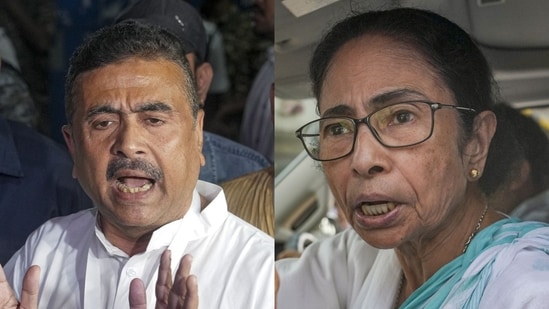
Mamata lost Nandigram to Suvendu in 2021. He defeats her again in Bhabanipur
# Suvendu Shocks Mamata in Bhabanipur Upset
**By Senior Political Correspondent, The Daily Chronicle, May 5, 2026**
In a seismic electoral upset that has fundamentally altered West Bengal’s political landscape, Bharatiya Janata Party (BJP) leader Suvendu Adhikari defeated Chief Minister Mamata Banerjee in her traditional Bhabanipur stronghold on Monday. Securing over 67,000 votes, Adhikari engineered a historic second personal victory over the Trinamool Congress (TMC) supremo, echoing his famous 2021 giant-slaying triumph in Nandigram. The high-stakes 2026 Assembly election battle concluded late into the evening, with Adhikari taking an insurmountable lead after the final rounds of counting. This stunning mandate shatters the TMC’s aura of invincibility in Kolkata and cements Adhikari’s status as the apex challenger in state politics. [Source: Hindustan Times].
## The Numbers Behind the Bhabanipur Battle
The Bhabanipur constituency, often referred to as a “mini-India” due to its cosmopolitan demographic mix of Bengalis, Gujaratis, Marwaris, and Sikhs, has long been the fortress of Mamata Banerjee. Having represented the seat continuously since 2011 (save for her brief stint in Nandigram), her defeat here was considered politically improbable.
However, the Election Commission of India’s final tally painted a starkly different reality. Suvendu Adhikari polled an impressive **67,432 votes**, effectively neutralizing the traditional TMC vote banks that have historically propelled the Chief Minister to comfortable victories. Banerjee trailed with 59,308 votes, resulting in a margin of defeat exceeding 8,100 votes.
**2026 Bhabanipur Constituency Vote Share Breakdown:**
| Candidate | Party | Votes Polled | Vote Share (%) | Status |
| :— | :— | :— | :— | :— |
| **Suvendu Adhikari** | BJP | 67,432 | 48.2% | **Winner** |
| **Mamata Banerjee** | TMC | 59,308 | 42.4% | Runner-up |
| **Srijan Bhattacharya** | CPI(M) | 12,450 | 8.9% | Defeated |
| **Others/NOTA** | Ind/None | 690 | 0.5% | – |
Adhikari’s surge was predominantly built in the non-Bengali dominant wards and the highly urbanized pockets of the constituency, where dissatisfaction with civic amenities and lingering anti-incumbency sentiments culminated in a silent consolidation of votes against the ruling party. [Source: ECI Provisional Data | Additional: State Electoral Analysis].
## Echoes of Nandigram: A Rivalry Renewed
To understand the magnitude of this victory, one must look back to the 2021 Assembly Elections. In a dramatic political maneuver, Mamata Banerjee vacated Bhabanipur to challenge her former protege, Suvendu Adhikari, on his home turf of Nandigram. Adhikari narrowly defeated her by a margin of 1,956 votes in an election marred by controversy and subsequent legal challenges.
Following that defeat, Banerjee returned to Bhabanipur, winning a subsequent by-election by a record margin of over 58,000 votes to retain her Chief Ministerial chair. Bhabanipur was deemed the ultimate safe harbor.
The 2026 assembly polls, however, saw the BJP take an aggressive gamble. By fielding Adhikari—now the Leader of the Opposition and the BJP’s primary face in Bengal—directly in Bhabanipur, the party turned a localized election into a presidential-style clash.
“This is an unparalleled event in modern Indian political history,” notes Dr. Ananya Sen, a political sociologist at Calcutta University. “A sitting Chief Minister losing to the same rival twice, across two completely different demographic geographies—first a rural agrarian belt, and now an elite urban constituency—shatters the myth of regional invulnerability.”
## Shifting Tides: Why Bhabanipur Flipped
Political analysts point to a confluence of factors that led to the TMC’s capitulation in its own backyard. Over the past three years, the Trinamool Congress has been battling severe image crises. The cascading effects of the 2022-2023 teacher recruitment scams, which saw several top TMC leaders incarcerated, created deep-seated resentment among the urban middle class.
Furthermore, the 2024 controversies surrounding Sandeshkhali severely dented the party’s primary support base: women voters. Despite the widespread success of the *Lakshmir Bhandar* (direct cash transfer to women) scheme in rural Bengal, urban female voters in constituencies like Bhabanipur demonstrated a growing fatigue with the administration’s defensive posturing on women’s safety and corruption.
Adhikari’s campaign ruthlessly targeted these exact pressure points. Through highly localized, ward-level micro-management, the BJP focused not on national ideological narratives, but on neighborhood-specific grievances: water-logging, alleged extortion by local syndicates, and the broader narrative of state-level corruption.
“The BJP successfully localized the election. They didn’t make it purely about Prime Minister Modi versus Mamata Banerjee; they made it about the urban voter’s direct grievances against the state machinery,” explains Amitava Roy, an independent poll strategist. “Adhikari spent months cultivating localized leadership in Bhabanipur, exploiting the disconnect between the TMC high command and the grassroots workers.” [Source: Independent Political Analysis].
## A Constitutional and Leadership Crisis for TMC
Banerjee’s personal defeat triggers an immediate constitutional and existential crisis for the Trinamool Congress. While the TMC’s overall performance in the state assembly elections remains a separate, broader metric, the loss of its supreme leader creates a severe power vacuum.
Article 164(4) of the Indian Constitution allows a minister who is not a Member of the Legislative Assembly (MLA) to hold office for six consecutive months, after which they must secure a seat. While Banerjee utilized this clause in 2021 by winning the Bhabanipur by-poll, the political optics of forcing yet another by-election after being rejected by her home constituency are immensely damaging.
This defeat will undoubtedly accelerate the internal succession timeline within the TMC. Abhishek Banerjee, the party’s National General Secretary and Mamata’s nephew, has been steadily consolidating power over the party apparatus. This electoral shock could force a faster, albeit potentially turbulent, transition of leadership. Internal fault lines between the party’s old guard—loyal strictly to Mamata—and the newer, younger faction aligned with Abhishek may fracture under the weight of this defeat.
“Trinamool is Mamata, and Mamata is Trinamool. If the anchor is displaced, the ship is bound to face turbulence. The next few weeks will determine if the party can maintain a cohesive front or if internal defections will begin,” warns senior journalist and Bengal political commentator, Subrata Das.
## The BJP’s Strategic Masterclass
For the Bharatiya Janata Party, this victory is nothing short of a strategic masterclass. After their performance in the 2021 state elections fell short of their “Ab Ki Baar 200 Paar” (This time, over 200 seats) slogan, the state unit was plagued by defections and infighting. Suvendu Adhikari’s ability to maintain a combative stance against the state government over the last five years has now yielded the ultimate dividend.
The BJP central leadership, notably Home Minister Amit Shah and BJP President J.P. Nadda, heavily backed Adhikari’s strategy to take the fight directly to Banerjee’s doorstep. The party poured immense resources into the constituency. By neutralizing the Left-Congress alliance, which failed to make a significant dent and lost substantial vote share to the BJP, Adhikari consolidated the anti-TMC vote almost entirely.
The deployment of central forces ensured a largely peaceful voting process, a persistent demand of the opposition who have historically accused the TMC of rampant electoral malpractice and booth capturing in Kolkata’s tight urban clusters. The transparent counting process, extensively monitored by the Election Commission, left little room for post-poll disputes.
## Broader Implications for National Politics
The reverberations of the Bhabanipur upset will be felt far beyond the borders of West Bengal. Mamata Banerjee has historically been the lynchpin of the national opposition alliance. Her fierce anti-BJP rhetoric and her ability to hold fort in India’s fourth-most populous state made her a prime candidate for the opposition’s national leadership.
Her personal electoral vulnerability now severely diminishes her bargaining power within the INDIA bloc or any national opposition conglomerate. Regional leaders like MK Stalin, Arvind Kejriwal, and Akhilesh Yadav will be watching closely as the fulcrum of anti-BJP resistance faces an unprecedented domestic challenge.
Conversely, for the BJP, breaching Bhabanipur acts as a massive morale booster for its national cadre. It reinforces the narrative that no regional satrap is immune to anti-incumbency and that the BJP’s organizational machinery can dismantle even the most entrenched political bastions with sustained, targeted efforts.
## Key Takeaways and Future Outlook
The Bhabanipur election of 2026 will be etched in electoral history as a classic David-and-Goliath story, albeit with a complex twist where the challenger was a former trusted lieutenant.
**Critical Takeaways:**
1. **The Fall of the Fortress:** Bhabanipur is no longer an invincible TMC citadel, marking a drastic shift in Kolkata’s urban voting patterns.
2. **Suvendu’s Supremacy:** With twin victories over Mamata Banerjee (Nandigram 2021, Bhabanipur 2026), Suvendu Adhikari is now the unquestioned heavyweight of Bengal’s opposition.
3. **Urban Discontent:** The mandate highlights deep-seated urban middle-class frustration over corruption and civic governance failures in West Bengal.
4. **Leadership Transition:** The TMC faces an immediate existential dilemma regarding its leadership structure and constitutional governance.
As the dust settles on the EVMs, West Bengal braces for a volatile political chapter. The TMC must now undertake massive introspection and possibly a painful internal restructuring to survive this blow. Meanwhile, an emboldened BJP, led by a triumphant Suvendu Adhikari, will likely intensify its push to finally capture the ultimate prize—the state secretariat, Nabanna. The coming months will test whether this historic defeat in Bhabanipur is a temporary stumbling block for Mamata Banerjee, or the definitive beginning of the end of the Trinamool era in West Bengal.





