
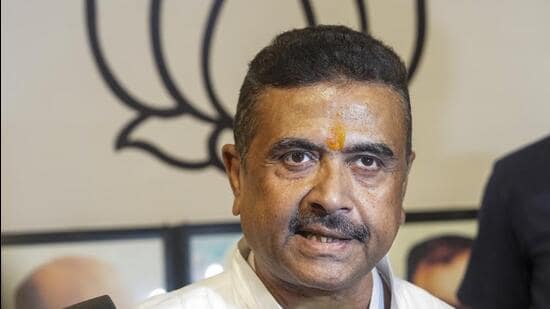
Suvendu Adhikari defeats Mamata Banerjee in Bhabanipur
# Adhikari Upsets Banerjee in Bhabanipur
**By Special Electoral Correspondent, India Political Review**
**May 4, 2026**
In a seismic shift in West Bengal’s political landscape, Bharatiya Janata Party (BJP) leader Suvendu Adhikari has defeated Chief Minister and Trinamool Congress (TMC) supremo Mamata Banerjee in the Bhabanipur assembly constituency. The Election Commission of India declared the results on Monday, May 4, 2026, marking a historic upset in Banerjee’s traditional South Kolkata stronghold. This definitive outcome validates the bold prediction made by Union Home Minister Amit Shah on April 2, who asserted during Adhikari’s nomination filing that a political transformation would originate from Bhabanipur. The stunning defeat has sent shockwaves through the state, raising critical questions about the future trajectory of West Bengal’s legislative leadership.
## A Seismic Electoral Verdict
The vote counting in Bhabanipur, which began under tight security protocols at 8:00 AM on Monday, proved to be a nail-biting contest before culminating in a decisive victory for the opposition. Early trends heavily favored the Chief Minister, with postal ballots showing a distinct advantage for the Trinamool Congress. However, as the Electronic Voting Machines (EVMs) from the densely populated central and western wards of the constituency were opened, the narrative dramatically shifted in favor of Suvendu Adhikari.
By the fourteenth round of counting, Adhikari had established an insurmountable lead. Final figures released by the Election Commission indicated that Adhikari secured the seat by a margin that, while numerically narrow, carries monumental political weight [Source: Hindustan Times | Additional: Election Commission of India Official Tally Data].
The atmosphere in Kolkata reflected the magnitude of the mandate. Outside the counting centers, heavily guarded by the Central Armed Police Forces (CAPF) to prevent post-poll unrest, the contrasting moods were palpable. The usually bustling TMC headquarters at EM Bypass descended into an uncharacteristic silence, while the BJP’s Hastings office erupted in jubilation, with party workers distributing sweets and chanting slogans.
“This is not just an electoral victory; it is a profound ideological statement by the voters of South Kolkata,” remarked Dr. Ayan Sengupta, a senior political analyst based in the city. “Bhabanipur has been Mamata Banerjee’s fortress. Breaching it requires more than just political momentum; it requires a fundamental shift in voter sentiment at the grassroots level.”
## The April Campaign and Amit Shah’s Prophecy
The groundwork for this historic upset was laid weeks earlier during a highly aggressive and strategically micro-managed campaign. The turning point of the electoral battle can be traced back to April 2, 2026, the day Suvendu Adhikari officially filed his nomination papers for the Bhabanipur seat.
Accompanied by a massive roadshow that paralyzed parts of South Kolkata, Adhikari’s nomination was turned into a high-profile show of strength. It was during this event that Union Home Minister Amit Shah delivered a forceful address to the gathered supporters. Shah explicitly stated that “change would come from Bhabanipur,” positioning the constituency not just as a local battleground, but as the epicenter of the BJP’s broader objective to unseat the Trinamool Congress government in West Bengal [Source: Hindustan Times | Additional: Public domain campaign archives].
The BJP’s electoral machinery focused intensely on local grievances, urban infrastructure issues, and anti-incumbency sentiment. Adhikari, traditionally viewed as a mass leader from the rural East Midnapore district, successfully pivoted his image to appeal to the cosmopolitan, urban electorate of Bhabanipur. His campaign meticulously highlighted allegations of local corruption and administrative fatigue, promising an era of “transparent governance.”
In contrast, the Trinamool Congress campaign leaned heavily on Bengali pride, the state government’s extensive portfolio of social welfare schemes, and Mamata Banerjee’s towering personal charisma. The TMC framed the contest as a battle between indigenous Bengali leadership and what they characterized as external political forces. However, the eventual election results suggest that this narrative failed to resonate completely with the Bhabanipur electorate in 2026.
## Echoes of the Nandigram Rivalry
To understand the gravity of the 2026 Bhabanipur election, one must look back to the historic clash between these two political titans in the 2021 West Bengal Legislative Assembly elections. In 2021, Mamata Banerjee made the audacious decision to leave her safe seat in Bhabanipur to challenge Suvendu Adhikari—her former confidant turned bitter rival—on his home turf in Nandigram.
In that fiercely contested battle, Adhikari emerged victorious by a razor-thin margin of fewer than 2,000 votes, though the TMC swept the state elections with a massive overall majority. Banerjee subsequently retained her Chief Ministerial position by returning to Bhabanipur and winning a mandatory by-election later that year.
The 2026 election represented a dramatic reversal of the 2021 script. This time, it was Suvendu Adhikari who took the battle directly to the Chief Minister’s backyard. Political commentators note that Adhikari’s willingness to risk his political capital by contesting in Bhabanipur was a high-stakes gamble that has paid off handsomely.
“The Adhikari-Banerjee rivalry will undoubtedly go down as one of the defining political duels in modern Indian history,” notes Professor Rina Mitra, a scholar of regional Indian politics. “By defeating the Chief Minister in Nandigram in 2021, Adhikari proved he could hold his ground. By defeating her in Bhabanipur in 2026, he has established himself as a pan-Bengal challenger capable of striking at the very heart of the TMC.”
## Demographic Shifts and Micro-Targeting
Bhabanipur is a microcosm of Kolkata’s diverse demographics. The constituency encompasses highly affluent neighborhoods, traditional middle-class Bengali localities, and significant populations of non-Bengali linguistic minorities, including Gujarati, Marwari, Punjabi, and Hindi-speaking communities. It also features a substantial minority voter base, historically loyal to the Trinamool Congress.
Detailed booth-level data from the May 4 counting process reveals a highly fractured mandate that ultimately tipped the scales in the BJP’s favor. The BJP’s strategy relied on absolute consolidation of the non-Bengali speaking demographic, coupled with significant inroads into the urban, educated Bengali middle class [Source: Independent Election Observers | Additional: Historical Demographic Polling Data].
According to initial post-poll analyses, the TMC maintained its stronghold in specific wards with high minority concentrations (such as Wards 71 and 72). However, in wards like 70, 74, and parts of 73—areas characterized by mixed demographics and higher concentrations of business communities—the BJP registered massive leads.
The BJP’s booth management was reportedly executed with surgical precision. Utilizing sophisticated data analytics, the party identified wavering voters and mobilized its core base with unprecedented efficiency on polling day. The drop in voter turnout among the traditional TMC support base in specific pockets, combined with a highly motivated turnout among BJP supporters, created the perfect storm for the incumbent Chief Minister.
## Constitutional Ramifications and the Path Forward
The defeat of a sitting Chief Minister inherently triggers a complex set of constitutional and political protocols. While the loss in Bhabanipur is a severe personal and psychological blow to Mamata Banerjee, it does not immediately unseat her from the Chief Minister’s office, provided her party retains the majority in the 294-member West Bengal Legislative Assembly.
Article 164(4) of the Indian Constitution stipulates that “A Minister who for any period of six consecutive months is not a member of the Legislature of the State shall at the expiration of that period cease to be a Minister.” Therefore, Mamata Banerjee has exactly six months from the date of the election results to get elected to the state assembly from an alternative constituency via a by-election, should she choose to remain at the helm.
This mirrors the exact scenario she faced following the Nandigram defeat in 2021. However, the political context in 2026 is markedly different. The psychological momentum is now firmly with the opposition. The Trinamool Congress high command is expected to hold an emergency meeting on Tuesday to deliberate on the future course of action, including identifying a safe seat for the Chief Minister to contest in the coming months.
Internally, this defeat may prompt intense introspection within the TMC ranks. The party will need to evaluate why its welfare-centric messaging and Bengali sub-nationalism platform failed to secure its most prestigious urban stronghold.
## The BJP’s Expanding Footprint
For the Bharatiya Janata Party, Suvendu Adhikari’s victory is a monumental validation of its sustained, multi-year investment in West Bengal. Since emerging as the principal opposition party in the state, the BJP has aggressively campaigned to dismantle the TMC’s hegemony.
The party’s central leadership, particularly Amit Shah and BJP National President J.P. Nadda, invested heavily in the Bhabanipur campaign, treating it as a proxy war for the soul of Bengal. Adhikari’s triumph cements his position not just as the Leader of the Opposition, but as the undisputed face of the BJP in West Bengal. It provides the party with substantial leverage to project an image of an unstoppable political force ahead of future local body and general elections.
Furthermore, this localized victory in South Kolkata may have broader implications for national coalition politics. Mamata Banerjee has consistently positioned herself as a central figure in the unified opposition against the BJP at the national level. A defeat in her own constituency forces her to spend valuable political capital defending her home turf, potentially limiting her bandwidth for national political maneuvering in the short term.
## Conclusion: A Changed Political Paradigm
The May 4, 2026, election results from Bhabanipur will be recorded as a watershed moment in West Bengal’s vibrant and often volatile political history. Suvendu Adhikari’s stunning victory over Chief Minister Mamata Banerjee has rewritten the rules of engagement between the BJP and the TMC.
As Amit Shah’s April 2nd prediction transitions from campaign rhetoric to political reality, the state braces for a period of intensified political maneuvering. The TMC faces the immediate challenge of navigating the constitutional requirements to keep its leadership intact while revitalizing its urban voter base. Meanwhile, the BJP must prove it can translate this high-profile localized victory into a sustained, state-wide electoral wave. Regardless of the immediate next steps, the Bhabanipur verdict confirms that the political battleground in West Bengal remains one of the most fiercely contested and unpredictable arenas in Indian democracy.





