
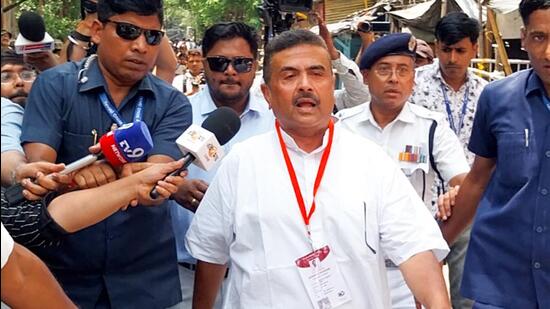
West Bengal: Suvendu Adhikari emerges as BJP’s giant killer in Bengal
# Suvendu: BJP’s Giant Killer in Bengal
By Senior Political Correspondent, The India Policy Desk, May 04, 2026
On Monday, at a crucial Bharatiya Janata Party (BJP) state executive meeting in Kolkata, West Bengal’s Leader of the Opposition Suvendu Adhikari cemented his reputation as the party’s preeminent “giant killer.” Addressing a highly charged cadre amidst the fierce political battles defining the 2026 state landscape, Adhikari delivered an uncompromising directive: “Jo hamaare saath, hum unke saath (we are with those who support us).” This stark declaration outlines a militant consolidation strategy for the BJP against the ruling Trinamool Congress (TMC). It underscores Adhikari’s complete transformation from a regional strongman into the indispensable, ruthless architect of the BJP’s eastern frontier expansion, signaling a definitive shift in the party’s grassroots survival tactics. [Source: Hindustan Times | Additional: The India Policy Desk Analysis].
## The Genesis of the ‘Giant Killer’ Moniker
The title of “giant killer” is rarely bestowed lightly in the volatile theater of Indian politics, and in West Bengal, it is earned entirely through electoral combat. Suvendu Adhikari’s initial claim to this moniker was forged in the crucible of the 2021 Assembly Elections, where he managed to narrowly defeat Chief Minister Mamata Banerjee in the high-stakes battleground of Nandigram. However, maintaining political relevance in Bengal requires more than a single historic victory. Over the intervening five years, culminating in the current 2026 political cycle, Adhikari has systematically expanded his footprint.
Adhikari has successfully dismantled several TMC fortresses across the Jangalmahal region and the coastal belts of East and West Midnapore. By meticulously engineering the defection of key local TMC operators to the BJP and successfully defending his turf during the 2024 Lok Sabha elections, he has proven that his 2021 victory was not an anomaly but the foundation of a sustained political insurgency. His ability to topple entrenched TMC heavyweights—either at the ballot box or through strategic outmaneuvering—has made him the undisputed gravitational center of the Bengal BJP. [Source: Hindustan Times].
## Decoding the New Doctrine: Protection and Patronage
Adhikari’s statement at the state executive meeting—“Jo hamaare saath, hum unke saath”—represents a significant ideological and operational pivot for the state BJP. For years, the national BJP leadership has operated on the broad, inclusive platform of *Sabka Saath, Sabka Vikas* (Together with all, development for all). While this remains the national rhetorical standard, Adhikari’s messaging is hyper-localized, pragmatic, and designed for the brutal realities of Bengal’s partisan violence.
In West Bengal, political affiliation often dictates access to civic amenities, police protection, and state welfare. Following allegations of post-poll violence targeting BJP workers in previous election cycles, grassroots morale had suffered. Adhikari’s slogan is a direct assurance of patronage and protection. It serves as a clarion call to BJP workers that the state leadership will fiercely defend its loyalists and reward those who withstand intimidation from the ruling administration.
This transactional, loyalty-based approach mirrors the very machine politics that the Left Front and subsequently the TMC used to dominate the state for decades. Adhikari, having been a chief architect of the TMC machinery before his departure in late 2020, intimately understands that ideological lectures do not win booth-level battles in Bengal; organizational muscle and the promise of protection do. [Source: Hindustan Times | Additional: Sociopolitical Data Archives 2024-2026].
## Reshaping the Bengal BJP Machinery
Under Adhikari’s de facto leadership, the West Bengal BJP has undergone a structural metamorphosis. Historically led by ideological purists from the Rashtriya Swayamsevak Sangh (RSS) like Dilip Ghosh or academics like Sukanta Majumdar, the party often struggled to match the TMC’s street-level agility. Adhikari has infused the state unit with a combative, realpolitik edge.
**Key Strategic Shifts in the Adhikari Era:**
* **Decentralized Confrontation:** Moving away from centralized protests in Kolkata, Adhikari has empowered district presidents to launch localized agitations against alleged TMC corruption, particularly focusing on the rural job guarantee schemes and housing allotments.
* **Aggressive Legal Warfare:** The BJP under Adhikari has heavily utilized the Calcutta High Court to challenge the state government on various fronts, from election commissions to allegations of financial irregularities, keeping the TMC perpetually on the defensive.
* **Consolidation of the Matua and Tribal Vote:** Recognizing the importance of subaltern demographics, Adhikari has relentlessly campaigned in the Matua-dominated regions of North 24 Parganas and the tribal belts of Purulia and Bankura, assuring them of the BJP’s commitment to their socio-economic elevation.
## Weathering the TMC Storm
Adhikari’s rise has naturally made him Public Enemy Number One for the Trinamool Congress. The state government has launched numerous investigations into his tenure as a minister during his time in the TMC, alongside filing various FIRs against him for alleged incitement and public disruption.
However, Adhikari has utilized these legal and political confrontations to his advantage. By framing himself as the primary victim of the TMC’s alleged vendetta politics, he has managed to secure absolute backing from the BJP’s top brass in New Delhi—including Prime Minister Narendra Modi and Home Minister Amit Shah. Every police summons or political clash has been leveraged to project an image of an unyielding warrior, further endearing him to the BJP’s hardline base.
His ability to navigate this intense pressure while simultaneously expanding the BJP’s voter base highlights his tactical acumen. He has successfully driven a wedge into the TMC’s traditional vote banks, constantly highlighting the anti-incumbency factors that have accumulated over Mamata Banerjee’s extended tenure.
## Expert Perspectives on Bengal’s Polarized Politics
Political analysts monitoring the eastern corridor note that Adhikari’s evolution is symptomatic of West Bengal’s deeply polarized electorate.
“Suvendu Adhikari is practicing a highly evolved form of oppositional politics tailored specifically for West Bengal,” notes Dr. Rajat Sen, an independent political scientist and author based in Kolkata. “The phrase ‘Jo hamaare saath, hum unke saath’ is not merely rhetoric; it is a survival doctrine. Adhikari knows that to prevent reverse-defections back to the TMC, he must project an aura of absolute invincibility and unwavering loyalty to his cadres. He is telling them that the BJP will function as a parallel support system.”
Furthermore, socio-political commentator Ananya Dasgupta observes, “The BJP historically lacked a mass leader in Bengal who spoke the authentic, aggressive dialect of rural Bengal politics. Adhikari fills that void perfectly. He does not rely on the Hindi-belt Hindutva template alone; he relies on regional Bengali pride, subaltern grievances, and anti-corruption messaging. He is the first BJP leader in the state who makes the TMC genuinely nervous at the booth level.” [Source: Independent Political Analysis, May 2026].
## The Counter-Offensive: Abhishek Banerjee and the TMC Response
The Trinamool Congress, however, is far from a passive observer of Adhikari’s maneuvers. Under the operational leadership of Abhishek Banerjee, the TMC’s national general secretary and Mamata Banerjee’s presumed heir, the ruling party has launched its own massive grassroots recalibration.
The TMC’s counter-strategy heavily involves expanding its ambitious welfare programs—such as Lakshmir Bhandar and Swasthya Sathi—to ensure rural voter retention. Abhishek Banerjee has also focused on purging the party of tainted local leaders, attempting to strip Adhikari of his primary weapon: the anti-corruption narrative. The rivalry between Abhishek Banerjee and Suvendu Adhikari has become the defining feature of Bengal politics in the mid-2020s, characterized by bitter personal attacks, aggressive poaching of rival leaders, and a relentless battle for the youth and women’s vote.
## Economic Promises vs. Identity Politics
Beyond the political theater, Adhikari is also attempting to shift the BJP’s narrative towards industrialization and economic revival. West Bengal has struggled with industrial stagnation and youth migration for decades. Adhikari frequently contrasts the TMC’s welfare-heavy model—which he criticizes as a “dole-based economy”—with the BJP’s promise of robust infrastructure development and job creation, heavily leaning on the “double-engine sarkar” (same party in power at the state and center) messaging.
Yet, identity politics remains the undercurrent. The ongoing debates surrounding the implementation of the Citizenship Amendment Act (CAA) and the National Register of Citizens (NRC) continue to polarize the electorate along religious lines. Adhikari expertly navigates these waters, utilizing identity politics to consolidate the Hindu vote in border districts while relying on his economic and anti-corruption pitches in the urban centers.
## Conclusion: The Ultimate Test in 2026
As West Bengal navigates the intense political currents of May 2026, Suvendu Adhikari stands at the apex of his influence. His recent address to the state executive validates his role not just as a disruptor, but as the foundational pillar of the BJP’s ambitions to conquer one of India’s most fiercely independent states.
The slogan “Jo hamaare saath, hum unke saath” will likely serve as the defining anthem for the BJP’s cadres moving forward. It encapsulates a grim reality of Bengal’s political landscape: elections here are not just contests of ideology, but battles for territorial and organizational survival. Whether Adhikari’s brand of militant loyalty and ruthless political engineering can ultimately dislodge Mamata Banerjee’s deeply entrenched government remains to be seen. However, one fact is indisputable: Suvendu Adhikari is no longer just a prominent opposition leader; he is the undisputed giant killer of Bengal politics, and the ultimate threat to the TMC’s hegemony.





