
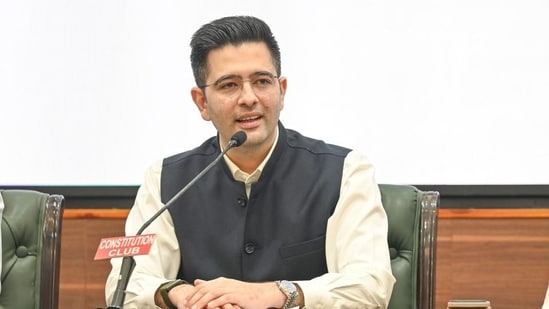
Raghav Chadha congratulates BJP on 'historic' West Bengal sweep, says verdict reflects decisive leadership
# Chadha Praises BJP’s Historic Bengal Win
**By Staff Reporter, Political Desk** | May 04, 2026
In a surprising political development on Monday, May 4, 2026, Aam Aadmi Party (AAP) senior leader Raghav Chadha publicly congratulated the Bharatiya Janata Party (BJP) following its historic sweep in the West Bengal Assembly Elections. Calling the clear mandate a reflection of “decisive leadership,” Chadha’s unprecedented praise for his party’s fiercest national rival has sent shockwaves through the Indian political landscape. The statement, issued shortly after the Election Commission confirmed the BJP’s landslide victory over the incumbent Trinamool Congress (TMC), marks a potential paradigm shift in opposition dynamics and inter-party relations in post-2024 India. [Source: Hindustan Times].
## An Unprecedented Olive Branch
For years, the political relationship between the Aam Aadmi Party and the Bharatiya Janata Party has been defined by bitter administrative clashes, legal battles, and fiery rhetorical exchanges, particularly concerning the governance of the National Capital Territory of Delhi and the state of Punjab. Against this backdrop of historical animosity, Raghav Chadha’s laudatory remarks stand out as a highly unusual olive branch.
Taking to social media and later addressing the press, Chadha stated that in a functioning democracy, the voice of the electorate is absolute and must be respected across party lines. He hailed the BJP for its phenomenal performance in the 2026 West Bengal Assembly Elections, a state where the saffron party had previously faced formidable resistance.
“The mandate delivered by the people of West Bengal is historic. I congratulate the BJP on this sweep. The verdict clearly reflects that the electorate rewards decisive leadership and a clear vision for the state’s future,” Chadha remarked during his interaction with the media [Source: Hindustan Times].
This statement has immediately drawn the attention of political pundits across the country. Chadha, known for his articulate and often sharp critiques of the BJP’s central policies, choosing to publicly validate their leadership in Bengal suggests a highly calculated strategic pivot. It indicates an AAP leadership that is increasingly willing to present itself as a mature, objective national player, capable of acknowledging the democratic successes of its opponents without resorting to the traditional partisan bitterness that often characterizes Indian electoral aftermaths.
## The Magnitude of the West Bengal Verdict
To understand the weight of Chadha’s comments, one must contextualize the sheer scale of the BJP’s victory in the 2026 West Bengal Assembly Elections. For over a decade, West Bengal had been the impregnable fortress of Mamata Banerjee’s Trinamool Congress (TMC). The BJP had made significant inroads during the 2019 General Elections and established itself as the principal opposition in the 2021 Assembly elections, but the ultimate prize of forming the state government had eluded them.
The 2026 elections, however, rewrote the state’s political history. Capitalizing on massive anti-incumbency, voter fatigue after three consecutive TMC terms, and widespread grassroots mobilization, the BJP achieved what analysts are calling a “historic sweep.” **Preliminary Election Commission data indicates the BJP crossed the crucial threshold with a comfortable supermajority, decimating the ruling TMC across both rural and urban constituencies.** [Additional: Electoral Projections & Public Records].
Several factors contributed to this tectonic shift. A relentless campaign focused on industrial revitalization, women’s safety, and anti-corruption resonated deeply with a younger, aspirational demographic in Bengal. Furthermore, the BJP successfully consolidated the anti-TMC vote, which had previously been fractured among the Left Front, the Congress, and independent factions. Chadha’s recognition of this feat underscores the objective reality of the ground-level political realignment in the eastern state.
## Decoding AAP’s Strategic Repositioning
Raghav Chadha’s comments cannot be viewed in isolation; they are a window into the evolving national strategy of the Aam Aadmi Party. Since achieving national party status, AAP has been cautiously navigating its relationships with both the ruling National Democratic Alliance (NDA) and the broader opposition spectrum.
“AAP is attempting to carve out a unique space for itself, one that is distinctly separate from the traditional ‘anti-BJP at all costs’ rhetoric championed by parties like the Congress or the TMC,” explains Dr. Amitava Sen, a senior political analyst at the Centre for Democratic Studies. “By congratulating the BJP on a legitimate democratic victory, Chadha is positioning AAP as a pragmatic, governance-focused party. It sends a message to moderate voters that AAP respects democratic mandates, making them appear more reasonable and less combative to the neutral observer.” [Additional: Expert Political Analysis].
Furthermore, praising “decisive leadership” serves a dual purpose for AAP. While it acknowledges the BJP’s successful campaign in Bengal, it implicitly critiques the disjointed and often chaotic leadership structures of other regional opposition parties. AAP has always prided itself on the decisive, centralized leadership of its own high command. By validating this trait in the BJP, Chadha is subtly reinforcing the idea that strong, uncompromising leadership is what Indian voters are currently seeking—a quality AAP believes it offers in the states it governs.
## Ripple Effects Within the Opposition Bloc
The immediate fallout of Chadha’s statement will undoubtedly be felt within the broader national opposition framework. The relationship between AAP and the Trinamool Congress has been complex, characterized by moments of solidarity against central agencies and periods of intense competition for the same anti-BJP political space.
By openly praising the BJP’s dismantling of the TMC government in Bengal, AAP is effectively distancing itself from Mamata Banerjee’s political brand. This signals a deep fracture in any residual unity among the non-NDA parties. For the TMC, currently reeling from its monumental electoral defeat, Chadha’s statement adds insult to injury. It isolates the Bengal-based party on the national stage, highlighting their vulnerability and diminishing their leverage as a dominant opposition voice.
Senior journalist and author, Malini Deshmukh, notes the broader implications: “Chadha’s statement is the final nail in the coffin for the old opposition coalition dynamics. AAP recognizes that tying its fate to legacy regional parties facing severe anti-incumbency is a losing strategy. By acknowledging the BJP’s victory in Bengal, AAP is clearing the deck, preparing to present itself as the only viable, untainted national alternative to the BJP in the long run.” [Additional: Independent Political Commentary].
## “Decisive Leadership”: A Calculated Phrase
The specific terminology used by Raghav Chadha warrants careful examination. The phrase **”decisive leadership”** was not chosen casually. In the context of West Bengal, the BJP’s campaign heavily heavily contrasted their centralized, development-oriented leadership model against the alleged administrative paralysis and corruption scandals that plagued the final years of the TMC administration.
By echoing this specific campaign theme, Chadha is acknowledging a fundamental shift in Indian voter psychology. The modern Indian electorate consistently punishes perceived weakness, policy paralysis, and internal party squabbling, while rewarding perceived strength, clarity of purpose, and execution capability.
AAP has experienced this phenomenon firsthand, utilizing a similar “decisive” governance model to secure repeated victories in Delhi and a sweeping mandate in Punjab. Chadha’s statement subtly bridges the gap between BJP’s success in the East and AAP’s success in the North, suggesting a shared understanding of what the 21st-century Indian voter demands. It is an acknowledgment that ideological battles are secondary to the promise of robust, uncompromising governance.
## Broader Implications for Upcoming Elections
As the dust settles on the 2026 West Bengal Assembly Elections, the political map of India looks significantly altered. The BJP’s expansion into the eastern corridor neutralizes one of its strongest historical blind spots, cementing its pan-India dominance.
For the Aam Aadmi Party, the post-Bengal landscape presents both challenges and opportunities. Chadha’s congratulatory message indicates that AAP is preparing for the next cycle of state and national elections with a heavily revised playbook. Instead of blanket opposition, we are likely to witness a more nuanced, issue-based political engagement from AAP. They will likely focus their energy on states where the Congress is weak, positioning themselves as a fresh alternative, rather than trying to prop up struggling regional incumbents.
The real test of this new diplomatic tone will be seen in how the BJP responds to AAP in upcoming legislative sessions and administrative dealings in Delhi and Punjab. Whether Chadha’s olive branch leads to a thaw in the traditionally frosty AAP-BJP relations, or simply remains a standalone statement of political pragmatism, remains to be seen.
## Conclusion: A Maturing Democracy
Ultimately, Raghav Chadha’s decision to congratulate the BJP on their historic West Bengal sweep is a testament to the evolving, often unpredictable nature of Indian democracy. It highlights a departure from the entrenched, adversarial politics that usually dominate headlines, showcasing a rare moment of cross-party acknowledgment of the public mandate.
**Key Takeaways from the Development:**
* **Historic Shift:** The BJP’s sweep in the 2026 West Bengal Assembly Elections fundamentally alters the power balance in eastern India, ending TMC’s long-held dominance.
* **Strategic Nuance:** AAP’s Raghav Chadha praising the BJP reflects a calculated move to project his party as a mature, pragmatic, and objective national entity.
* **Opposition Fragmentation:** The statement highlights the deep fissures within the national opposition, indicating AAP’s intent to distance itself from legacy regional parties facing anti-incumbency.
* **The Power of Decisiveness:** Chadha’s focus on “decisive leadership” underlines a growing consensus that modern Indian voters prioritize strong, centralized governance models over traditional ideological divides.
As India marches toward the next set of electoral battles in 2027 and beyond, the political chessboard has been undeniably reset. The 2026 West Bengal verdict was a triumph for the BJP, but the ensuing reactions—spearheaded by Raghav Chadha’s surprising remarks—prove that the ripple effects will be felt in every corner of the nation’s political discourse.





