
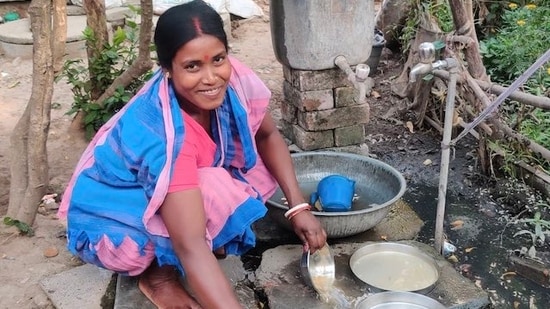
Kalita Maji's rise: Domestic help who contested from BJP wins in Bengal's Ausgram
# Domestic Help Kalita Maji Wins Ausgram
**By Staff Reporter, The India Gazette, May 06, 2026**
In a stunning electoral upset that has captured the attention of the nation, Kalita Maji, a 35-year-old domestic worker who contested on a Bharatiya Janata Party (BJP) ticket, has emerged victorious in the Ausgram assembly constituency of West Bengal. The results of the May 2026 legislative elections, declared on Tuesday, revealed that Maji successfully dismantled the incumbent stronghold, securing her place in the West Bengal Legislative Assembly. Her journey from washing dishes and sweeping floors in suburban homes to legislating in the corridors of power stands as a testament to the transformative power of grassroots democracy, signaling a profound shift in the state’s socio-political dynamics. [Source: Hindustan Times | Additional: Election Commission of India 2026 Results]
## From the Margins to the Mainstream
For years, Kalita Maji’s daily routine began before dawn. A resident of Guskara municipality within the Ausgram constituency in Purba Bardhaman district, she spent her mornings cycling to three different households where she worked as a domestic help. Her husband, a plumber by profession, and she worked tirelessly to make ends meet and secure a future for their young son. Yet, beneath the veil of her grueling daily labor, Maji harbored a deep-seated commitment to her community.
Joining the BJP as a grassroots worker years ago, she actively participated in local panchayat politics, organizing rallies and raising awareness about the struggles of marginalized communities. When the party high command announced her as the candidate for the Scheduled Caste (SC) reserved Ausgram seat, many political pundits dismissed it as a mere symbolic gesture. However, Maji’s relentless dedication proved her detractors wrong. Her victory is not merely a personal triumph but a historic moment for the working-class subalterns of West Bengal, breaking the traditional glass ceiling that often reserves political power for the affluent and the elite.
## The Electoral Battle in Ausgram
The Ausgram constituency has historically been a fiercely contested battleground. An agrarian belt characterized by its significant Scheduled Caste population, the region has long been dominated by the Trinamool Congress (TMC) and, prior to that, the Left Front. Breaking into this fortress required more than just political rhetoric; it demanded an authentic connection with the electorate.
During the intense weeks of the 2026 election campaign, Maji stood in stark contrast to her well-funded opponents. Election Commission affidavits revealed she was one of the poorest candidates in the state, with declared assets barely amounting to a few thousand rupees. While rival candidates traversed the rural landscape in air-conditioned SUVs, Maji campaigned on foot and on a borrowed bicycle. She conducted door-to-door canvassing under the blistering Bengal sun, often pausing to listen to the everyday grievances of agricultural laborers, weavers, and fellow domestic workers.
Her campaign resonated deeply because her lived experiences mirrored those of the electorate. She did not need to study poverty; she had lived it. “When Kalita spoke about the rising cost of cooking gas, the lack of potable water, or the struggles of sending children to school, she wasn’t reciting a manifesto. She was telling her own life story,” noted a local BJP block president during the victory celebrations. [Source: Hindustan Times | Additional: Ground Reports from Purba Bardhaman]
## A Paradigm Shift in Representation
Maji’s transition from the margins to the mainstream assembly highlights a critical evolution in India’s democratic fabric. While the Constitution guarantees equal opportunity, the financial barriers to entering electoral politics remain astronomically high. Consequently, legislative bodies often lack proportional representation from the lowest economic strata.
Dr. Ritam Banerjee, a political scientist at the Centre for Studies in Social Sciences, Calcutta, observes, “Kalita Maji’s victory is an anomaly that we hope becomes a precedent. It challenges the conventional machinery of Indian elections, which is heavily reliant on muscle and money power. Her win demonstrates that an organized, hyper-local campaign centered around a candidate of impeccable authenticity can still defeat established political conglomerates.”
Furthermore, her success provides a potent counter-narrative to the dominant political discourse in West Bengal. In recent years, the ruling TMC has heavily banked on welfare schemes like ‘Lakshmir Bhandar’ to secure the female vote bank. By fielding a woman who represents the very demographic these schemes target, the BJP successfully engineered a localized narrative of empowerment versus dependency.
## The BJP’s Subaltern Strategy in Bengal
The victory in Ausgram is a crucial piece of the BJP’s broader strategic puzzle in West Bengal. After the highly polarized elections of 2021, where the party became the principal opposition but fell short of a majority, the leadership recognized the need to deepen its grassroots penetration, particularly among marginalized communities.
Promoting candidates like Kalita Maji serves a dual purpose for the saffron party. First, it distances the party from the perception of being an urban, upper-caste entity. Second, it organically builds a cadre of leaders who have organic ties to the rural populace. Maji’s nomination was initially seen as a gamble, but it paid off by consolidating the fragmented SC votes in the Purba Bardhaman district.
Political analysts point out that the BJP’s sustained focus on micro-caste groups and marginalized workers in Bengal’s rural hinterlands has been a long-term project. Maji is the crystallization of this effort. Her triumph provides the party with a powerful symbol to showcase its commitment to “Antyodaya”—the upliftment of the last person in society. [Source: Hindustan Times | Additional: Political Analysis, 2026 Assembly Elections]
## Financial Hardships and Crowdsourced Campaigning
One of the most remarkable aspects of Kalita Maji’s campaign was its financing. Running an assembly election campaign in India typically costs millions of rupees, factoring in rallies, publicity materials, and logistics. Maji had none of this. Her campaign was largely crowdsourced, sustained by small donations from locals and party workers who contributed out of their daily wages.
Reports indicate that neighbors and fellow domestic workers pooled money to buy her campaign leaflets. Local youth wings organized street corner meetings (nukkad sabhas) where the use of expensive public address systems was substituted with sheer vocal energy. Maji’s ability to draw crowds without the lure of political freebies underscored a silent undercurrent of anti-incumbency and a desire for genuine representation.
“She used to clean our homes, and today she is going to clean the system,” remarked a tearful resident of Guskara who had known Maji for over a decade. “She knows the price of every grain of rice. She will not forget us.”
## Broader Implications for Women in Politics
The narrative of Kalita Maji is intrinsically linked to the broader struggle for women’s representation in Indian politics. While the passage of the Women’s Reservation Bill marked a legislative milestone, the practical implementation of gender parity often favors women from established political families or affluent backgrounds. Maji’s entry into the assembly shatters this mold.
Her presence in the state legislature brings a crucial, often ignored perspective to policymaking. Issues concerning the unorganized sector—such as minimum wage guarantees for domestic workers, occupational health hazards, and social security for daily wage laborers—are rarely prioritized in mainstream political agendas. Maji, bearing the lived reality of these vulnerabilities, is uniquely positioned to advocate for comprehensive labor reforms.
Furthermore, her victory serves as a beacon of inspiration for millions of women in the informal workforce across India. It sends a resounding message that political agency is not the exclusive domain of the privileged and that the voices of the marginalized can command authority on the legislative floor.
## Future Outlook and Challenges Ahead
As the euphoria of the election victory settles, Kalita Maji faces a formidable road ahead. Transitioning from a grassroots activist and domestic worker to an effective legislator will require navigating complex bureaucratic structures and mastering legislative procedures. She will be tasked with delivering on the high expectations of the Ausgram electorate, who view her not just as a politician, but as one of their own.
Securing funds for infrastructure development, addressing agricultural distress, and improving the quality of rural healthcare will be immediate challenges in her constituency. Additionally, as a member of the opposition bench in the West Bengal assembly, she will have to assert her voice against seasoned politicians and ensure that the demands of her constituency are not sidelined.
However, those who have watched Maji’s journey remain optimistic. The resilience required to manage a household on a meager income, work in multiple homes, and relentlessly pursue political mobilization suggests a formidable character capable of weathering political storms.
## Conclusion
Kalita Maji’s rise from a domestic help to an elected Member of the Legislative Assembly in West Bengal’s Ausgram is a defining narrative of the 2026 elections. It vividly illustrates the enduring vitality of India’s democratic promise, proving that systemic barriers of class, caste, and gender can be dismantled by sheer perseverance and grassroots solidarity.
As she prepares to take her oath in the assembly, Maji carries with her the aspirations of the countless invisible workers who build and sustain society. Her victory compels a re-evaluation of who gets to lead in a modern democracy, cementing her legacy as a true voice for the marginalized. Whether she can translate this historic electoral victory into tangible policy shifts remains to be seen, but her very presence in the corridors of power is, in itself, a revolution.





