
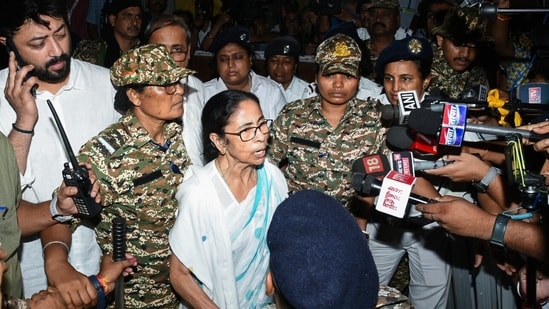
'Our fight was with EC, not BJP': Mamata Banerjee's fresh claims after BJP's Bengal win
# Mamata Blames EC for BJP Bengal Sweep
By Senior Political Correspondent, The National Review | May 05, 2026
On Tuesday, Trinamool Congress (TMC) chairperson Mamata Banerjee launched a scathing attack on the Election Commission of India (ECI) following the Bharatiya Janata Party’s (BJP) sweeping victory in the 2026 West Bengal Assembly elections. Amid reports of widespread post-poll clashes across the state, the EC officially declared the BJP the winner with a staggering 207 seats, unseating the TMC after a 15-year reign. Refusing to concede ideological defeat to her political rivals, Banerjee claimed her party’s actual battle was against the federal electoral watchdog, alleging deep institutional bias rather than a legitimate loss of the public mandate. [Source: Hindustan Times].
## A Seismic Political Shift in West Bengal
The declaration of the 2026 Assembly election results marks a watershed moment in Indian political history. Securing **207 out of 294 seats**, the BJP has achieved a commanding two-thirds majority, successfully forming its first-ever government in the eastern state. The Trinamool Congress, which rode to power in 2011 by dismantling the 34-year-old Left Front citadel, has been reduced to a mere 78 seats, a drastic fall from the 215 seats it secured in the 2021 assembly polls.
This monumental reversal of fortunes underscores a massive consolidation of the anti-incumbency vote. The results indicate a comprehensive geographic sweep by the saffron party, dominating not just its traditional strongholds in North Bengal and the western Jangalmahal region, but also breaching the TMC’s fortress in South Bengal and the Greater Kolkata metropolitan area.
**2026 West Bengal Assembly Election Tally:**
| Political Party / Alliance | Seats Won (2026) | Change from 2021 |
| :— | :— | :— |
| **Bharatiya Janata Party (BJP)** | **207** | +130 |
| **Trinamool Congress (TMC)** | **78** | -137 |
| **Left Front + Indian National Congress** | **8** | +7 |
| **Others / Independents** | **1** | 0 |
The sheer scale of the victory has stunned political observers, but for the outgoing Chief Minister, the numbers do not reflect the will of the electorate. Instead, they represent what she termed an “electoral engineering marvel” orchestrated by central agencies.
## Banerjee’s Direct Attack on the Election Commission
Addressing a visibly subdued crowd of supporters outside her Kalighat residence, Mamata Banerjee refused to attribute the BJP’s victory to public disillusionment with her government. “Our fight was with the Election Commission, not the BJP,” Banerjee stated emphatically, outlining a series of allegations against the electoral body. [Source: Hindustan Times].
Banerjee’s core argument rests on the ECI’s handling of the election logistics. She accused the Commission of designing a grueling, multi-phase election schedule that disproportionately favored the resource-rich national ruling party. Furthermore, the TMC leadership has fiercely criticized the unprecedented deployment of Central Armed Police Forces (CAPF) across the state.
According to TMC officials, the ECI acted in a partisan manner by systematically transferring key state police officers and district magistrates perceived to be sympathetic to the state government just weeks before the polls. “The entire state administrative machinery was paralyzed. Central forces intimidated voters in rural belts, and the ECI turned a blind eye to our repeated complaints regarding the malfunction of Electronic Voting Machines (EVMs) in minority-dominated booths,” a senior TMC general secretary claimed during a press briefing late Tuesday.
## Post-Poll Violence Plagues the State
Tragically, the historic mandate has been overshadowed by an alarming deterioration of law and order. Immediately following the declaration of the early trends, reports of intense clashes and violence between rival political factions erupted across several districts. [Source: Hindustan Times].
The districts of **North 24 Parganas, Birbhum, and South 24 Parganas** have reported significant unrest, with incidents of arson, vandalism of party offices, and localized skirmishes. The violence mirrors the volatile aftermath of the 2021 elections, which drew severe strictures from the Calcutta High Court and the National Human Rights Commission.
In response to the deteriorating security situation, the Election Commission has taken the unprecedented step of directing the Ministry of Home Affairs to retain over 400 companies of central paramilitary forces in West Bengal until the end of May. The BJP state leadership has accused TMC workers of targeting their supporters in a desperate response to the electoral defeat, while TMC leaders claim their workers are being hunted down by emboldened BJP cadres backed by central forces.
The Governor has issued a stern warning, demanding an immediate restoration of peace and reminding the outgoing administration of its constitutional duty to protect all citizens during the transition of power. [Additional Source: Public Security Mandates / ECI Guidelines].
## Deconstructing the BJP’s Winning Strategy
While Mamata Banerjee has directed her ire at the Election Commission, independent political analysts point to a confluence of deeply rooted socio-political factors that paved the way for the BJP’s 207-seat landslide.
**1. Crippling Anti-Incumbency and Corruption Allegations:**
The TMC government has been battling severe anti-incumbency sentiments exacerbated by a cascade of corruption scandals. From the protracted teacher recruitment (SSC) scam that saw prominent ministers jailed, to the public distribution system anomalies, the BJP successfully painted the state government as systemically corrupt. The electorate’s fatigue with local-level extortion—colloquially known as “cut money”—played a critical role in alienating the rural working class.
**2. Echoes of Sandeshkhali and Women’s Safety:**
The narrative around women’s safety, which gained national prominence following the Sandeshkhali protests over the last few years, proved electorally fatal for the TMC. The BJP aggressively campaigned on the deterioration of law and order, specifically targeting the TMC’s alleged protection of local strongmen. This resonated deeply with female voters, a demographic that had previously been the bedrock of Mamata Banerjee’s support base due to welfare schemes like *Lakshmir Bhandar*.
**3. Strategic Demographic Consolidation:**
The BJP executed a flawless micro-targeting strategy among subaltern Hindu communities. By successfully implementing the Citizenship Amendment Act (CAA) rules prior to the elections, the BJP solidified its support among the **Matua community** and other Namasudra voting blocs in the border districts. Simultaneously, aggressive outreach in the tribal belts of Purulia, Bankura, and Jhargram yielded massive electoral dividends.
## Expert Perspectives on the Historic Mandate
Political scientists caution against dismissing the election results merely as an administrative failure, while also noting the dangers of political leaders delegitimizing constitutional institutions.
Dr. Animesh Ray, a senior fellow at the Center for Electoral Studies in New Delhi, observed: *”Mamata Banerjee’s strategy to blame the Election Commission is a classic political deflection tactic. While it is true that the prolonged multi-phase elections put regional parties at a logistical disadvantage against national juggernauts, to attribute a 207-seat sweep entirely to ECI bias ignores the genuine, palpable anger against the TMC’s local leadership.”*
Conversely, some governance experts argue that the ECI must address the optical issues of its deployments to maintain unwavering public trust. *”When a sitting Chief Minister actively campaigns on the premise that the electoral referee is compromised, it damages the democratic fabric,”* noted civil rights advocate Meera Sanyal. *”The ECI’s aggressive transfer of local police chiefs created an environment where the TMC felt administratively choked. However, the voter turnout data shows a highly engaged electorate that voted decisively for change.”* [Source: Independent Political Analysis].
## Implications for National Politics
The fall of West Bengal to the BJP has profound implications for the national political landscape as India looks toward the future.
For the **Bharatiya Janata Party**, conquering Bengal represents the final frontier of its ideological expansion in the East. It vindicates the party’s relentless, decade-long organizational push in a state historically dominated by the Left and regional forces. This victory will significantly bolster the National Democratic Alliance’s (NDA) numbers in the Rajya Sabha over the coming years, facilitating smoother passage for ambitious national legislative agendas.
For the national opposition and the **INDIA bloc**, the loss of Bengal is a catastrophic blow. Mamata Banerjee has been a pivotal, albeit mercurial, anchor for the anti-BJP coalition. The decimation of the TMC drastically reduces the opposition’s geographical footprint and bargaining power. Furthermore, the complete marginalization of the Left-Congress alliance—which managed only 8 seats—demonstrates a highly polarized, bipolar political environment where traditional secular-left forces have lost their relevance.
## Conclusion: A Tense Transition of Power
As the dust settles on the 2026 West Bengal Assembly elections, the immediate priority for the state apparatus remains the restoration of law and order. The unprecedented mandate of 207 seats provides the incoming BJP government with exceptional legislative strength, but governing a deeply polarized state with a history of political violence will be an immediate test of its administrative mettle.
Mamata Banerjee’s refusal to accept the political nature of her defeat, choosing instead to wage a narrative war against the Election Commission, indicates that the TMC will adopt an intensely combative role in the opposition. The allegations against the ECI, while lacking empirical proof of widespread tampering, will likely be utilized to keep the TMC cadre mobilized in the face of this historic defeat.
Ultimately, West Bengal is standing at the precipice of a new political era. The transition from a fiery regional powerhouse to a BJP-ruled administration will require delicate handling to ensure that the ongoing clashes are quelled and democratic norms are upheld, proving that the true victor in any election remains the peaceful will of the citizenry.





