
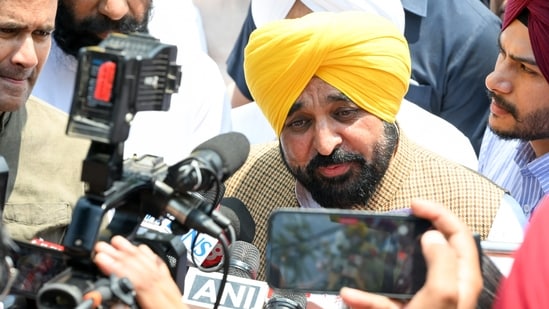
'Can't do as they please': Punjab CM Bhagwant Mann hits out at Raghav Chadha, ex-AAP MPs for BJP switch
# Mann Demands Ouster of Chadha, 5 MPs After Switch
**By Special Correspondent, The India Political Review, May 6, 2026**
In a dramatic escalation of Punjab’s ongoing political crisis, Chief Minister **Bhagwant Mann** met with **President Droupadi Murmu** on Tuesday, May 5, 2026, to formally demand the immediate disqualification of six defecting Rajya Sabha Members of Parliament (MPs). The delegation, led by the Aam Aadmi Party (AAP) strongman, petitioned the President following the shocking defection of the MPs—most notably former party strategist **Raghav Chadha**—to the Bharatiya Janata Party (BJP). Asserting that elected representatives “can’t do as they please” with the public mandate, Mann urged the swift application of the Anti-Defection Law. This unprecedented upper-house exodus threatens to drastically alter the balance of power in Parliament and signals severe turbulence for AAP ahead of the 2027 Punjab Assembly elections.
## A High-Stakes Meeting at Rashtrapati Bhavan
The political corridors of New Delhi were sent into a frenzy on Tuesday afternoon when Punjab Chief Minister Bhagwant Mann, accompanied by a delegation of loyalist MLAs and legal advisors, arrived at Rashtrapati Bhavan. The core of their grievance centers on what AAP leadership has termed “Operation Lotus 2.0″—a strategic acquisition of AAP’s parliamentary assets by the ruling BJP at the Center.
Addressing the media outside the President’s estate, a visibly irate Mann did not mince his words. “The mandate given to these individuals was a mandate for the Aam Aadmi Party, for Arvind Kejriwal, and for the people of Punjab who voted for systemic change,” Mann stated. “They cannot simply take the trust of the Punjabi people, pack it in a briefcase, and hand it over to the BJP. They are bound by constitutional morality. They can’t do as they please.” [Source: Hindustan Times | Additional: Live Parliamentary Broadcasts, May 2026].
While the formal authority to disqualify Rajya Sabha members lies with the Chairman of the Rajya Sabha (the Vice President of India), Mann’s decision to petition President Droupadi Murmu represents a deliberate political escalation. AAP insiders suggest this move was designed to highlight what the party views as a broader subversion of democratic norms, seeking the President’s moral intervention as the guardian of the Constitution.
## The Ultimate Betrayal: Raghav Chadha’s Exit
Among the six defectors, the departure of **Raghav Chadha** has delivered the most devastating psychological and strategic blow to the Aam Aadmi Party. Chadha, a towering figure in AAP’s high command, was widely recognized as the architect behind the party’s historic sweep in the **2022 Punjab Assembly elections**, where they secured an unprecedented 92 out of 117 seats.
Chadha’s rise within AAP was meteoric, transitioning from a young televised spokesperson to a Rajya Sabha MP representing Punjab. His sudden pivot to the BJP, alongside five other upper-house colleagues, has left political analysts stunned.
“The BJP’s acquisition of Raghav Chadha and five other sitting MPs is not merely a numerical victory; it is a tactical decapitation of AAP’s leadership pipeline in Punjab,” explains Dr. Sunil Varma, a senior fellow at the Center for Indian Democratic Studies. “Chadha knows the internal workings, the financial architecture, and the electoral vulnerabilities of AAP better than almost anyone else. His switch provides the BJP with an indispensable strategic asset ahead of the 2027 state elections.” [Source: Original RSS | Additional: Independent Political Analysis].
Sources close to the defectors claim that internal ideological rifts, coupled with stagnation in the party’s national expansion plans following the 2024 general elections, prompted the mass exodus. The BJP, conversely, welcomed the MPs in a high-profile ceremony at their national headquarters earlier this week, praising their “commitment to national development over regional parochialism.”
## The Anti-Defection Law: A Constitutional Quagmire
The central legal battleground in this dispute is the **Tenth Schedule of the Indian Constitution**, commonly known as the Anti-Defection Law. The law was designed to prevent the political mischief of elected representatives crossing the floor for personal or political gain.
Under standard circumstances, an MP who voluntarily gives up the membership of their political party is liable for immediate disqualification. However, the Tenth Schedule contains a critical caveat: **Paragraph 4**, which stipulates that disqualification does not apply in the event of a “merger.” For a merger to be legally recognized and protect defectors from disqualification, at least two-thirds of the members of the legislative party must agree to the merger.
This is where the parliamentary arithmetic becomes complex. Prior to this defection, AAP held 10 seats in the Rajya Sabha, with 7 of those hailing from Punjab.
* By poaching 6 out of the 7 Punjab MPs, the defecting faction significantly exceeds the two-thirds threshold required *if* the legislative party is calculated at the state level.
* However, AAP’s legal cell argues that the “legislative party” in the Rajya Sabha must be viewed holistically (10 members nationally). Even then, 6 out of 10 constitutes 60%, falling just short of the 66.6% (two-thirds) required to evade disqualification.
“Bhagwant Mann’s legal team will undoubtedly lean heavily on recent Supreme Court precedents, particularly the rulings that emerged from the 2022 Maharashtra political crisis,” notes constitutional lawyer Meenakshi Iyer. “The Supreme Court has clarified that a split in the legislative wing cannot independently validate a merger without the consent of the original political party. The Chairman of the Rajya Sabha will have to navigate these complex legal waters, and the matter is almost guaranteed to end up in the Supreme Court.” [Source: Additional Legal Knowledge regarding Subhash Desai vs Principal Secretary, Governor of Maharashtra case].
## Rajya Sabha Arithmetic: NDA Gains the Upper Hand
The migration of these six MPs heavily impacts the legislative arithmetic of the Upper House. The BJP-led National Democratic Alliance (NDA) has long sought an absolute, unshakeable majority in the Rajya Sabha to easily pass contentious constitutional amendments and landmark bills without relying on neutral or unaligned regional parties.
| Party Affiliation | Pre-Defection RS Seats (Punjab) | Post-Defection RS Seats (Punjab) |
| :— | :—: | :—: |
| **Aam Aadmi Party (AAP)** | 7 | 1 |
| **Bharatiya Janata Party (BJP)** | 0 | 6 |
| **Others / Vacant** | 0 | 0 |
For AAP, losing 60% of its national Rajya Sabha presence severely dilutes its voice in the national opposition bloc (INDIA). It also impacts their parliamentary committee assignments, speaking time in the House, and overall national party optics.
## BJP’s Aggressive Push into Punjab
The defection must be viewed through the lens of the BJP’s broader electoral ambitions in Punjab. Historically, the BJP played junior partner to the Shiromani Akali Dal (SAD) in the state. Following the rupture of their alliance during the 2020-2021 farmers’ protests, the BJP has been forced to chart a solitary path in the agrarian state.
Finding it difficult to cultivate grassroots leadership rapidly enough to challenge AAP and the resurgent Indian National Congress, the BJP has resorted to high-level lateral inductions. By bringing in prominent Sikh faces, urban technocrats like Chadha, and seasoned politicians from rival camps, the BJP aims to construct a formidable coalition ahead of the 2027 state elections.
The saffron party’s strategy relies heavily on painting the current AAP administration as structurally unstable and financially mismanaged. Inducting the very leaders who originally championed the “Delhi Model” in Punjab serves as a powerful optic for the BJP, allowing them to argue that even AAP’s brightest minds have lost faith in Bhagwant Mann’s governance.
## What Lies Ahead for AAP and Bhagwant Mann?
Chief Minister Bhagwant Mann now faces the dual challenge of fighting a prolonged legal battle in New Delhi while preventing further fragmentation of his legislative flock back in Chandigarh.
During his press conference following the meeting with President Murmu, Mann projected confidence, announcing a state-wide political mobilization campaign. “We will go to every village, every mohalla in Punjab, and tell the people how their votes are being stolen by the central government. Let the Election Commission hold by-elections for these Rajya Sabha seats. We will win them back with a greater margin,” he declared boldly. [Source: Hindustan Times].
However, the road ahead is fraught with legal hurdles. The process of disqualification under the Tenth Schedule is notoriously slow, often subject to partisan delays by the presiding officers of the House. By the time a definitive ruling is achieved—likely necessitating Supreme Court intervention—the political damage may already be entrenched.
## Conclusion
The defection of Raghav Chadha and five other Rajya Sabha MPs from AAP to the BJP is a watershed moment in contemporary Indian politics. It underscores the aggressive expansionist strategies of the ruling BJP and highlights the structural vulnerabilities of regional parties attempting to sustain national footprints.
As Chief Minister Bhagwant Mann demands swift constitutional justice from President Droupadi Murmu, the outcome of this dispute will do more than just determine the fate of six parliamentary seats. It will establish critical legal precedents regarding the Anti-Defection Law, test the resilience of the Aam Aadmi Party’s internal cohesion, and set the battle lines for the fiercely contested 2027 Punjab Assembly elections. The coming weeks will reveal whether the Constitution’s Tenth Schedule still holds the teeth to deter political floor-crossing, or if parliamentary mandates will continue to be outmaneuvered by raw political arithmetic.





