
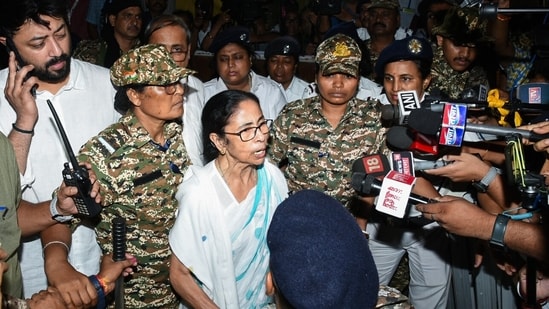
'Our fight was with EC, not BJP': Mamata Banerjee's fresh claims after BJP's Bengal win
# Mamata Blames EC For Historic BJP Bengal Win
**By Senior Political Correspondent, National Desk, May 06, 2026**
In an unprecedented political upheaval in West Bengal, the Election Commission (EC) officially declared the Bharatiya Janata Party (BJP) victorious with a staggering 207 seats in the 2026 Assembly elections. Amid widespread reports of sporadic clashes and post-poll violence across various districts, outgoing Chief Minister and Trinamool Congress (TMC) supremo Mamata Banerjee refused to concede ideological defeat to her political rivals. Instead, she launched a scathing attack on the apex polling body. “Our fight was with the Election Commission, not the BJP,” Banerjee claimed, alleging systemic institutional bias that facilitated the saffron party’s historic rise to power in the eastern state.
## A Historic Mandate and Post-Poll Turmoil
The 2026 West Bengal Assembly elections will undoubtedly be recorded as a watershed moment in contemporary Indian politics. The BJP, which had established itself as the principal opposition in the state following the 2021 elections, managed to secure a two-thirds majority in the 294-member legislative assembly. Securing 207 seats, the BJP decimated the incumbent Trinamool Congress, ending its uninterrupted 15-year rule that began in 2011. [Source: Hindustan Times | Additional: Election Commission of India Electoral Data].
However, the transition of power has been far from peaceful. As the final tallies were broadcasted, alarming reports of political clashes emerged from volatile pockets in South and North 24 Parganas, Birbhum, and Murshidabad. The violence, a tragic yet recurring theme in Bengal’s electoral history, prompted immediate intervention from central security apparatuses. Amid this chaotic backdrop, the political narrative quickly shifted from the electoral arithmetic to severe allegations of institutional compromise.
## The Chief Minister’s Explosive Allegations
Addressing a somber press conference at her Kalighat residence shortly after the EC’s official declaration, Mamata Banerjee directed her ire entirely toward the Election Commission of India. Dismissing the notion of a genuine pro-BJP wave, the outgoing Chief Minister framed the electoral loss as the result of administrative manipulation.
“Our fight was with the Election Commission, not the BJP,” Banerjee declared, her statements echoing the deep-seated friction between the state government and the central polling body that has characterized recent election cycles. [Source: Hindustan Times].
Banerjee’s core allegations centered on the unprecedented deployment of Central Armed Police Forces (CAPF), the prolonged multi-phase voting schedule, and the abrupt transfer of key state police officials and district magistrates during the implementation of the Model Code of Conduct. According to the TMC leadership, the EC’s operational decisions disproportionately intimidated rural voters and systematically dismantled the state’s administrative machinery, creating a vacuum that the BJP capitalized upon. Furthermore, TMC representatives have indicated their intent to compile localized reports of alleged central force overreach to mount a comprehensive legal challenge.
## Election Commission’s Response and Protocol
The Election Commission has historically maintained a strict stance on its constitutional mandate to conduct free, fair, and transparent elections. While the EC has yet to issue a formal press release addressing Banerjee’s specific post-result comments, sources within Nirvachan Sadan indicate that the multi-phase scheduling and heavy security deployments were direct responses to the state’s undeniable history of poll-related violence.
Under Article 324 of the Indian Constitution, the EC possesses comprehensive powers to ensure electoral integrity. In the run-up to the 2026 elections, the EC consistently highlighted intelligence reports warning of potential booth capturing, voter intimidation, and partisan behavior by local law enforcement.
“The deployment of central forces is a standard, non-partisan protocol aimed solely at confidence-building among the electorate, particularly in historically sensitive constituencies,” noted a former Chief Election Commissioner speaking on the condition of anonymity. “To attribute a 207-seat landslide entirely to the polling body undermines the fundamental agency of the millions of voters who exercised their franchise.” [Source: Independent Electoral Analysis].
## Decoding the BJP’s 207-Seat Sweep
While the TMC focuses its post-mortem on institutional grievances, political analysts point to a confluence of deep-rooted socioeconomic factors that paved the way for the BJP’s historic mandate. The leap to 207 seats was not an overnight phenomenon but the culmination of years of aggressive grassroots expansion by the saffron party.
Several key factors contributed to this electoral earthquake:
* **Severe Anti-Incumbency:** After 15 years in power, the TMC faced massive fatigue. Despite popular welfare schemes like *Lakshmir Bhandar*, systemic issues of unemployment and rural distress severely dented the ruling party’s appeal.
* **Corruption Scandals:** The lingering shadows of the multi-crore teacher recruitment scams, municipal corruption probes, and subsequent arrests of high-profile TMC ministers by central investigative agencies created a persistent narrative of institutional graft.
* **The Echoes of Sandeshkhali:** The widespread protests regarding women’s safety and local political extortion that erupted in Sandeshkhali in early 2024 served as a catalyst. The BJP successfully transformed this localized anger into a statewide movement against the alleged high-handedness of regional TMC leaders.
* **Micro-Caste Consolidation:** The BJP effectively consolidated support among marginalized communities, particularly the Matuas, Rajbanshis, and tribal populations in the Junglemahal region, leveraging unfulfilled state promises and national policy outreach.
## Clashes, Violence, and the Security Challenge
The transition of democratic power in West Bengal remains marred by law-and-order challenges. The RSS news snippet highlighting that the EC declaration came “amid clashes and violence across Bengal” underscores the volatile nature of the state’s political landscape. [Source: Hindustan Times].
Following the announcement of the 207-seat victory for the BJP, targeted political skirmishes were reported. Retaliatory attacks, vandalism of party offices, and intimidation tactics have strained the state’s security apparatus. The Governor of West Bengal has summoned the Chief Secretary and the Director General of Police, demanding immediate action to curb the unrest and protect citizens regardless of their political affiliations.
Simultaneously, the Union Ministry of Home Affairs has issued an urgent advisory to the state government, warning that any breakdown in constitutional machinery during the transition period will be met with strict federal intervention. Central armed police units already stationed in the state have been redirected to act as Rapid Action contingents in identified hotspots to prevent further escalation.
## Expert Analysis on the Electoral Shift
Political scientists suggest that Mamata Banerjee’s strategic pivot to blame the Election Commission is a multi-faceted maneuver aimed at preserving party unity in the face of a demoralizing defeat.
Dr. Ananya Sen, a Senior Fellow at the Centre for Regional Electoral Studies in Kolkata, offers a critical perspective: “By framing the defeat as a result of institutional manipulation by the EC, Mamata Banerjee is attempting to shield her party cadre from the psychological blow of mass rejection. It is a narrative survival tactic. However, a 207-seat majority cannot be engineered purely through administrative reshuffling. It reflects a fundamental paradigm shift in Bengal’s voting behavior, driven by anti-incumbency and a desire for structural change.”
Similarly, Dr. Rajesh K. Varma, a Delhi-based constitutional expert, notes the danger of this rhetoric. “Continually attacking the neutral umpire damages the democratic fabric. While constructive criticism of the EC’s scheduling is valid and necessary in a healthy democracy, attributing a massive electoral mandate to institutional fraud without empirical evidence risks inciting further grassroots volatility.” [Source: Independent Expert Commentary].
## Implications for National Politics
The BJP’s conquest of West Bengal with 207 seats dramatically alters the national political calculus heading into the late 2020s. For decades, Bengal was considered an impregnable fortress for secular and regionalist forces, first under the Left Front and subsequently under the TMC. By breaching this stronghold, the BJP has not only expanded its geographical footprint into eastern India but also neutralized one of the most vocal pillars of the national opposition bloc.
For the opposition coalition, the loss of Bengal necessitates a severe recalibration of strategy. Mamata Banerjee, long viewed as a potential prime ministerial candidate and a unifying figure against the BJP, now faces the daunting task of rebuilding her party from the opposition benches in her home state. Conversely, the BJP’s victory serves as a massive psychological boost, proving their ability to unseat entrenched regional satraps through sustained, multi-year organizational efforts.
## Conclusion: A Turbulent Transition Ahead
As the dust settles on the 2026 West Bengal Assembly elections, the state stands at a critical historical juncture. The BJP must now pivot from an aggressive opposition force to a responsible governing entity, tasked with fulfilling its expansive developmental promises while navigating a deeply polarized society.
Meanwhile, Mamata Banerjee’s assertion that her “fight was with the EC, not the BJP” sets the stage for a protracted legal and political battle over the integrity of Indian electoral institutions. Whether this narrative will sustain the TMC through its darkest political hour remains to be seen. In the immediate term, the supreme priority for both the incoming government and central authorities must be the restoration of law and order, ensuring that the democratic transition of power is not further stained by the tragic specter of political violence.





