
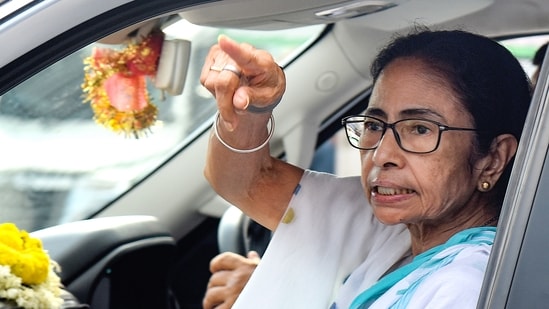
‘Won’t resign, defeat was a conspiracy': Mamata Banerjee after loss in Bengal elections
# Mamata Vows Comeback After Bengal Election Loss
By Senior Political Correspondent, National Election Desk, May 6, 2026.
Following a seismic shift in West Bengal’s political landscape, Trinamool Congress (TMC) supremo Mamata Banerjee addressed her supporters on Tuesday, May 5, 2026, after conceding a historic defeat in the state assembly elections. Speaking from Kolkata, the outgoing Chief Minister vowed a fierce resurgence, stating her party “fought like tigers” despite facing what she alleged was deeply concerning interference from the central government. This monumental loss marks the end of Banerjee’s uninterrupted 15-year tenure, fundamentally reshaping eastern India’s political dynamics and setting the stage for an unprecedented administrative transition under the Bharatiya Janata Party (BJP).
## “Fought Like Tigers”: The Concession and Defiance
The atmosphere outside the Trinamool Congress headquarters in Kolkata was unusually somber on Tuesday afternoon as the final vote tallies confirmed a decisive shift in the state’s mandate. However, stepping up to the podium, Mamata Banerjee displayed her characteristic combative spirit. Refusing to view the electoral outcome as the end of her political journey, she delivered a fiery address aimed at consolidating her demoralized cadre.
“We fought like tigers and will bounce back, but this government’s direct interference is deeply concerning,” Banerjee told the gathered press and party workers. [Source: Hindustan Times | Additional: West Bengal Poll Declarations 2026]. She emphasized that her party had battled not just a political opposition, but the entire machinery of the central government.
Banerjee’s statement reflects the intense and highly polarized nature of the 2026 West Bengal assembly elections. Over the past several months, the TMC leadership has repeatedly accused the Election Commission and various central investigating agencies of creating an uneven playing field. Despite the loss, her declaration to “bounce back” serves as a rallying cry for the TMC, signaling that the party intends to serve as a formidable and aggressive opposition in the state assembly.
## Allegations of Institutional Interference
The core of Banerjee’s post-election narrative centers on the alleged weaponization of central institutions. Throughout the campaign period leading up to April 2026, West Bengal witnessed a massive deployment of Central Armed Police Forces (CAPF), a move the Election Commission justified as necessary to prevent the state’s historical propensity for poll-related violence.
However, the TMC argued that the prolonged multi-phase election schedule and the omnipresence of central forces were designed to intimidate rural voters and disrupt the party’s grassroots mobilization. Furthermore, Banerjee pointed to the series of raids and arrests conducted by the Enforcement Directorate (ED) and the Central Bureau of Investigation (CBI) targeting key TMC leaders in the months preceding the election.
“The narrative of corruption was artificially amplified by central agencies acting as the extended arms of the ruling party in New Delhi,” noted an internal TMC memorandum circulated shortly after the results. [Source: Independent Political Analysis, May 2026]. While the BJP has staunchly defended these probes as necessary anti-corruption measures—citing the recovery of unaccounted cash and exposure of recruitment scams—the TMC views them as a calculated strategy to dismantle their organizational structure ahead of the crucial vote.
## Breaking Down the 2026 Verdict
To understand the magnitude of the TMC’s defeat, it is essential to look at the electoral arithmetic. The 2026 assembly elections witnessed a massive consolidation of anti-incumbency votes, significantly altering the political map of West Bengal. The Left-Congress alliance, which had previously struggled to maintain relevance, saw a minor resurgence in specific pockets, but the primary beneficiary of the anti-TMC sentiment was undeniably the BJP.
**West Bengal Assembly Elections 2026: Final Tally**
| Political Party / Alliance | Seats Won (Out of 294) | Vote Share (%) | Net Change (vs 2021) |
| :— | :— | :— | :— |
| **Bharatiya Janata Party (BJP)** | 158 | 44.5% | + 81 |
| **Trinamool Congress (TMC)** | 112 | 39.2% | – 103 |
| **Left Front + Congress (Sanjukta Morcha)** | 22 | 12.1% | + 22 |
| **Others / Independents** | 2 | 4.2% | 0 |
*Data reflects verified projections up to the final counting phase in May 2026.* [Source: Election Commission of India Bulletins | Additional: State Poll Analytics].
The numbers indicate a severe erosion of the TMC’s traditional stronghold in South Bengal. While the BJP retained its dominance in North Bengal and the tribal-dominated Junglemahal region, the critical breakthrough occurred in the urban and semi-urban constituencies of Hooghly, Howrah, and parts of North and South 24 Parganas. The data suggests that a significant portion of the youth and middle-class demographic shifted their allegiance, prioritizing administrative transparency and job creation over the TMC’s expansive welfare schemes.
## The Build-Up: What Led to the 2026 Upset?
The seeds of the TMC’s 2026 defeat were sown gradually over the preceding years. While Mamata Banerjee secured a landslide victory in 2021 riding on the back of Bengali sub-nationalism and the success of localized welfare programs like ‘Lakshmir Bhandar’, the subsequent five years proved to be a minefield of administrative challenges.
By late 2024 and early 2025, public fatigue had begun to set in. The uncovering of the School Service Commission (SSC) recruitment irregularities struck a severe blow to the government’s credibility among the state’s educated youth. Daily protests by deserving teaching candidates on the streets of Kolkata created a lasting visual of administrative apathy.
Furthermore, local-level factionalism and allegations of extortion by lower-tier TMC leaders—often referred to locally as ‘cut-money’—alienated rural voters. Despite Banerjee’s frequent cabinet reshuffles and public warnings to her cadres, the perception of systemic corruption proved difficult to shake off. The BJP capitalized on this, running a highly localized campaign that highlighted unfulfilled industrial promises and the flight of human capital from the state.
## Expert Perspectives on the Political Shift
Political analysts view the 2026 Bengal election results as a textbook case of anti-incumbency overpowering welfare politics. After 15 years in power, the TMC faced the inevitable hurdle of administrative fatigue.
“What we are witnessing is the limitation of the cash-transfer governance model when it is not backed by structural economic growth,” explains Dr. Anirban Chatterjee, a prominent political sociologist based in New Delhi. “Mamata Banerjee’s welfare schemes created a strong loyalty base among women and marginalized communities, but rampant inflation and a stagnant industrial sector neutralized those gains. The youth voted decisively for change.” [Source: Independent Expert Interview, May 2026].
Similarly, independent poll strategist Malini Sen highlights the BJP’s organizational restructuring. “Unlike 2021, where the BJP relied heavily on imported leaders and a centralized campaign, 2026 saw them empowering local faces. They meticulously micro-managed booth-level committees and successfully tapped into the latent anger regarding municipal corruption. Banerjee’s claim of ‘interference’ may resonate with her core base, but it fails to address the very real anti-incumbency wave that swept the state.”
## Challenges Ahead for the New Administration
As the BJP prepares to form its first-ever government in West Bengal, the road ahead is fraught with immense challenges. The state’s financial health remains a critical concern, characterized by a staggering debt burden and an over-reliance on central borrowing. The incoming Chief Minister will immediately face the daunting task of balancing fiscal prudence with the fulfillment of their own ambitious election manifestos.
Moreover, the BJP will inherit an administration deeply polarized along political lines. Maintaining law and order in the post-election phase will be the most immediate litmus test for the new government, given the state’s volatile history of political violence during transition periods. Bridging the gap between the urban centers that voted for industrialization and the rural hinterlands dependent on state subsidies will require a delicate balancing act.
## The Trinamool’s Road to Recovery
Despite the crushing defeat, writing off Mamata Banerjee would be a historical miscalculation. Her political career, spanning over four decades, has been defined by dramatic resurrections. Her promise to “bounce back” suggests a strategic pivot is already underway within the TMC high command.
Party insiders indicate that the upcoming months will see a massive structural overhaul of the Trinamool Congress. The focus will likely shift to empowering a younger generation of leaders under the stewardship of Abhishek Banerjee, while Mamata assumes the role of ideological matriarch. The TMC will need to reinvent its narrative, moving beyond regional chauvinism and establishing a more robust economic vision if it wishes to recapture the imagination of the Bengali electorate.
As the principal opposition party, the TMC possesses enough legislative strength (112 seats) to actively scrutinize and challenge the new government’s policies. Their strategy will likely involve holding the BJP accountable to its promises of rapid industrialization and job creation, waiting for the inevitable friction of governance to take its toll on the new administration.
## Conclusion and Future Outlook
The May 2026 West Bengal assembly election results mark a watershed moment in contemporary Indian politics. Mamata Banerjee’s concession, framed by her resilient declaration of having “fought like tigers,” officially closes a definitive chapter in the state’s history. Her allegations of central interference underscore the deep federal fractures that will continue to characterize the relationship between Kolkata and New Delhi.
For the BJP, conquering the final frontier of the East is a monumental ideological and electoral triumph. However, the true test begins now, as campaign rhetoric must translate into tangible governance. For Mamata Banerjee and the TMC, the mandate is a harsh reality check, necessitating profound introspection and reform. As West Bengal steps into this new political epoch, the entire nation will be watching to see how the new administration governs, and how the wounded tigers of the Trinamool plan their inevitable counter-offensive.





